Showing posts with label conservation. Show all posts

Tuesday, October 11, 2022

Class and conservation

Recently published in the American Journal of Legal History is William B Meyer's "Class, Conservation, and the Police Power in the American Gilded Age: The Origins of Lawton v. Steele". The abstract:

The leading police power case of Lawton v. Steele, decided by the US Supreme Court in 1894, offers insight into the question of judicial class bias during the decades following the Civil War. Conflict arose in rural northern New York State over restrictions on livelihood fishing by nets imposed to protect sport angling by affluent tourists. Opposition to the restrictions was grounded in a producerist worldview and class consciousness. The matter reached the courts in a challenge to state laws permitting the summary destruction, without legal process, of nets placed illegally. Seemingly prohibited by the Fourteenth Amendment and previous case law, such destruction was upheld by a Supreme Court divided along ideological lines, correlating with the justices’ Whig or Jacksonian antecedents. The dissenters, those of Jacksonian sympathies, argued unsuccessfully against the challenged laws.

Winslow Homer, Adirondack Lake (Blue Monday) (1892)

Thursday, April 21, 2022

Environmentalism Then and Now

I just came across a site by the American Bar Association's Division for Public Education with teaching materials on the history of environmental law

It's an eclectic group of resources. For instance the PowerPoint presentation entitled "Environmentalism Then and Now: Is Going Green New? You Be the Judge..." includes slides on a 1681 regulation by William Penn requiring Pennsylvanians to conserve one tree for every five cut down, and a 1739 petition by Benjamin Franklin to the Pennsylvania Assembly to stop waste dumping in Philadelphia harbor.

There's also a unit on the Exxon Valdez spill and ensuing litigation, including Supreme Court briefs.

Exxon Vladez - skimming operation (NOAA)

Wednesday, February 17, 2021

The conservation constitution

A recent issue of Perspectives on Politics has a review by Richard Andrews of Kimberly K. Smith's The Conservation Constitution: The Conservation Movement and Constitutional Change, 1870–1930 (University Press of Kansas, 2020). Andrews writes that while existing works on the history of US conservation policy "focus on the policies expressed in statutes and regulations and on the actions of the administrative agencies, with only limited mention of the legal and constitutional arguments that were battled out in the courts", Smith's book "provides a valuable new complement to these studies by presenting a far more detailed history of the legal and constitutional arguments presented to and ultimately decided by the courts during the period from 1870 to 1930". Andrews continues:

Smith’s primary aim, well summarized in the final chapter (pp. 254ff.), is “to explain how lawyers and judges reworked constitutional doctrine to accommodate the expansion of state power over the natural environment during the Progressive era; and more specifically, how legal decisionmakers conceptualized the natural environment, its relation to human society, and the public interests at stake to create the constitutional ‘common sense’ that federal and state governments have authority to protect natural resources and the integrity of ecosystems in the interest of future generations.” In the process, she discusses the interweaving of principles such as the public trust doctrine, the police power, public nuisance doctrine, parens patriae standing, the interstate compacts clause, and federal constitutional arguments based on the interstate and foreign commerce, property, war, treaty, spending, and eminent domain powers, as well as the interstate nuisance doctrine. She argues that even though many of these issues continue to be argued in the modern era, the sheer number of these constitutional foundations, once accepted by the courts, has ultimately made governmental environmental management authority strongly resilient to challenges. She also urges greater recognition of the roles of skilled lawyers and judges, along with the better-known politicians and citizen advocates, in achieving this stronger role for the state in environmental conservation. Finally, she notes the continuing need for further evolution of our understanding of the Constitution: the Progressive understanding did not address the distributive imperfections of environmental regulation, nor the implications of administrative processes for procedural justice, nor—perhaps most problematic today—the absence of effective capacity for national economic and environmental planning, particularly in international cooperation to address global environmental challenges such as climate change. 

 After some minor criticisms, Andrews adds: 

Sunday, August 2, 2020

The Nature State

The latest English Historical Review has a review by Karen Jones of The Nature State: Rethinking the History of Conservation, edited by Wilko Graf von Hardenberg, Matthew Kelly, Claudia Leal and Emily Wakild (Routledge, 2017). Jones writes:
Building on the work of David Blackbourn, James Scott, Adam Rome, Paul Sutter, and Frank Zelko, the present volume asks us to take a fresh look at the mechanics of power and governmental activity in matters of conservationist enquiry, taking in ideas about global networks, modernity, localism and the politics of negotiation. Implicit here are two concepts: firstly, a challenge to the idea of American hegemony in leading the world in conservation thinking and, secondly, a sense that in embarking on various kinds of environmental governance, state organs were able to propagate their influence and reach. Here the book reveals a foundational tension, arguing for the ‘irregular but near-universal character of the nature state’ (p. 9), while also pointing to the way in which different geographies, constituencies and structures created a site-specific patchwork polity marked by formal and informal demonstrations of authority.
*****
... the book is provocatively, but somewhat deceptively titled. In fact, in the story of environmental resources and political capital set out here across diverse geographies, we find not one state but many, sometimes redoubtable, sometimes hamstrung, and always complicated.

Tuesday, July 14, 2020

Historic Spanish conservation laws

The US Library of Congress's online Herencia collection, containing royal decrees, papal bulls, legal opinions, judgments, and royal orders from Spain from the 15th through the 19th centuries, has recently been running a crowdsourcing project to review transcriptions of the historic documents.

Two collections that might interest readers of this blog are the collections of laws and statutes on agriculture, conservation, hunting, and fishing, and that on disease and public health law.
Royal Order of December 12, 1748 concerning the conservation of forests and plantations (LOC)

Wednesday, June 20, 2018

FDR and the environment

The Journal of Land Use and Environmental Law recently published an extended review by Michael Blumm of Douglas Brinkley's Rightful Heritage: Franklin D. Roosevelt and the Land of America (HarperCollins, 2016). The abstract:
Douglas Brinkley, biographer of Theodore Roosevelt and his environmental legacy, has produced a sequel on his distant cousin, Franklin Delano Roosevelt (FDR). In a comprehensive ecobiography, Brinkley shows in some detail how committed an environmentalist FDR was, protecting federal lands, encouraging state conservation efforts, making wildlife protection a national priority, and dedicating the federal government to soil protection and forest replanting. Although FDR’s romance with federal dams undercuts the assertion somewhat, the Brinkley biography successfully shows that FDR has a legitimate claim to being the foremost of environmental American presidents.

Tuesday, January 30, 2018

LBJ's environmental legislation

A recent issue of Federal History has an article by Nancy Germano, "Negotiating for the Environment: LBJ's Contributions to the Environmental Movement". From the article:
Environmental historian Martin V. Melosi refers to the Johnson administration as "a transitional force in the evolution from old-style conservation to modern environmentalism." This article presents evidence in support of Melosi's statement by showing that the Johnson presidency, typically associated with civil rights, the War on Poverty, and the Vietnam conflict, also created an environmental legacy. In addition to a record number of federal laws directed at protection of natural resources, Johnson's rhetoric and actions set the stage for American environmentalism. He, along with Lady Bird Johnson, initiated new conversations and approaches for natural resource protection and shaped environmental advocacy for the nation. In the process, Johnson generated an enduring conviction that environmentalism and individualism-the individual's claimed freedoms and property rights-could thrive hand-in-hand.
This article explores two legislative campaigns during the Johnson administration-urban beautification and protection of wild and scenic rivers-that exemplified the president's stance on natural resource conservation. These campaigns demonstrated the priorities of environmental "restoration," cleanup, and stewardship later adopted by the environmental movement. By generating public participation in environmental programs and fiercely negotiating the possible outcomes, Johnson's approach and recommended strategies prefigured the work of environmental activists.
Germano notes:
In addition to those discussed in this article, laws relating to the environment signed by Johnson include the Clean Air Act (PL 88-206), Pesticide Control Act (PL 88-305), Wilderness Act (PL 88-577), Land and Water Conservation Fund Act (PL 88-578), Fire Island National Seashore (PL 88-587), Canyonlands National Park Act (PL 88-590), Water Resources Planning Act (PL 89-80), Water Quality Act (PL 89-234), Solid Waste Disposal Act (PL 89-272), Water Pollution Control Act (PL 89-753), Guadalupe Mountains National Park Act (PL 89-667), Endangered Species Act (PL 89-669), Indiana Dunes National Lakeshore Act (PL 89-761), San Gabriel Wilderness Act (PL 90-318), and Great Swamp Wilderness Area Act (PL 90-532).

Thursday, August 3, 2017

Canadian water law

The McGill Journal of Sustainable Development Law recently published an article by Jamie Benidickson, "The Evolution of Canadian Water Law and Policy: Securing Safe and Sustainable Abundance". The abstract:
Canadian water law has evolved over an extended period of time as a complex mixture of federal and provincial legislation and case law with provincial arrangements influenced by both riparian and prior appropriation doctrine as well as by the civil law tradition of Quebec. The article reviews highlights from the long-term evolution of Canadian water law, policy and institutions following a chronological path from Confederation in 1867 to the present. Three key shifts that have more recently begun to appear in background assumptions of Canadian water law are then identified. In particular, it is noted (1) that general confidence in the abundance of water is giving way to concerns over security and occasional scarcity, (2) that the primacy of human water uses is gradually being moderated by acknowledgement of the importance of environmental flows, and (3) that international considerations may be relevant to a greater degree than previously contemplated. The concluding section of the paper presents emerging policy directions in relation to the legacy of historic water law and policy decisions and the shifting assumptions previously reviewed with emphasis on sustainability, conservation initiatives and watershed frameworks.
Vermillion River, Kootenay National Park
For pre-1867 Canadian water law, see the recent series beginning here.

Thursday, June 15, 2017

Property in water and urban water supply

"New" Jersey City reservoir, c. 1880
Yesterday's This Day in Water History posted an interesting story on a 1919 fine handed down to Jersey City for using too much water, but both the original report and the commentary reflect some misunderstandings. The blog quotes an editorial on "Public Control of Water" from the Municipal Journal of June 14, 1919:
Water companies and departments have appealed to consumers from time to time to restrict consumption in order to avert a water famine in the city, and meters are used largely to prevent waste; but we believe it is something new to impose a penalty for excessive consumption. As told last week, Jersey City, N. J., has been fined by the state $22,285 for using from the Rockaway river more than the 100 gallons per day per capita which had been allotted to it. 

Friday, February 10, 2017

Race and public lands

A recent issue of Environment and History has an article connecting issues of conservation and race, Harald Witt's "Indigenous Trees and Forests: Contradictions, Conflict and Conservation in Natal and Zululand (1900–1960)". The abstract:
At the turn of the nineteenth century, it was estimated that nine-tenths of the identified forests in Natal had been permanently alienated from the Crown through their incorporation into private lands and Native Trust Lands. The entrenchment of the political power of white land-owners in the twentieth century ensured that official attempts at restraining private land-owners from destroying indigenous forests on their lands were doomed to fail. Trust forests, as quasi state forests, were however, more accessible to Forestry officials, who remained convinced that the management and ultimately preservation of these forests could best be controlled and managed by themselves. This article examines the manner in which the conservation and administrative control of the various forests on Trust lands became the subject of dispute between various organs of the state in the first half of the twentieth century. This contestation was characterised, on one level, by a general shift from a conservationist and utilitarian approach in regard to the management of indigenous forests to one that was far more preservationist in definition while, at the same time, illustrating fierce administrative tensions between a relatively compassionate Department of Native Affairs and a Department of Forestry that subscribed to a more racialised agenda.
 Coastal Forest Dunes at Sodwana, Zululand (Carlos de Resende)

Friday, January 20, 2017

In memoriam: Wolfgang Burhenne

January 6 saw the passing of Wolfgang Burhenne, a key figure in post-war German and international environmental law, at age 92.

A review by Tracy Mehan in the Environmental Forum earlier this year tells explained that Burhenne spent much of World War II imprisoned by the Nazis for aiding the resistance. Then, after the war:
through an unpaid engagement with a hunting club, he eventually obtained employment with the hunting administration of the Free State of Bavaria. There he became involved in hunting legislation. And so his passion became the preoccupation of his professional life. Hunting shaped his ideas on sustainability, i.e., “use natural resources in a way that allows full recovery.” “Sustainable use is a principle I have always known from hunting,” maintained Burhenne.
Burhenne and his second wife, Françoise, were “directly involved in nearly all major international conventions concerned with conservation over the past 25 years, and the development of the World Conservation Union (IUCN) Environmental Law Center in Bonn,” as described by the United Nations Environment Program when awarding them the UNEP International Environmental Prize in 1991. “No two people have done more to strengthen the position of international and national environmental law as a fundamental element of environmental management,” according to the citation....
Wolfgang Burhenne was a highly successful policy entrepreneur and the node connecting several nongovernmental organizations and foundations, some of which he basically created from scratch. His wife provided the intellectual ballast while he forged the alliances, negotiated the treaties and raised the money. Together they worked on countless drafts and treaties that are the foundation of much of international environmental law, among them the 1973 Convention on International Trade in Endangered Species of Wild Fauna and Flora (CITES), the 1979 Convention on the Conservation of Migratory Species of Wild Animals, the 1982 UN World Charter of Nature, the 1985 ASEAN Agreement on the Conservation of Nature and Natural Resources, and the 1992 Convention on Biological Diversity.

Thursday, December 15, 2016

More on forests in revolutionary France

Vallée de La Loue - ©CRT de Franche-Comté
H-Environment just published a roundtable review of Kieko Matteson's Forests in Revolutionary France: Conservation, Community, and Conflict, 1669–1848 (Cambridge UP, 2015), previously covered here. Some legal highlights, starting with Caroline Ford's comments:
The book is based on a wealth of archival material and primary documents that Matteson found in both national and provincial archives in France. She sorts through and illuminates very technical modes of forest management, while setting the scene for conflicts between local communities and the French state in masterful ways. She seeks to explore reform efforts on the part of the state as well as the ideological agenda of lawmakers, landowners and commentators in order to explore both the successes and failures of natural resource allocation and environmental conservation in the context of sweeping revolutionary change and the expansion of state power. She examines a number of important questions in this regard including why conservation policies prompted resistance; and how customary rights were supplanted by those of private property. To this extent she resuscitates a debate, which has recently again become the focus of some attention among environmental historians in France on the “tragedy of the commons,” which was sparked by Garrett Hardin’s 1968 article in Science and Elinor Ostrom’s rebuttal (among others).
*****
The great strength of Matteson’s close study of the Franche-Comté lies in grounding her work in a micro context, in a specific time and place. She shows the very real impact of policies enacted in the capital on a rural region of France, but one wonders how and whether imperial conquest that began during the period which she explores and French encounters with other forested landscapes shaped (or did not shape) policy in the metropole, a subject explored in Richard Grove’s path-breaking Green Imperialism. Matteson mentions, for example, that the French forest code was exported wholesale to Algeria at the time of conquest, where conditions were far different from those in metropolitan France. Many foresters served in both France and in her colonial possessions. This code was finally revised in 1903, and one wonders about the extent to which foresters considered and compared colonial and metropolitan forests and landscapes. 
***** 
Finally, calls for saving forests came from other quarters and were articulated less in terms of conservation than in terms of heritage preservation and patrimoine. These calls came not from engineers, scientists, or foresters but from a middle class urban public. It was the Barbizon school of painters who were behind Napoleon III’s 13 August 1861 decree that created the first protected natural landscape in the forest of Fontainebleau as a réserve artistique, and the painters fought pitched battles with foresters, who defended their own conservationist initiatives, such as planting pines. Both made claims about protecting the forest, but in very different ways.

Friday, December 2, 2016

Lessons from environmental history

I recently came across Erik Podhora's "Lessons for Climate Change Reform from Environmental History: 19th Century Wildlife Protection and the 20th Century Environmental Movement", published in last year's Journal of Environmental Law and Litigation. The abstract:
The prospect of national climate change legislation currently seems dim, but protective legislation for the natural environment has not always been out of reach. State wildlife laws of the 19th century demonstrated that concerted action could persuade state legislatures to shift away from the fundamental paradigm of unregulated hunting when the declining populations of many species caused public alarm. Nearly a century later, in 1969, several high-profile incidences of acute pollution occurred, and a widespread environmental movement blossomed that prompted a previously indifferent President to champion the call for environmental policy. If this pattern held true, unusually strong storms or wildfires of increasing frequency and intensity in recent years should have generated public support for legislation to combat climate change. However, climate change reformers in the 21st century have not been able to convince Congress to seriously consider remedial legislation. This Article explores the factors that contributed to the success of the 19th century state wildlife movement and the 20th century environmental movement in order to better understand what climate change reform efforts may be missing.

Sunday, October 9, 2016

French forest law

The latest American Historical Review has a review by Jeff Horn of Kieko Matteson's Forests in Revolutionary France: Conservation, Community, and Conflict, 1669–1848 (Cambridge UP, 2015). Horn writes:
Matteson is at pains to demonstrate that over the long term, “peasant communities and practitioners of customary rights” retained “significant control over their forests” “through tenacity, wiliness, and sheer violence” (xv).
In an introduction, six long but fast-moving chapters, and a lengthy epilogue, Matteson considers the relationship of states, various types of property owners (such as seigneurs), and communities to forests, their management, and their economic exploitation.... Conservation is a major theme, particularly its intellectual foundations in Enlightened natural philosophy that Matteson refers to as a “formative period in the development of French environmental discourse and conservationist policy” (50). These ideas are then traced across subsequent regimes. Shifts in state oversight of the forests, mostly negative, form the spine of this book. Jean-Baptiste Colbert’s 1669 forest ordinance is at the heart of the first chapter, the “failure” of the changes made by the Revolutionaries in 1789–1791 is the focus of chapter 4, and the background and reception of the Forest Code of 1827 are the subjects of chapters 5 and 6.
Matteson makes three main arguments. First, she asserts that “peasant opposition to state forest policies produced greater gains than previously appreciated, even when it was crushed at the time.” Matteson also claims that the French environmental conservation had less to do with ecology “than with extending state power, suppressing sedition, and substituting commercial exploitation for communal utility.” Third, she maintains that “local, community-based arrangements for the management and use of natural resources … have been unfairly maligned, both in the historiography of the Revolution and in contemporary policymaking” (10–11).... 

Monday, July 25, 2016

City smoke ordinances

The Library of Congress webpage The Evolution of the Conservation Movement, 1850-1920 has quite a bit of legal material from the period:
The collection consists of 62 books and pamphlets, 140 Federal statutes and Congressional resolutions, 34 additional legislative documents, excerpts from the Congressional Globe and the Congressional Record, 360 Presidential proclamations, 170 prints and photographs, 2 historic manuscripts, and 2 motion pictures.
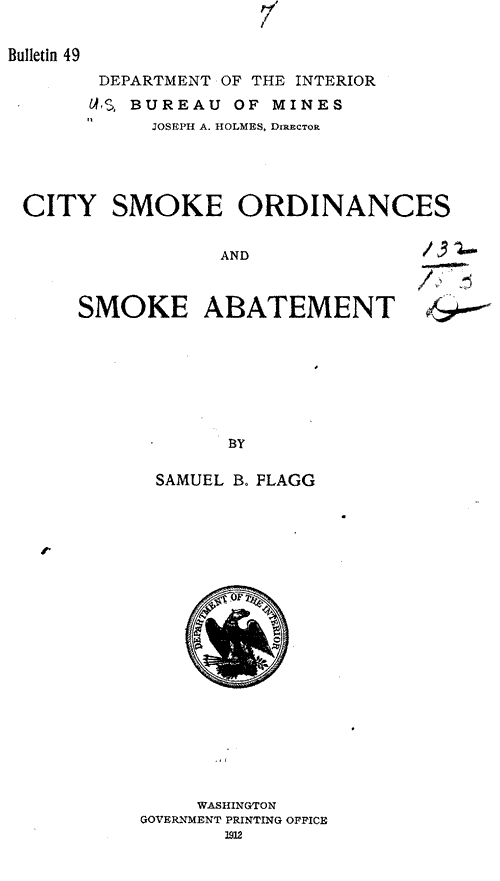
There are some unexpected treasures here, for instance Samuel Flagg's 1912 booklet, City Smoke Ordinances and Smoke Abatement, published by the Bureau of Mines (see title page below). The website explains:
Although concern for the effect of human environmental activity on human welfare did not move to the center of what is now called the environmental movement until the 1960s, the turn-of-the-century conservation movement did include something contemporaries referred to as "human conservation:" an attempt to improve the quality and quantity of human life, particularly in the nation's burgeoning urban centers, through attention to certain kinds of environmental management, particularly technological intervention. Within this framework, engineers, scientists and public policy-makers sought to determine how natural resources, such as mineral fuels, could be used with both maximum efficiency and minimal detriment to the human environment. This brief survey by the U.S. Bureau of Mines provides a concise and systematic overview of contemporary anti-air-pollution efforts as reflected in the smoke-abatement ordinances of cities throughout the country, and prescribes the essential characteristics of ordinances appropriate for municipalities of different sizes. An Appendix reprints actual ordinances from Chicago, Pittsburgh, Des Moines, Milwaukee, Los Angeles, and Boston by way of example. It should be noted that the problems caused by urban smoke are defined (p. 8) in terms of economic waste, damage to buildings, loss of light, dirt, and injury to vegetation, but not as a direct threat to human health.
For more environmental law treatises of the period, see here. For more on smoke regulation, see here and here.

Sunday, July 17, 2016

Reagan the environmentalist

A little while back Dan Farber at Legal Planet posted "Ronald Reagan – Environmentalist Governor". Some excerpts:
It may surprise you to learn this — it certainly surprised me. But Ronald Reagan has been called “the most environmental governor in California history — protecting wild rivers from dams, preserving a Sierra wilderness by blocking highway builders, creating an air resources board that led to the nation’s first auto smog controls.” This may be an exaggeration, but there were some major environmental achievements.
***** 
[An LA Times story] recounts Reagan’s support for legislation to create the Lake Tahoe interstate compact in order to save the lake.... In addition... Reagan was instrumental in securing legal protection for California’s wild and scenic rivers. 
Perhaps most notably, Reagan signed the California Environmental Quality Act. He also signed the signed the Mulford-Carrell Act, combining the Bureau of Air Sanitation and the Motor Vehicle Pollution Control Board to create the California Air Resources Board (CARB). Reagan appointed the first head of the Board, Arie Jan Haagen-Smit, a Cal Tech chemist who was responsible for linking smog to automobile emissions. By all account, this “stubborn Dutchman” was a dedicated and successful champion of pollution control.
Reagan as President was a much different figure. As we all know, his Administration was no friend to the environment. But even during his Presidency, there were some bright spots, such as his enthusiastic signing of the Montreal Protocol to protect the ozone layer.
In short, Reagan was a more complicated figure than the stereotyped right-winger that both ends of the political spectrum have portrayed. And in his California days, he had a legitimate claim to be considered an environmentalist. 

Thursday, March 24, 2016

FDR and environmental law

I've long thought that the New Deal era doesn't get its rightful due as a critical phase in the history of environmental law. It seems Douglas Brinkley's new book, Rightful Heritage: Franklin D. Roosevelt and the Land of America (Harper Collins, 2016), makes a similar argument. As one would expect for a Brinkley book, it's already been reviewed by the New York Times and Washington Post.

Clay Risen in the Times puts the emphasis on the supposed tension between environmental protection and economic growth. Dennis Drabelle in the Post is a little more sensitive to legal history, writing that "Brinkley can be superficial when it comes to legal issues — it’s not always clear what authority FDR is drawing on when he takes a pro-environmental stance". Drabelle writes of the Duck Stamp Act:
Brinkley is good at showing how strands of Roosevelt’s life united to shape approaches to preservation that other presidents might have missed. Take an idea to raise money for waterfowl conservation which had been working its way through Congress. It culminated in the Duck Stamp Act of 1934, which requires all waterfowl hunters over 16 to buy, in addition to a state hunting license, a federal stamp, the proceeds from which go to acquiring wetlands and funding wildlife refuges. As a lifelong philatelist, Roosevelt “loved stamps too much to allow each year’s duck issue to be anything but irresistible.”
Roosevelt was a great believer in bipartisanship, and the director of what was then the Biological Survey in the Agriculture Department (now the U.S. Fish and Wildlife Service in the Interior Department) was Jay Norwood “Ding” Darling, a Republican who, in his previous job as a Pulitzer Prize-winning editorial cartoonist, lampooned the Democratic president repeatedly. At FDR’s request, Darling designed the first duck stamp, featuring “two striking mallards in flight descending on a lake.” From this literally splashy beginning evolved a much-anticipated annual contest — still being held — in which wildlife artists vie to submit the winning design (and to rake in the income generated by fans who buy reproductions). In addition to excitement and artistry, the program has generated more than $500 million through 2009, which has been used to purchase 5 million acres of waterfowl habitat.

The Duck Stamo program is still running. For all the stamps, see here.

Sunday, January 24, 2016

Legal history and the takeover of the Malheur Wildlife Refuge

Three weeks ago antigovernment gunmen took over Malheur Wildlife Refuge in Oregon, USA, and they have been in a standoff with law enforcement officials since then. The gunmen (from out of state) are demanding that the land be "returned" to the local county. Some background is provided by Alan Feuer in the New York Times, who explains that the gunmen are echoing the claims of the "Wise Use movement":
Wise Use answers the question of who should own the West by granting moral primacy to natural resource companies and to logging and ranching families....
Though composed of many activists and scores of organizations, Wise Use found its voice in the late 1980s when a timber industry adviser named Ron Arnold published “The Wise Use Agenda.” The manifesto offered an expansive plan to gut environmental regulation, increase private ownership of public land and compel the federal government to open its holdings to mining, oil and logging companies and to the unrestricted use of off-road vehicles.
Mr. Arnold adopted the phrase “wise use” from Gifford Pinchot, the first head of the United States Forest Service (who said that “conservation is the wise use of resources”). In 1988 he held a conference, bringing together the likes of Exxon and the National Cattlemen’s Association, with the goal of seeding the West with grass-roots groups that could wrest control of federal land and give a local flavor to his Reaganite aims.
“Arnold sent organizers into distressed rural communities to set up front groups with environmentally friendly sounding names that whipped up hostility against the government,” said Tarso Ramos, the executive director of Political Research Associates, a research group that studies right-wing movements. What resulted, Mr. Ramos said, was a “coalition of natural-resource companies, property developers and conservative activists working with a network of community organizations.”
This coalition achieved success in pushing its agenda. By the early 1990s, politicians friendly to the Wise Use cause had introduced or passed legislation in nearly 30 states giving local governments and citizens expanded powers to lay claim to federal land. Among those politicians was Representative Helen Chenoweth-Hage, an Idaho Republican, who became notorious for mocking the Endangered Species Act by holding what she called “endangered salmon bakes.” There was also Gale A. Norton, the interior secretary under President George W. Bush, who once worked as a lawyer for the Mountain States Legal Foundation, which has billed itself as “the litigation arm of Wise Use.”
Legal Planet's Jonathan Zasloff provides some other background:

Wednesday, October 7, 2015

Antimonopoly in Public Land Law

Michael Blumm and Kara Tebeau recently posted "Antimonopoly in Public Land Law". The abstract:
Public land law is often thought to be divided into historical eras like the Disposition Era, the Reservation Era, and the Modern Era. We think an overarching theme throughout all eras is antimonopoly. Since the Founding, and continuing for over two-and-a-quarter centuries into the 21st century, antimonopoly policy has permeated public land law. In this article we show the persistence of antimonopoly sentiment throughout the public land history, from the Confederation Congress to Jacksonian America to the Progressive Conservation Era and into the modern era. 
Antimonopoly policy led to widespread ownership of American land, perhaps America’s chief distinction from England and Europe. The policy fostered acreage limits in federal grants, a preference for bona fide settlers, and eventually an evolution from land sales to free land under the Homestead Act. Antimonopoly principles were also present in public timber, mining, and rangeland policies from the earliest days. In the Progressive Conservation Era antimonopoly fueled a public land withdrawal and reservation movement, landmark leasing and licensing programs that maintained public control over fuel minerals and waterways, and the first explicit federal policy concern over future generations. The modern era has seen the codification of multiple use management, the enactment of comprehensive land planning statutes, and the rise of multi-species concerns, among other antimonopoly policies.
Although antimonopoly policies seem to be under some threat from recent Congresses, a turn toward monopoly would amount to a renunciation of centuries of public land policy. This history strongly counsels against such these proposals as, however imperfectly realized on-the-ground, antimonopoly has been always been cardinal feature of public land law and policy and is deeply embedded in the nation’s identity as a reflection of republican values of individualism and equal opportunity.
More on antimonopoly in American natural resource law here.

Sunday, October 4, 2015

Roscoe Pound, environmental law professor

In an interesting twist in the discussion on the first environmental law course in the US, Richard Lazarus writes:
When I decided to research the history of environmental law teaching here at Harvard a few years ago, which took me back to David Cavers and into the 1950s, I also decided to follow the “natural resources” thread as well. What I discovered was that Harvard Law School’s first “environmental law professor” based on that broader view was Professor Roscoe Pound (later Dean Pound). Pound arrived at Harvard around 1910 from the University of Nebraska. Pound had a BA/Masters/PhD in Botany. I think he was the first PhD in Botany from the University of Nebraska. He was not a lawyer though he went to law school. His primary interests were mining law and water law. 
Roscoe Pound
Upon arriving at Harvard, Pound taught a course in the fall of 1911 in the “Law of Mining and Irrigation.”  When he became Dean a few years later, he turned both subjects over to lecturers, one taught the mining law class and the other water law. Lucas Bannister, who taught the water law class, was a highly regarded expert in water law from Denver, Colorado. Bancroft Gherardi Davis was the lecturer on mining law.   Each taught the class for a few decades and were highly acclaimed lawyers of their day.
Pound also wrote about water law. One of his most famous law review articles, Pound, The End of Law as Developed in Legal Rules and Doctrines, 27 Harv. L. Rev. (1914) concerns legal evolution and what Pound called “The Socialization of Law.” Pound used water law in his article as a primary example of law’s socialization, describing how the need to “protect the general social interest” in water’s reasonable use “is changing the whole water law of the western states.”  He concluded, presciently, “It means that in a crowded world the social interest in the use and conservation of natural media has become more important than individual interests of substance.”
Pound was a complicated guy and some of his later thinking was far less glorious, and worse than that.  But I came across the 1914 article when I first began law teaching (now a few years ago), and have always thought it worth passing on to my students. In some ways, it is reassuring. In other ways, very much not so, because it underscores how long the problems have been known and how hard it has proven to achieve the law reform necessary to address them. Climate change is the latest, of course.
For more on the first course, see here.