Showing posts with label Joseph Sax. Show all posts

Sunday, December 24, 2017

Water rights V: Public rights

(Continuing the series on water rights:)

Whatever property regime applies to water, the public often retains certain rights in the resource. Thus, for instance, in American law, though a river's water may be owned by riparian landowners or appropriators, the federal government retains a "navigation servitude" in the water with which private owners (and states) cannot interfere (Trelease, 1965).

Joseph Sax
Recent decades have seen much discussion of the "public trust doctrine", rules that allow public interests, especially environmental ones, to trump the normal property rules in water. Though the doctrine has its roots in the traditional civil and common law, particularly with regard to tidelands (Selvin, 1980), its modern form was first articulated by Joseph Sax in a highly influential article (1970), in which he argued that the historical doctrine should be developed to encourage courts to subject actions that harm the environment to strict scrutiny. In the field of water rights the doctrine has been applied by American state courts in recent decades to push states to protect environmental values, even when this protection is in tension with private property rights (Craig, 2010). The best-known expression of this trend is the decision of the California Supreme Court in the Mono Lake case, in which the court ruled that longstanding water diversions from the lake by the city of Los Angeles might need to be limited by the state in order to protect ecological values being harmed by the lowering of the lake level. In recent years the doctrine has been adopted in additional countries around the world (Cullet, 2009; Blumm and Guthrie, 2012).

The public trust doctrine continues to receive support from many commentators, but it has also been criticized. On the one hand, it has been argued that the doctrine places undue reliance on an inflexible, property rule as applied by the judiciary, while environmental protection should be sought from progressive legislation (Lazarus, 1986). On the other, the doctrine has been criticizes as historically without basis, undemocratic, and invasive of private property rights (Huffman, 1989, 2007).

Next: A human right to water. The full article is here.

Tuesday, September 29, 2015

The first environmental law course

Spurred by Laurence Tribe's claim that he taught the first environmental law class in the US, an environmental law professor list recently discussed what was the first environmental law course taught in the US. Julian Conrad Juergensmeyer noted that he taught a course called the Law of Pollution Control at Indiana University Law School Bloomington in 1966 and 1967, and someone thought that Joseph Sax taught a course at Colorado in the mid-sixties.

David Cavers (U Chicago Photographic Archive)
So far, though, it seems that David Cavers at Harvard was the first (preceding Tribe by at least five years). Based on course catalogs at Harvard, Richard Lazarus found that Cavers taught a course “Legal Protection of Environmental Quality” in 1967, a course in “Government Regulation: Product and Environmental Hazards” in 1965 that focused on “air pollution, water pollution, and atomic radiation”, and a course called “Problems in the Public Control of Atomic Energy” in 1951.

Can any of you think of any earlier classes, including those not necessarily called "environmental law"? What about in countries other than the US? Please write me with thoughts.

Wednesday, April 22, 2015

The public trust doctrine in the UK Supreme Court

The Supreme Court of the United Kingdom recently decided a case, R (on the application of Newhaven Port and Properties Limited) v East Sussex County Council, that includes quite a bit of discussion of the public trust doctrine and its history. The doctrine, which, in its basic form, recognizes certain rights of public property in certain waters and beaches, has become a staple of environmental law teaching and scholarship in recent decades, thanks in large part to its revival and adaptation by Joseph Sax.

A bathing machine, of the sort at issue in Blundell v Catterall
While many courts and writers are fond of tracing the doctrine's origins to ancient Roman law and English common law, close followers of the topic will know that the leading English precedent on the topic is the 1821 ruling of the King's Bench in Blundell v Catterall, in which the majority actually ruled against recognition of public rights of access to a private beach (though Justice Best's dissent is probably more often quoted). Now comes the Supreme Court of the UK and examines the history of the doctrine in English law and elsewhere in detail--see, in particular, paragraphs 32-51 and 106-136.

Some of my favorite parts of Lord Carnwath's concurrence:
106. At least since Brinckman v Matley [1904] 2 Ch 313, the decision of the Court of King’s Bench in Blundell v Catterall (1821) 5 B & Ald 268 has been taken as establishing at Court of Appeal level that under English law the public has no general right to go onto the foreshore for the purpose of bathing or other recreation.... Not even the strong dissenting judgment of Best J in the earlier case, the advocacy of a future Lord Chancellor (Buckmaster KC), nor the criticism of three textbook writers cited by him (p 320), were sufficient to persuade the court to revisit the issue, or even to call on opposing counsel. The members of the court were unanimous in their praise for the model judgment of Holroyd J, regarded it seems as “one of the finest examples” of how a judgment should be expressed (p 323)....
107. No doubt because judicial fashions have changed, I confess that I do not find the enthusiasm of the Court of Appeal for the judgment of Holroyd J altogether easy to share. Its erudite analysis of extracts from Justinian, Bracton, and Hale, and of obscure exchanges between the court and counsel in some early English cases, makes rather heavy reading to modern eyes.

Thursday, April 9, 2015

More on Joseph Sax

At the recent ASEH conference in Washington, DC I attended an interesting panel commemorating Joseph Sax and examining his influence in several fields. The organizers of the panel have created a website with the panel presentations, as well as other resources on this important figure in the history of environmental law.

Also on the same topic, I recently came across Mark Van Putten's "Making Ideas Matter: Remembering Joe Sax", recently published in the Michigan Journal of Environmental and Administrative Law. The abstract:
Joe Sax made his ideas matter. He had consequential ideas that shaped an entire field—in his case, environmental law—both in theory and in practice. His scholarship was first rate and has enduring significance in academia, as evidenced by the fact that two of his law review articles are among the 100 most frequently cited articles of all time. Others are more competent to review the importance of his scholarship; my experience in environmental advocacy is more pertinent to evaluating his impact on environmental policymaking. Here, his ideas have had a greater impact than any other legal academic. As the New York Times observed in the opening sentence of its obituary for Professor Sax, he “helped shape environmental law in the United States and fueled the environmental movement.” As environmental law historian Richard Lazarus put it, Sax “provided much of the strategic blueprint followed by the environmental public interest groups,” which is still followed more than fifty years after he began his career at the University of Colorado Law School in 1962. How did a self-effacing, erudite, bookish professor come to have such an impact?
If you know of other remembrances or other resources having to do with  Prof. Sax, please send them my way, or offer to write something on him for this blog!

Thursday, March 27, 2014

More foundation stories

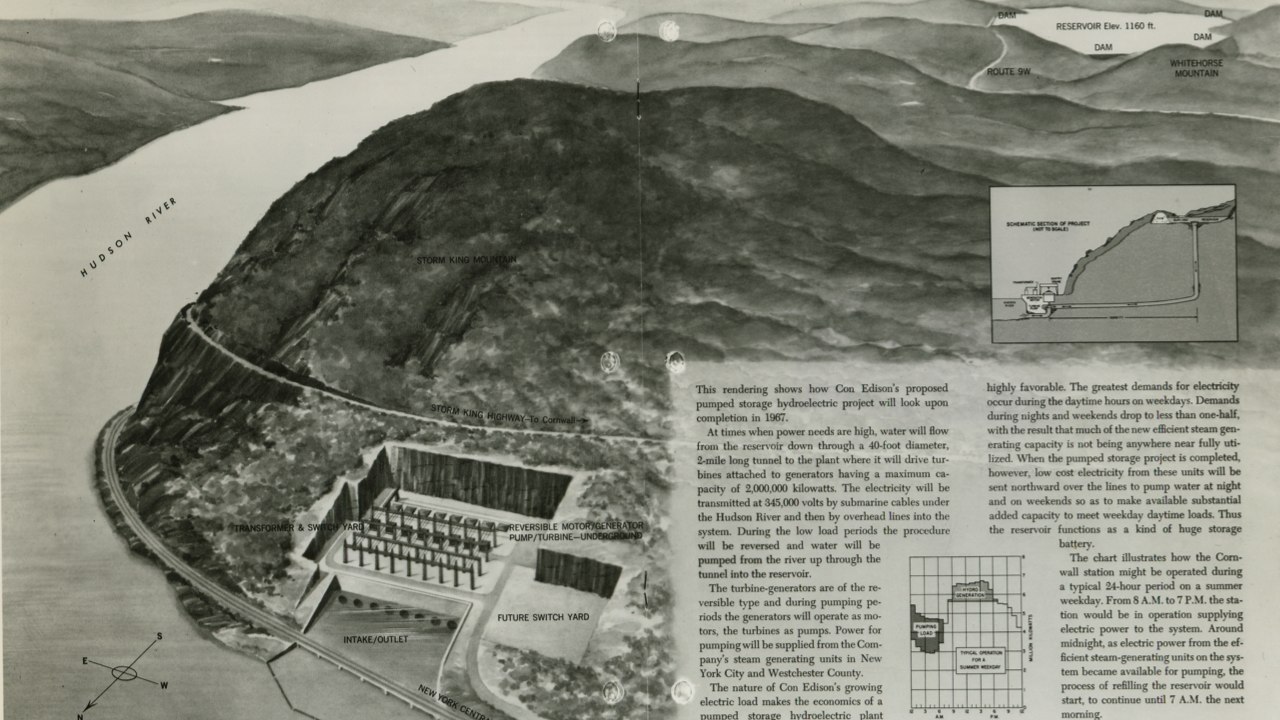
Environmental Law Prof Blog has the text of Nicholas Robinson's recent tribute to Professors Joseph Sax and David Sive at the Pace U. School of Law Garrison Lecture, compellingly describing, among other things, the 1960s environmental litigation over development in the Hudson River Valley and expansion of the Sierra Club to the eastern US. Robinson also mentions Lloyd Garrison's involvement in the Storm King litigation. Robinson writes that "public interest litigation to safeguard the environment was born in these cases".

Robert Rodriguez, Jr., View of Storm King Mountain from Breakneck Ridge
(Scenic Hudson)


Con Ed's Proposal for Storm King Mountain Power Plant
(Scenic Hudson)

Robinson also reflects on the worldwide influence of Sax and Sive:
The ripples from their professional work have spread far and wide. It is fair to observe that the reforms that Sive and Sax engendered in time produced Principle 10 of the Declaration of Rio de Janeiro on Environment and Development, adopted by the UN 1992 Earth Summit. This principle embodies many of the reforms that they urged in the 1970s and beyond: rights of access to environmental information, to pubic participation in environmental decision-making and to access to the courts. These are today recognized as global norms. The combined legacy of their lives is global.

Tuesday, March 11, 2014

In Memoriam: Joseph Sax

Earlier this week the great environmental law scholar Joseph Sax passed away, at age 78. Read the appreciation by Holly Doremus at Legal Planet.

As noted by the New York Times, Professor Sax was perhaps best known for his advancing the concept of "public trust doctrine" as an organizing concept of environmental law. Before Sax "revived and re-invented" (as Carol Rose put it) this now-widespread idea in his seminal article, The Public Trust Doctrine in Natural Resource Law: Effective Judicial Intervention, few had heard of the doctrine. Since then, thousands of articles, briefs, and court decisions in the US and other countries have cited as a matter of course to Justinian and Matthew Hale and argued for the relevance of the doctrine to various environmental issues (Fred Shapiro counts 856 citing legal articles).

As Rose explained in her 1998 symposium article, Sax's 1970 article can be understood as his response to ascendant theories of agency capture of the regulatory process and then-new public choice theory, which provided an explanation of the ability of small but cohesive groups to dominate the policy-making process to the detriment of the wider public interest. The public trust doctrine as advanced by Sax was less about property (as was the original doctrine) than about administrative law: Sax wanted courts to be wary of the regulatory process that often sacrificed public good to private interest.

Sax's passing is an opportunity to reflect on the fact that even ubiquitous and seemingly timeless legal ideas have a history, and that history includes not just formal sources of law, but also scholars and others who mold it and change it to fit changing times. It is also an opportunity to be grateful for the deep and wide body of public-minded scholarship (see Doremus's post) left for us by this giant of the law.

Thursday, June 20, 2013

The public trust doctrine and origin stories

Michael Blumm and Mary Wood have posted Chapter 1 of their forthcoming The Public Trust Doctrine in Environmental and Natural Resources Law (Carolina Academic Press, 2013) on SSRN. According to the abstract, this casebook has a strong historical component:
The public trust doctrine (PTD) is an ancient property law doctrine which first surfaced in Roman law in the Justinian Code, was revived in medieval England largely through the efforts of Sir Mathew Hale, and became entrenched in American law in the nineteenth century through the process of statehood. In the twentieth century, the doctrine became a favorite of the law professoriate and the environmental community for its potential to recognize public rights in private property. Thus, the doctrine both promotes public access to trust resources and justifies public regulation of them. It also equips the public with the right to challenge governments concerning their management of PTD resources.