Showing posts with label capitalism. Show all posts

Wednesday, January 26, 2022

The New England river commons

H-Environment recently published Zachary Bennett's review of Erik Reardon's Managing the River Commons: Fishing and New England's Rural Economy (U Mass Press, 2021). From the review:

After more than two centuries of damming and polluting their rivers, Americans are reversing course. Dams are coming down and the migrating fish that astonished early European explorers are returning.... Although rivers are coming to resemble their pre-industrial state now more than ever, few serious studies of early American waterways exist. Erik Reardon shows that these struggles to preserve riverine ecosystems are much older than river restoration advocates may have considered...

*****

The first two chapters establish the importance of river fisheries in indigenous and early colonial communities, arguing that both created sustainable common-use practices to protect fish. Reardon quotes heavily from other secondary sources and his arguments echo the likes of Jeffrey Bolster who have shown that colonists severely depleted fisheries immediately upon their arrival. Reardon effectively demonstrates that colonists both noticed that decline and realized they needed to enact conservation measures at least a full century before industrialization.

Chapter 3 reads as a composite biography of four river fisherman from Maine to Rhode Island who lived at the turn of the nineteenth century.... Their way of life came under considerable threat when commercial fishing practices entered rivers in the nineteenth century that netted the salmon and shad for sale in distant markets and enriched an emerging merchant class. Reardon shows that this class of farmer-fishermen ultimately turned to the state to punish unsustainable fishing practices and preserve rivers as traditional commons space.

Tuesday, February 20, 2018

Compensatory mitigation and neoliberalism

Restored perennial and season marsh and riparian forest
at Wildlands Mitigation Bank, Placer County, California (EPA)
The always interesting Dave Owen recently posted "The Conservative Turn Against Compensatory Mitigation", whose primary subject is the recent turn described in the article's title (compensatory mitigation is a policy that require parties receiving permits for environmentally harmful activities to compensate for them by improving environmental conditions elsewhere). Owen also has something to say about the origins of the practice, rejecting the arguments of critics who have portrayed compensatory mitigation as part of a neoliberal, capitalist resurgence:
The proponents of compensatory mitigation reform hardly ever identified their efforts as measures to boost the capitalist system. As one retired departmental employee explained to me, even during the Reagan Administration, debates about compensatory mitigation were driven more by conflicts over regulatory intensity and states’ rights rather than by Milton Friedman-style market ideals. And later reformers’ key goal was to strike a compromise between political mandates to accommodate economic development and legal mandates to protect the environment, and to make permitting decisions in an expedited fashion. Compensatory mitigation policy, in other words, evolved to fulfill agency goals, not to advance a free-market agenda, even though the policies did sometimes bring regulated industries the benefits of expedited and more flexible permitting.
I have to say that I don't find this very convincing, though it is true that compensation mechanisms can serve as a way of balancing interests, as Calabresi and Melamed taught us. First of all, I doubt whether one can get a full and reliable account of agency motivations by interviewing agency sources. Second, as Laleh Khalili points out in a recent interview at Viewpoint, officials and managers often work to advance capitalism without being conscious of it. Finally (and relatedly), I would posit that regulators " driven... by conflicts over regulatory intensity and states’ rights" were in fact often responding to "Milton Friedman-style market ideals" (whether they realized it or not). "States' rights" and "regulatory reform" are ideas the popularity of which in the last few decades owe a lot to business interests, politicians, and intellectuals pushing a neoliberal, capitalist agenda. It is no surprise that "agency goals" meshed with the neoliberal agenda (or that the recent conservative about-face on compensatory mitigation exposes the essential bad faith behind much of "regulatory reform").

Sunday, January 28, 2018

Historical analysis in environmental law VI: What is at stake

In the last couple of posts in this series I suggested several directions of inquiry for uncovering the history of environmental law. In this final post in the series, I would like to tentatively offer some thoughts on why the historical exploration of environmental law matters.

First of all, history can help us better understand current environmental law. For instance, David Driesen has recently advanced a positive theory of environmental law, attempting to explain its salient features, such as reliance on certain types of standards. Notably missing from his account are historical explanations for these aspects of environmental law, explanations which might be provided by works such as those of Morag-Levine.  Or take the argument of 'free market environmentalists' that private law would do a better job of protecting the environment than modern regulation; this type of argument could be checked against the historical experience of legal systems that have relied on private law for this purpose.

AC Pigou
Second, the history of environmental law is a topic that offers an opportunity to bridge the material and the abstract, or to take up environmental historian Linda Nash's challenge 'to show how what is presumed to be social or cultural is thoroughly intertwined with the natural.' Such an endeavour would be beneficial to both environmental history and legal history, as legal doctrines, institutions, and ideologies—social and cultural artifacts—developed with regard to the natural, may circulate beyond the narrow confines of environmental law to other legal contexts. One thinks, for instance, of Pigouvian taxes, cost-benefit analyses, and feasibility standards, all developed 'intertwined with the natural' but spreading their branches far afield.

Environmentalists often portray themselves as acting in the name of an apolitical public interest.

Thursday, January 4, 2018

Historical analysis in environmental law II: "The one came not near the other all the night"

Edvard Munch, Separation (1896)
(Continuing the series on historical analysis in environmental law. Links to the full series and the article are here.)

In May 2010 Environmental History, the leading journal in its field, published an article by Aaron Sachs on antebellum environmental thought as expressed in contemporary American cemeteries. A few months later legal historian Alfred Brophy published a blog post on American antebellum constitutionalism as expressed in speeches made in cemeteries. Though both pieces focused on the same cemeteries, with rich discussions of the political, social, and cultural contexts in which they operated, neither work made any reference to the other, nor, indeed, to the literature or historical sub-discipline in which the other was located. Three years later, both pieces were released in expanded form, again with no interaction between them or their scholarly worlds.

This was not an isolated (non-)incident. Though the fields of environmental history and legal history seemingly share a wealth of common interests—the histories of capitalism, slavery, and the administrative state are a few of the topics receiving intense attention in both fields in recent years—the two fields move through parallel intellectual universes with nary a glance at one another.

If there is a certain symmetry in the blissful ignorance in which each field operates with regard to the scholarship of its sister field, the same cannot be said of the relative interest each takes in the subject matter of the other. In the last decade (2007-2016) Law and History Review, the leading English-language legal history journal, published only three articles that might be described as engaging with environmental issues; and only one of these—its author an environmental historian, not a legal one—was directly on an environmental topic. Meanwhile the situation in Environmental History, the leading journal in its field, in the same period was radically different; counting conservatively, over twenty-five articles in this journal engaged significantly with legal issues, on a wide variety of topics, including a collection of essays dedicated to a single environmental statute. A similar picture emerges from an examination of leading European journals in the two fields: On the one hand, Journal of Legal History with two articles dealing with issues of public property that might be tagged as environmental and Rechtsgechichte with three on environmental topics; on the other, Environment and History with close to thirty articles with significant treatment of legal issues.

Friday, November 3, 2017

Postwar America's greatest environmentalist

More on working-class environmentalism and the law (see, most recently, here): Jacobin recently ran a piece by Connor Kilpatrick claiming that "Postwar America’s greatest environmentalist was a labor leader". There's a lot here also about politics, religion, climate skepticism and more. Some excerpts:
Today, the AFL-CIO lobbies Congress to pass the Keystone XL pipeline while noted NASA climate scientist James Hansen, one of the first to link global warming to fossil fuels, is repeatedly arrested for protesting such projects. And while in 2017, the idea that the interests between wonky environmentalists and jobs-focused trade unionists would diverge seems like common sense, it’s only because the bad guys won.
But it wasn’t a preordained victory. For nearly a decade in the 1960s and ’70s, environmentalism seemed to be on the cusp of a popular reckoning against the powers of capital. And it found an ally in the labor movement which, for a few years, looked like it might be able to not only cling to life but find a way back into the heart of American society.
[Tony] Mazzocchi and his union, the Oil, Chemical and Atomic Workers International (OCAW), were the primary muscle behind the 1970 Occupational Safety and Health Act (OSHA), signed into law by Richard Nixon. Looking back on that victory, which mobilized both labor and the burgeoning environmental movement, Mazzocchi said: “We have demonstrated that an unpopular idea can be generated into a powerful political program that’ll reignite the consciousness of the American people.”

Monday, August 21, 2017

Oil, competition, and Martians

The Public Domain Review recently posted (courtesy of archive.org) a fascinating and entertaining animated short from 1956 by the American Petroleum Institute, entitled "Destination Earth". As the Review explains:
Produced at the height of the Cold War, and made at the behest of the American Petroleum Institute (still the biggest lobby for the U.S. oil and gas industry), this great little promotional film from John Sutherland Studios champions not only the wonders of oil as might be expected, but also free-market capitalism. The surprisingly humorous cartoon tells the story of how the suspiciously Stalin-like leader of Mars, named Ogg, sends a rather calamity-prone citizen to Earth to find a better power source for his poorly-running “state limousine”. The exploring Martian, of course, lands in the United States and soon discovers the many and myriad delights of petroleum, and that, in contrast to his home planet, competition between companies is rife. His take-home lesson (and one drilled into the viewer on numerous occasions) is that “competing for the customer’s dollar” is key to the success of the oil industry and, of course, the thriving country as a whole. Delivering the news to Ogg back on Mars, the leader replies defiantly that “competition is downright un-Martian”, but the ordinary Martians are not to be deterred and soon rise up to overthrow Ogg and set up a thriving oil industry (and capitalist culture) of their own — the short ending with the slogan “destination unlimited” writ proudly across the screen.

Sunday, November 6, 2016

A new metaphor for Magna Carta and property - Part II: A new metaphor for property

The second post by Paul Babie on Magna Carta and the Forest Charter (the first post is here):
Green Man (13th Century), Bamberg Cathedral, Germany
© 1992 Clive Hicks (reproduced with permission)
At the outset of Part I, and of my article, quite intentionally, but without comment, I placed the image of a medieval forest; it is a visual representation of lands as they might have been at the time of Magna Carta. It captures, at least partially, Magna Carta’s legacy for property centered, one way or another, in the individualist-absolutist story.

We have heard this individualist-absolutist story told repeatedly, over a very long time: property as choice structured to suit the interests and preferences of the individual, with that power of choice and control protected against all others, including the sovereign. It has become, more than anything else, a metaphor for the liberal conception of property; the same conception that the Supreme Court adverts to and relies upon again and again, just as Chief Justice Roberts did most recently in Horne. The image of the medieval forest represents, visually, that metaphor. While romantic, that image is misleading and false.

The metaphor of Magna Carta as individualist-absolutist property misleads and is false because it represents only half the story—the other half is told by the Great Charter’s lost sister, the Forest Charter. Without the Forest Charter’s story, a necessary dimension of the freedom and liberty of property—the obligation towards others and towards the community—is neglected. The Forest Charter forces us to find a new metaphor, one that represents the dual stories of property as both individualist-absolutist and as community-obligation. This Section suggests replacing the metaphor in the form of an image that would have been very familiar to Kings John and Henry III, to the barons who forced their hand, and to most other people alive at the time that those kings set their seals upon Magna Carta and the Forest Charter: it is the image of the Green Man.

Sunday, October 30, 2016

A new metaphor for Magna Carta and property - Part I: Magna Carta and two stories of property

Today we have the first of two guest posts (the second is here) by Paul Babie of Adelaide Law School on Magna Carta and the Forest Charter (for my own post on the topic see here - DS):
A Medieval Forest
(Gaston III, Count of Foix, Livre de Chasse (1387))
Many thanks to David Schorr for asking me to write this Guest Blog, based upon my article ‘Magna Carta and the Forest Charter: Two Stories of Property (What Will You be Doing in 2017?)’ 94 North Carolina Law Review 1431 (2016). In this post, I have removed the citations—these can be found in the original article.

In mid-2015, an interesting exchange took place in the United Kingdom House of Lords. On June 4, Baroness Miller of Chilthorne Domer put this question to the government:
To ask Her Majesty’s Government whether they will mark the 800th anniversary in 2017 of the granting of the Charter of the Forest in a similar way to that in which the Magna Carta is being marked this year.
And on June 18, Lord Faulks answered:
The Charter of the Forest was an important document in its own right when it was issued by Henry III in 1217 at the same time as a re-issue of Magna Carta. The Charter re-established rights of access to the forest for free men that had been eroded over the time. However, although the provisions of the Charter of the Forest remained in force for a number of centuries, it has not enjoyed the same lasting and worldwide recognition as Magna Carta, which has had an enduring significance on the development of the concept of the rule of law. Consequently, while the Government is actively supporting the celebration of the 800 anniversary of Magna Carta this year, it has no plans to mark and celebrate the 800th anniversary of the Charter of the Forest.
At one time, the “Charter of the Forest” or the “Forest Charter” enjoyed a status equal to its indispensable partner, Magna Carta. Indeed one could not be understood without the other and the failure to remember this fact, either now or in 2017, leaves impoverished our understanding of Magna Carta’s legacy. Why?

Thursday, September 29, 2016

When loggers were green

The Forest History Society awarded its 2016 Blegen Award for the best article on forest and conservation history to Erik Loomis for his "When Loggers Were Green: Lumber, Labor, and Conservation, 1937-1948", published in Western Historical Quarterly.

Soleduck Falls shelter, Olympic National Park, constructed 1939
(M. Stupich, courtesy of National Park Service, Pacific Northwest Region)
The IWA was a strong supporter of the creation of the park for protecting old-growth forest

There's a lot of law in the article, though the union was often on the losing side. The opening paragraphs:
In April 1939, Harold Pritchett, president of the International Woodworkers of America (IWA), went on radio station KIRO in Seattle to explain his union’s program for forest conservation. Pritchett bluntly attacked the timber industry for its wasteful practices, noting, “under the present policy of timber destruction three feet of Northwest timber is being used for every new foot being grown.” Saying the nation’s forests were too important to serve corporate masters, Pritchett demanded a government-led reforestation program that would hire unemployed loggers and recharge the timber resource. He argued for federal policies mandating selective logging rather than clear-cutting large patches of forest. Pritchett justified federal intervention by comparing it to the New Deal’s expansion of government authority into public utilities and banking as well as the passage of the Social Security Act. Only through “initiating a forest program that is based on the needs and also the responsibilities of the forest land owners” under “federal control of forest cutting practices,” Pritchett declared, could the forests of the Northwest remain productive for future generations.

Tuesday, May 10, 2016

The environment and the Great Transformation

                  (from famouseconomists.net)

The latest Journal of Environmental Law has an interesting review article by Ben Pontin on two books: Michelle Maloney and Peter Burdon, Wild Law—In Practice (Routledge, 2014); and Bettina Lange, Fiona Haines and Dania Thomas (eds), Regulatory Transformations: Rethinking Economy–Society Interactions (Hart Publishing, 2015). Pontin writes:
This review article compares ‘Wild Law’ and Polanyian critiques of modern day environmental regulation, drawing on two recent edited collections. Each critique unfolds within a rather different intellectual tradition, but there are nonetheless important areas of common ground that justify reading the two together. One area of common ground is a concern with the regulation of social and economic impacts on the natural environment in the context of what it means to be ‘human’. Polanyi did not in his lifetime receive the credit he deserved for being among the very first to write explicitly about regulation in relation to ‘human beings and their natural environment’. This was decades before the word ‘environment’ entered into the lexicon of policy and law in the USA (National Environmental Policy Act 1969) and the UK (Environmental Protection Act 1990). To this extent the catchy neologisms of Wild Law (‘Earth Jurisprudence’, ‘Earth Community’, ‘Earth Governance’, ‘Earth Justice’ and of course ‘Wild Law’ itself), are building on a Polanyian heritage.
A second key area of common ground concerns the limitations of markets as a means of structuring economic and social relations. While neither standpoint rejects markets as means of conducting economic transactions up to a point, each is predisposed towards modes of regulation that are embedded (using Polanyi’s language) in ethical values, rather than the profit motive. Polanyi arrived at this market-critical position from a historical perspective, but as one contributor to the collection by Lange and others points out, Polanyi was preaching to the converted in criticism of 19th-century ideology in the 1930s and 1940s. The difference with Wild Law and modern exponents of Polanyian ideas is that they are facing a renaissance of classical political economy (so-called ‘neo-liberalism’), which is evidenced by an approach to environment regulation based on creating new markets in environmental ‘goods’. This is illustrated in areas such as nature conservation and climate change (eg tradeable biodiversity and carbon credits, respectively), and more broadly by the treatment of economic growth as a bottom line within environmental policy. Much hinges, therefore, on the guile with which these two critiques are articulated (including the scope for learning from one another where possible).
Introducing Polanyi to a legal audience that is largely unfamiliar with his work is a primary aim of the collection of Lange and others, and it is done well. By way of the briefest of distillations, Polanyi’s leading work is The Great Transformation (first published in 1944). In it he tells the story of colossal policy failure, when—in 19th-century Britain—the legislature and courts were persuaded to put into practice Adam Smith’s theory of meeting a nation’s needs through the invisible hand of the free market. That entailed the repeal of protectionist legislation (notably corn laws), and the introduction of economically liberal reforms to statute and common law relating to labour and care for the poor and vulnerable. Polanyi’s achievement was to have grounded a theory of regulation in the experience of this laissez faire experiment:
"Before the process [or planned marketisation] had advanced very far, the labouring people had been crowded together in new places of desolation, the so-called industrial towns of England; the country folk had been de-humanized into slum dwellers; the family was on the road to perdition; and large parts of the country were rapidly disappearing under the slag and scrap heaps vomited forth from the ‘satanic mills.’ Writers of all views and parties, conservatives and liberals, capitalists and socialists invariably referred to social conditions under the Industrial Revolution as a veritable abyss of human degradation."
Polanyi argued that this refuted Smith’s account of human beings as natural traders, with an instinct to bargain their way through life in search of personal material improvement. The universality of condemnation (‘writers of all views and parties’) suggested to Polanyi a naturally spontaneous resistance to free trade. Christopher Decker coins a distinction between Smith’s and Polanyi’s understanding of the human being in terms, respectively, of ‘economic man’ and ‘whole of man’. This makes for an interesting framework for exploring the differences between the Polanyian and the Wild Law critiques of markets (Wild Law looks to more than the ‘whole man’).
Polanyi uses the concept of a ‘double-movement’ to capture the transformation of society during the industrial revolution, and this is among the frames of reference of Lange and others’ collection. Economic relations, Polanyi argued, are naturally embedded in social ones, such that their ‘dis-embedding’ (as a consequence of the experiment with the theories of Smith and the wider Manchester School) elicited a ‘counter movement’, in which the economic sphere was re-embedded in the social sphere by means of regulation.
There's plenty more interesting discussion here.

Saturday, August 29, 2015

Welfare states and environmental states

Erling Nielsen, "The Norwegian Labour Party" (1930) (Thornews)

While political science looks at the past a little differently than does the discipline of history, it can pose theories that can be helpful for structuring or motivating historical inquiry.

Environmental Politics recently published an article by Ian Gough, "Welfare states and environmental states: a comparative analysis", that asks about the correlation between the development of the welfare state and "the environmental state". The abstract:
A framework is presented for thinking about state intervention in developed capitalist economies in two domains: social policy and environmental policy (and, within that, climate-change policy). Five drivers of welfare state development are identified, the ‘five Is’ of Industrialisation: Interests, Institutions, Ideas/Ideologies, and International Influences. Research applying this framework to the postwar development of welfare states in the OECD is summarised, distinguishing two periods: up to 1980, and from 1980 to 2008. How far this framework can contribute to understanding the rise and differential patterns of environmental governance and intervention across advanced capitalist states since 1970 is explored, before briefly comparing and contrasting the determinants of welfare states and environmental states, identifying common drivers in both domains and regime-specific drivers in each. The same framework is then applied to developments since 2008 and into the near future, sketching two potential configurations and speculating on the conditions for closer, more integrated ‘eco-welfare states’.
The article finds that the two issues actually react differently to the "five Is":
A broad-brush conclusion might be the following. Common drivers of changes in welfare states and environmental states include globalisation and internationalisation, the rising power of capital and business over other classes, and the continuing dominance of neo-liberal ideas. Neo-liberalism is a block to progress in both domains, but the other factors operate in different ways in the two domains. International economic and political linkages favour the environmental state but weaken the welfare state. Business power promotes inequality and weakens welfare and, in many countries, blocks climate-mitigation programmes; but its impact on the environmental state depends on the balance of carboniferous and Green business interests.
On the other hand, institutions and ideas continue to explain cross-national differences in both domains. Deep institutional differences persist across the advanced capitalist countries reflecting welfare regimes and varieties of capitalism. These, interacting with different power and ideational constellations, continue to drive different policy outputs in both spheres of state activity with contrasting social and environmental outcomes. Broadly speaking, these demarcate the Anglosphere from the EU.

Friday, December 5, 2014

Environmental justice in India

Environmental Justice recently published Ravi Rajan's "A History of Environmental Justice in India". The abstract:
Indian environmentalism has, for the most part, been about social justice. During the 1970s and 1980s, it was concerned with differential access to natural assets and ecosystem services. The Bhopal Gas Disaster of 1984 raised new issues, pertaining to industrial risk and safety. This article traces the history of environmental justice from the 1970s onward. It describes the perspective of Indira Gandhi, India's Prime Minister from 1967 to 1984, and her attempts at reconciling the environment with development and economic justice; discusses the emergence of a red-green environmentalism during the 1980s and 90s; and explores Bhopal and its implications; before addressing the issues that are front and center today, in the early twenty-first century.
The article has some trenchant quotes from Indira Gandhi's speech, "Man and Environment", at the United Nations Conference on Human Environment at Stockholm in 1972. Here's one:
The extreme forms in which questions of population or environmental pollution are posed, obscure the total view of political, economic and social situations…It is an over-simplification to blame all the world's problems on increasing population. Countries with but a small fraction of the world population consume the bulk of the world's production of minerals, fossil fuels and so on. Thus we see that when it comes to the depletion of natural resources and environmental pollution, the increase of one inhabitant in an affluent country, at his level of living, is equivalent to an increase of many Asian, Africans or Latin Americans at their current material levels of living…All the “isms” of the modern age—even those which in theory disown the private profit principle—assume that man's cardinal interest is acquisition. The profit motive, individual or collectives, seems to overshadow all else. This overriding concern with self and today is the basic cause of the ecological crisis.
Rajan writes:
Indira Gandhi's Stockholm speech was not just a one-off rhetorical flourish in an international forum. It also came to signify the codification of India's approach to development in the second half of the twentieth century. The essence of this approach was that India would strive to harness its natural resources, and invest in modern technology to raise the quality of economic life of the average person. At the same time, efforts would also be made to conserve the environment and preserve its vital forces. Indira Gandhi recognized that there were many shades of gray, and that this grand strategy was easier to talk about rhetorically than implement in practice. For example, she grappled with the consequences of development upon India's tribal peoples and their cultures, only to reconcile the inevitability of development. Again, despite her vehement critique of Western population control advocates, she ended up presiding over an extremely coercive, government-sponsored, forced sterilization program. She lamented the increasing monocultures that resulted with the pursuit of industrial forestry by the government's own forest department but appeared frustrated that her own government did not heed her concerns. In many speeches she repeated the argument in Stockholm that Western industrialism was not a paradigm for countries like India; and articulated the need for balance and alternatives, including, for example, appropriate technology and renewable energy. Yet, she offered no concrete alternatives or pathways for environmental governance.

Sunday, November 30, 2014

Pontin on environmental law-making in Victorian Britain

We recently had the pleasure of hosting Ben Pontin at the Law and Environment Workshop at TAU. Ben presented some of his fascinating, ongoing research on what he terms "the first green industrial revolution", the wave of environmental law-making (both judicial and legislative) that swept Victorian Britain.

Ben's presentation on his book project on the influence on environmental law of Britain's landowning class and its struggle with capitalist industrialists was fascinating. Hopefully we'll hear more about this work, complementing recent work on middle- and working-class environmentalism, soon.

A recent article of Ben's, "Environmental Law-Making Public Opinion in Victorian Britain: The Cross-Currents of Bentham’s and Coleridge’s Ideas", published in the Oxford Journal of Legal Studies, sets out some of the intellectual and cultural background, as explained in the abstract:
James Northcote, Portrait of Samuel Taylor Coleridge (1804)
It is increasingly clear that law and its enforcement in Victorian Britain were quite effective in tackling formative industrial problems concerning pollution and broader threats to nature. What is unclear is the political philosophy, if any, underlying this historic achievement. A prevalent view is that early ‘environmental’ law lacked any philosophical underpinning (being instead a piecemeal reaction to the various problems of industrialization as and when these presented themselves). The article revisits this issue with reference to Dicey’s analysis of 19th century ‘law-making public opinion’. Dicey identified three broad streams of seminal opinion that, he argued, shaped laws as the century unfolded. The early part of the century was dominated by ‘Old Toryism’, including the romantic conservatism associated with Samuel Taylor Coleridge. This then gave ground to ‘Benthamism’ (or ‘individualism’) which in turn ceded dominance to ‘collectivism’ (also influenced by Bentham’s ideas). Whilst Dicey ignored laws relating to the environment, I argue that this is not because these presented a particular difficulty for his thesis. Indeed, all three seams of ‘law-making opinion’ converged around the legal protection of nature to offer a rich and diverse philosophical foundation for environmental law.

Sunday, November 16, 2014

The history of capitalism, growth, and environmental limits

The Nov. 24 issue of The Nation has a very interesting, extended review by Timothy Shenk of a number of recent books on the history of capitalism. Given that environmental history is now intensively engaged with the topic of capitalism, that legal historians are also part of the new school, and that the emerging history of environmental law gives a prominent place to the industrial revolution and capitalism, I think this is a central topic for readers of this blog. Shenk writes:
Mostly young, and mostly specializing in the history of the United States, historians of capitalism are one part of a broader revival in political economy. Yet the success enjoyed by this segment of a larger groundswell remains noteworthy—and surprising. Despite the seeming predictability of the subject’s popularity at a time when economic issues have moved to the forefront of public debate, turning capitalism into the central category of historical analysis requires intellectual sacrifices, pushing some topics into the spotlight and relegating others to the shadows. This has not escaped the capitalism cohort’s peers, many of whom fear that the trend would undo advances made by a generation of cultural historians, while leading to even more scholarship of and by white men. Historians of capitalism vigorously protest those charges, but murmurs of discontent have already begun, and they will grow louder if the field continues to thrive.
Shenk is critical of the new trend's focus on economic growth as a corollary of capitalism:

“The First Cotton Gin,” Harper’s Weekly, Dec. 18, 1869
...the new historians of capitalism have a... complicated relationship with economists.... This is nowhere more evident than in the routine conflation of economic growth with capitalism. Though far from the only subject addressed by these historians, economic growth serves a crucial purpose in their accounts, in which capitalism’s ability to satisfy the yearning for more becomes its trump card. An incentive that has stymied would-be revolutionaries for centuries, economic growth unites communities around the pursuit of mutual enrichment, promises social mobility and political stability, and excuses every sacrifice made in its name. Despite its contemporary ubiquity, however, the idea that economic growth is a necessary feature of collective life has a brief history—much briefer than the history of economic growth itself. Not until the middle of the twentieth century was economic growth accepted as a natural and obviously attractive feature of a modern economy, and even then its reign soon came under assault.
Today, confronting the twin pressures of mounting income inequality and escalating concerns about climate change, partisans of economic growth face stronger opposition than at any time in decades. Even if continued growth were desirable, an increasing number of economists are convinced that a decrease from the last century’s norm will be unavoidable in the century ahead. It is a strange tableau: while economists speculate on growth’s decline, a swath of the historical profession, eager to challenge the tyranny of economists, has attempted to make modernity into the story of economic growth—a story that the economists of a prior generation did more than any other group to canonize. Understanding how we arrived at this intellectual crossroads requires a history of its own. 

Monday, July 14, 2014

Revisionist English nuisance law history: Part 2

[by Ben Pontin]

As explained in Part One, interpretations of English nuisance law’s contribution to environmental protection during the industrial revolution are changing. That is to say, increasing attention is being given to those instances where victims of industrial nuisance obtained remedies from the courts. Previously, emphasis had been placed on the doctrinal (notably in Joel Brenner’s account) and institutional limitations (in John McLaren’s) of victims of industrial nuisance obtaining a remedy. One of the turning points has been the close study of Adderley’s action against Birmingham Corporation in 1858 (the ‘Great Birmingham Sewage Case’), discussed in my book Nuisance Law and Environmental Protection.

In order to make sense of Adderley’s (and nuisance law’s) achievements – and why they do not fit within the traditional account of nuisance law failure – it is necessary to embrace a level of complexity in the social and economic backdrop of nineteenth century nuisance law that is lacking in the earliest leading studies of this subject. Thus, whereas Victorian Britain in Brenner’s account is characterised as dominated by urban and manufacturing interests in the face of which the courts daren’t say ‘no’ (McLaren is more nuanced), Adderley’s case suggests a power structure far more sympathetic to the plaintiff than hitherto contemplated by historians in this field. A power structure, that is, in which the landed aristocracy spun a persuasive enough (at the time) narrative of noble, honourable and authoritative resistance to the materialist excesses of industrialisation.

Sunday, July 13, 2014

Revisionist English nuisance law history: Part 1

[The first in a series of posts by Ben Pontin:]

English nuisance law is a tort to land that has attracted considerable – some would say disproportionate - interest within circles of environmental law history. In Coventry v Lawrence [2014] UKSC 13 (at [176]), Lord Carnwath commented on part of my contribution to the field as follows:
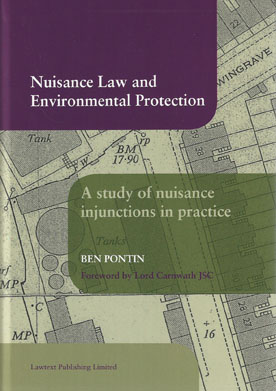
Ben Pontin in his valuable recent book Nuisance Law and Environmental Protection (2013) shows how since the middle of the 19th Century common law nuisance has played an important complementary role to regulatory controls, on the one hand stimulating industry to find better technical solutions to environmental problems, and, on the other, stimulating the legislature to fill gaps in the regulatory system. He sees the present appeal as an important opportunity for the Supreme Court to review the proper role of this part of the law of nuisance in the modern world. (p 184)
Coventry concerned the relationship between nuisance law and regulation, which is a topic that has been central to nuisance law history since the pioneering studies of Joel Brenner and John McLaren in the 1970s and 80s.

Brenner and McLaren argue in different ways to the conclusion that effective legal remedies for revolutionary pollution awaited statutory regulation later in the nineteenth century. Prior reliance on nuisance law, as it had evolved since antiquity, substantially (so the argument goes) failed to remedy industrialisation’s legendary ‘monster nuisances’. The explanation for nuisance law’s weakness provided by Brenner lies with courts moving away from ‘pre-industrial’ strict liability to favour the ‘wealth generating polluter’ in their disputes with neighbours seeking to protect their property and its amenity (Brenner, ‘Nuisance Law and the Industrial Revolution’ (1974) Journal of Legal Studies 403). McLaren’s explanation differs in its focus on litigation costs and similar ‘institutional’ limits of nuisance law in the face of the vast scale of industrial pollution (McLaren, ‘Nuisance Law and the Industrial Revolution – Some Lessons from Social History’ (1983) Oxford Journal of Legal Studies 155).

The Chancery Court claim in
AG v Birmingham
By contrast, my book offers a revised portrayal of nuisance law, as a success. It does so with reference to a small selection of in-depth case studies of specific instances of industrial nuisance litigation, beginning with Attorney General v Birmingham Corporation (1858) 4 K & J 528. Contextual records relating to the litigation underpinning this case reveal some intriguing events, and ultimately a remarkable practical achievement. Over the course of forty years of litigation, affecting hundreds of thousands of people, involving tens of millions of pounds of investment (on today’s currency calculation), the enjoined municipal defendant invented and adopted a sewage purification technology that satisfied the plaintiff (Sir Charles Bowyer Adderley) and led to the injunction’s lifting. The case inspired others to litigate sewage pollution, and thus it is understandable that Lord Robert Carnwath (again) in a recent article refers to the ‘Great Birmingham Sewage Case’ (in ‘Judges and the Common Laws of the Environment – at Home and Abroad’ (2014) Journal of Environmental Law doi: 10.1093/jel/equ009).

‘Great’ litigation in this and other fields of industrial pollution cannot be divorced from its complex social and economic backdrop, characterised by a territorial elite under threat from capitalism reinventing itself as a the nation’s guardian of ‘Nature’s treasures’. How gothic revivalism shaped nuisance law’s achievements is the subject of a blog to follow.

Thursday, June 6, 2013

Environmental history, capitalism, and adaptation to climate change

Here's someone who doesn't think we can learn very much from history about climate change (and apparently thinks that Geoffrey Parker, a great military historian, is just another "Ph.D. historian", of which there are apparently too many. Though he does grant that "Dr. Parker has some interesting things to say".) Matthew Kahn writes on his blog:
Is long run history relevant for thinking about how we will adapt to climate change?  I don't think so.   Our world economy is changing so rapidly that I learn little about our future ability to adapt from 16th century Europe.
He goes on to write that Parker "ignores the role that capitalism plays as an evolutionary force in helping us to adapt to new challenges. He ignores the innovative possibilities of modern capitalism." Maybe so, but history might have a thing or two to say about where the faith in "the innovative possibilities of modern capitalism" comes from, as well as the relationship between this faith and the employment of Darwinian concepts.

A 16th century view of adaptation

Tuesday, May 14, 2013

Environmental history and capitalism in Monsanto v. Bowman


In a surprise to nobody, today the US Supreme Court handed a major victory to Monsanto, the St. Louis-based agribusiness giant. Vernon Bowman, a 75-year old soybean farmer, harvested genetically-modified seeds on his Indiana farm. These were not just any old seeds, and Bowman signed a contract upon purchase agreeing not to save any seeds from the harvest. Like about 90% of all soybeans in the united States, these contained the  Roundup Ready® gene, making them resistant to the herbicide Roundup, also a Monsanto product.

Bowman’s lawyers argued patent exhaustion; Monsanto (and others) argued that patent protection was necessary to recoup their R&D costs, and that without patent protection “there would be no financial incentive to continue investing in technologies with easily replicable features.”