Showing posts with label recreation. Show all posts

Tuesday, March 14, 2023

The history of Sierra Club v Morton

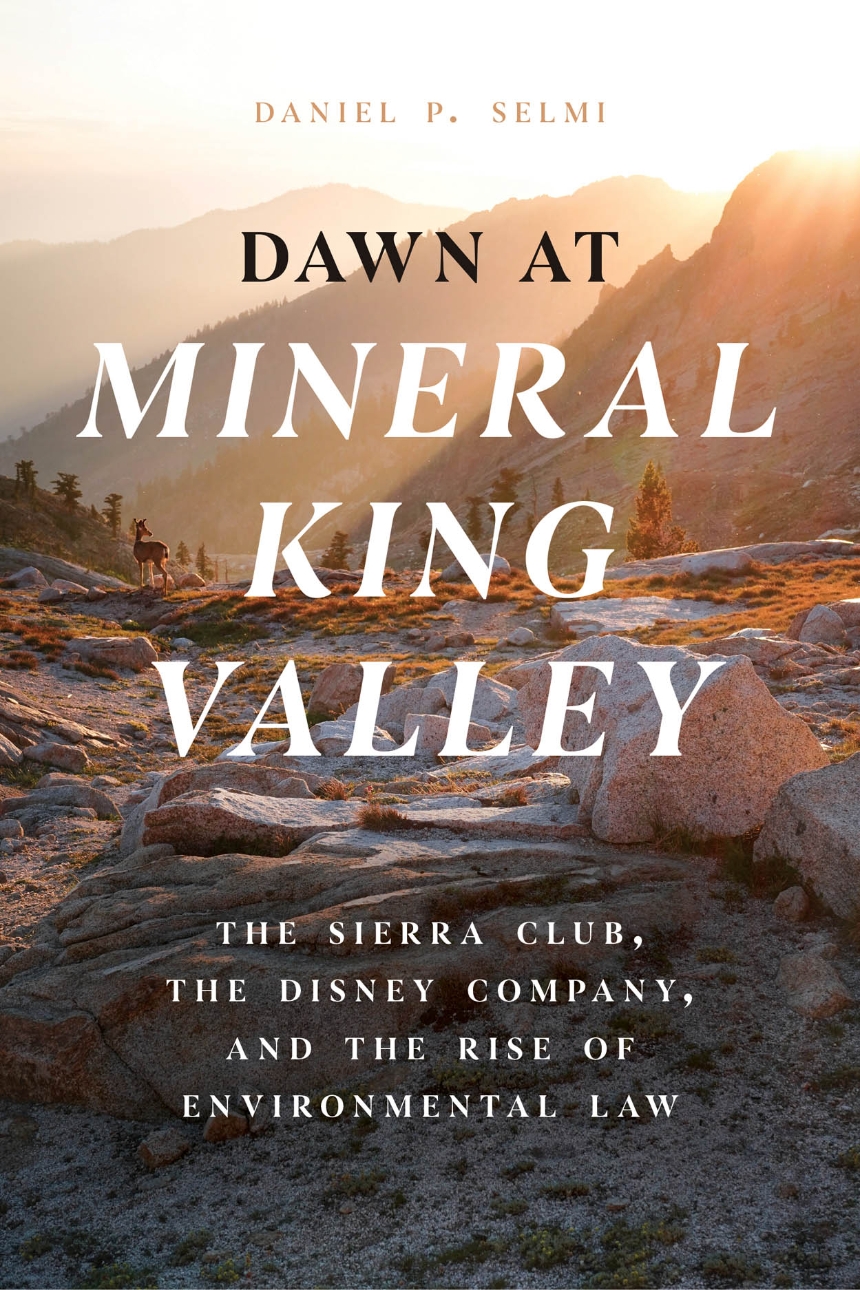
Jotwell recently ran a review by Angela Fernandez of Daniel P. Selmi's Dawn at Mineral King Valley: The Sierra Club, the Disney Company, and the Rise of Environmental Law (U Chicago Press, 2022). Fernandez writes:
Sierra Club v. Morton [known to some as the "Should Trees Have Standing" case - DS] is a seminal 1972 U.S. Supreme Court case on standing, the essential procedural question of who has a legal right to initiate a lawsuit based on a plaintiff’s alleged injury traceable to a defendant’s unlawful conduct. Daniel Selmi’s new book provides a deep dive into the history and context of this famous case, showing that it was about much more than the majority decision’s denial of the Sierra Club’s standing. And it was not, as some have claimed, launched as a test case to establish standing for environmental groups or the entities themselves, the possibility William O. Douglas went into in his famous dissent dear to the hearts of those interested in the Rights of Nature.
*****

Despite the fact that Selmi seeks to de-center standing in his history of the case, or at least destabilize the understanding that standing was what Sierra Club v. Morton was always meant to be about, he presents an excellent and thorough discussion of the issue. Selmi explains that the Sierra Club insisted on its general interest in a case that would impact the environment of concern to its members rather than Club members’ actual use of the area, which the Supreme Court indicated it would have accepted. As Justice White reportedly put it: “Why didn’t the Sierra Club have one goddamn member walk through the park and then there would have been standing to sue.” (P. 204.)

Monday, December 4, 2017

Recreational conflict on British rivers

Wastwater, the Lake District, England
(Canoekayak,com)
Rounding out coverage of September's issue of Water History, Marianna Dudley published “Muddying the waters: recreational conflict and rights of use of British rivers”. The abstract:
Rivers have historically been spaces of recreation, in addition to work, trade, and sustenance. Today, multiple groups (anglers, canoeists, rowers, swimmers) vie for the recreational use of rivers in Britain. But, this paper argues, legal definitions of rights of use have not kept up with the growth of recreational river use. Focusing on two groups, anglers and canoeists, it explores the emergence of conflict between recreational users of British rivers in the twentieth century, and subsequent campaigns for universal public rights of navigation on inland waterways. As a result of conflict (real and perceived), small-scale organized groups have re-conceptualized river spaces in ways that reflect a modern engagement with, and understanding of, water through recreation. This papers foregrounds recreation as a form of water-use that generates important water-knowledge. Grounded in the Environmental Humanities, it draws on notions of legal geographies, ‘modern’ waters, and hydrocommons to suggest that small-scale conflicts on British rivers are challenging how we use, govern, and conceptualize river water.

Saturday, November 7, 2015

Property in the Prussian forest

The recent issue of Environment and History had a review by Charles Closmann of Jeffrey K. Wilson, The German Forest: Nature, Identity, and the Contestation of a National Symbol, 1871-1914 (U. Toronto Press, 2012). After discussing the book's treatment of German cultural attitudes to the forest, Clossman writes:
Subsequent parts of the book examine debates about how to manage Germany’s forests. Drawing from minutes of the Prussian Landtag, Wilson shows how conservative landowners supported what they considered to be modern definitions of property rights in debates over an 1880 Prussian Forest Law. On the other side, left liberal critics supported the public’s traditional right to wander freely in the woods, collecting timber for fuel, gathering berries, and picking mushrooms. A subsequent chapter traces debates over Berlin’s Grünewald, with Wilson demonstrating again how left-liberal and some working class critics demanded that the Prussian state preserve a major forest in the city’s outskirts. In this case, enthusiasm for a beloved forest stemmed not from irrational anxiety about modernity, but in part from a desire to enhance recreational opportunities for the working class. Wilson notes, ‘The struggle to protect the Grünewald demonstrates the rational and progressive aspect of the forest discourse’ (p. 131).
Support for forest preservation also came from the state, for different motives. In chapter five, Wilson shows how Prussian state foresters attempted to restore the degraded forests of the Tuchel Heath, in the Prussian East. In this case, state officials intended to scientifically manage the region’s forests and to discipline what they saw as an ethnic Polish population desperately in need of German Kultur. A dramatic story of heroes, thieves and frustrated officials, the story of the Tuchel Heath is well-supported with documents from German and Polish sources, and with lively illustrations from Oskar von Riesenthal’s Bilder aus der Tucheler Heide. 
See here for an earlier article by Wilson on a similar subject. For more on German working-class environmentalism, see here.

Sunday, July 26, 2015

Property and the Appalachian Trail

Maybe some of you are out hiking right now. When you get back you may want to read Sarah Mittlefehldt's Tangled Roots: The Appalachian Trail and American Environmental Politics (U Washington Press, 2014), reviewed in January's Environmental History by Margaret Brown. Brown writes:
The Appalachian Trail (AT) is a remarkable story of volunteerism because in the early years no government agencies were involved in its creation and maintenance. Local hiking clubs sought permission of landowners to develop the trail and negotiated the rough terrain of property rights. “The AT maintainer had to be one-third trail worker, one-third organizer of other trail workers, but one-third diplomat among the landowners” (p. 38). Not until 1945 was a bill proposed to incorporate the AT under federal authority, and it took the 1968 National Trails Act to create the concept of a distinct corridor of protected landscape under the care of state agencies, the US Forest Service, and the National Park Service. According to Mittlefehldt, the 1968 law did not simplify the story of the AT; rather, it polarized landowners because the protected corridor required additional takings at the same time that the Sagebrush Rebellion and the property rights movement were gathering momentum. The conflict between environmentalism and property rights resulted in the unique contemporary position of the trail: the entire management of the AT was given in 1984 to a nongovernmental nonprofit—the Appalachian Trail Conservancy (ATC)—with both a professional staff and a prodigious number of volunteers.

Friday, May 29, 2015

Desegregation of national parks

Another article from Environmental History's virtual issue on environmental justice (other were noted here and here), Terence Young's "'A Contradiction in Democratic Government’: W. J. Trent, Jr., and the Struggle to Desegregate National Park Campgrounds", brings together environmental history and the history of desegregation, at the same time reminding us that desegregation in various contexts took place by administrative action before Brown v. Board of Education. The abstract:
Camping began in the nineteenth century as an elite form of pilgrimage to the wild, but the arrival of inexpensive automobiles in the early twentieth century greatly expanded camping's social diversity. The change was not universally embraced, especially when African Americans were involved, and the issue came to a head during the 1930s after two racially segregated national parks were opened in southern states. As complaints flowed in, William J. Trent, Jr., became adviser for Negro affairs to Interior Secretary Harold L. Ickes. He had no special interest in the outdoors or national parks, but Trent championed increased African American access to the parks and an end to discrimination in them. NPS leadership resisted Trent's efforts until Secretary Ickes ordered them to create one nonsegregated demonstration area in Shenandoah National Park in 1939. The policy was extended to other areas in 1941 and the next year, with World War II shifting into high gear, campground and other forms of segregation were ended throughout the park system.
Shenandoah National Park (National Park Service)

Tuesday, June 17, 2014

The sporting life

I recently had the pleasure of hearing Greg Alexander present his recent paper, "The Sporting Life: Democratic Culture and the Historical Origins of the Scottish Right to Roam", at a workshop here in Tel Aviv. To me the article is a model for the way recent environmental laws can be better understood by placing them in a socio-political historical context that extends beyond modern "environmentalism" narrowly construed; in this case hundreds of years of debate over land reform and the secular transfer of power from the Scottish landed gentry to the working classes. The abstract:

File:James Bryce Vanity Fair 25 February 1893.jpg
Henry Charles Seppings-Wright,
Privy Councillor, Professor and Politician
(caricature of James Bryce, Vanity Fair 25 Feb. 1893).
Bryce, a scholar, politician, and diplomat,
was a key figure in the movement to provide
public access to the Scottish Highlands.
In 2003, the Scottish Parliament enacted the Land Reform (Scotland) Act, which, among other reforms, grants to "everyone" a right to access virtually all land in Scotland for a wide variety of purposes, including recreation, educational activities, and even some commercial or for-profit activities. Legal recognition of this broad-ranging "right to roam" comes after more than a century of debate over the public’s right to access privately-owned land in the Scottish Highlands. This paper is the first historical account of the origins of the remarkable Scottish right to roam. It sets the debate over the right to roam with a clash between two different visions of the sporting life: One, older, rooted in the Victorian and Edwardian periods, viewed the sporting life as one of hunting, aided by the use of modern technology — rifles and such — and much older technology in the form of dogs and horses. The other vision is of more recent vintage. It is a vision of contact with nature through walking, hiking, and similar forms of unmediated interaction with nature. Curiously, both visions of the sporting life claimed the mantle of preservation and conservation. The paper argues that the culture of unmediated contact with nature ultimately prevailed as a democratic culture became more entrenched in both politics and society.