Showing posts with label western USA. Show all posts

Sunday, March 12, 2023

Nature versus the Common Law VI: Diversion of water

In the last installment in this series we looked at how the English rule on escaping water in Rylands v Fletcher was rejected in British India due to perceived differences in the environments and needs of the two countries. Today we look at a classic issue of water law, complaints by riparian owners of upstream water uses that interfered with their own uses. As with the issue of escaping water, what was considered "natural" could turn, here too, on local natural conditions.

The traditional common law rule of conflicting riparian uses – that an upstream riparian may not divert a stream's water to the (unreasonable) detriment of downstream owners – was explained by the court of King's Bench in 1625 (Shury v Piggot, 81 English Reports 280) in terms of natural law: "a water-course […] doth begin ex jure naturæ, having taken this course naturally, and cannot be averted" and "the nature of this [water-course] is to be current [i.e. to flow]".

In the leading case of Evans v Merriweather in 1842, the Illinois Supreme Court advanced a distinction: An upper riparian might reasonably consume all the water in the stream if his use were a "natural" one, necessary for existence, but not were it to be considered "artificial", for the mere increase of "comfort and prosperity". The court then suggested that the application of this distinction would vary depending on natural conditions:

The supply of man's artificial wants is not essential to his existence; it is not indispensable; he could live if water was not employed in irrigating lands, or in propelling his machinery. In countries differently situated from ours, with a hot and arid climate, water doubtless is absolutely indispensable to the cultivation of the soil, and in them, water for irrigation would be a natural want. Here [in Illinois] it might increase the products of the soil, but it is by no means essential, and can not, therefore, be considered a natural want of man.

What riparian uses were to be recognized as "natural", and therefore permitted, was thus dependent on the climate and environment. Irrigation would be considered an "artificial" use in the American Old Northwest, as it would be in England, but the court had legitimized changing the law if and when the common law spread to arid lands.

This way of thinking was crucial for the development of water law in the arid western states and territories of the United States, in which the traditional common law of riparian rights was rejected in favor of a new system. The new law, known as "prior appropriation", opened up water resources to appropriation by all, not just riparian owners, and allowed them to take as much of the water as they could put to beneficial use, regardless of the effect on later appropriators. An early case from Colorado discussed whether an appropriator could dig a ditch across another's land without permission, an invasion of property that would clearly not be allowed under the traditional common law. Along the way it advanced a general theory of the adaptation of property law to environmental conditions:

Wednesday, February 1, 2023

The legal environment and communal irrigation

The latest issue of the International Journal of the Commons has an article by Steven M. Smith, "Dynamics of the Legal Environment and the Development of Communal Irrigation Systems". From the Introduction (citations removed):

Archinia, Acequia System of El Rancho de las Golondrinas

Given the importance of external forces to the success of the commons, calls to integrate political ecology with the commons literature are becoming a common refrain. The combination can be approached from both directions: how do power structures shape institutions and how do institutions shape power structures? I take a historical perspective to explore both questions and their dynamic relationship. Specifically, I consider how external legal changes alter the incentives for how local users organize themselves and how those changes in local organizations alters the political coalitions, affecting subsequent legal changes.

To explore the question, I document and analyze the evolution of the legal environment and the development of communal irrigation systems, known as acequias, in current day New Mexico, US. Acequias have been held up as a case of a long-lived successful communal management regime of a natural resource . In the region of study, some acequias date back to the 16th century when Spain first colonized the area. The acequias have experienced sizeable shifts in their external legal surroundings, most rapidly and significantly during the US territorial period (1851–1912), that can be used to assess the relationship of external legislation and communal irrigation systems.

Wednesday, September 28, 2022

The US Clean Water Act at 50

Another 50th anniversary: Legal Planet reports that the California Environmental Law & Policy Center at U.C. Davis School of Law will convene a conference to commemorate the 50th anniversary of the federal Clean Water Act on Friday, October 7th. Highlights include "a stimulating conversation between two water quality experts who were instrumental in drafting the Clean Water Act in 1972 and California’s landmark Porter-Cologne Act, the state’s comprehensive water pollution control statute that both predated and influenced the CWA."

The free, in-person conference will be held at the U.C. Davis School of Law.  Advance registration is required.


Tuesday, March 8, 2022

California's 19th-century water law

 Over at Legal Planet, Holly Doremus complains:

California’s water law was developed in the 19th century. It has not been comprehensively reformed since, despite substantial population growth, changing social values, and the appointment 45 years ago of a blue-ribbon commission to recommend changes. Now the “new normal” of the anthropocene promises reduced water availability coincident with increased demand.

It is past time for comprehensive reconsideration of California’s water law system. Fellow Planeteer Rick Frank and I have been working with a diverse group of water law experts to come up with some initial recommendations for change.

The experts' report, titled "Updating California Water Laws to Address Drought and Climate Change",  is here. 

California water law is indeed antiquated, arcane, and impossibly complex. The odd thing to my mind is how mild the reforms being called for are - things like speeding up stream adjudications, protecting domestic wells, improving monitoring and enforcement, and the like - mostly very nineteenth-century ideas themselves (see my book, The Colorado Doctrine). Nothing questioning the basics of the mixed appropriation and riparian system that California uses, or adopting ideas from the many models of water law in countries around the world. I suspect that the authors think this is all that is politically and constitutionally feasible at this point, but it seems to me that even if all these reforms are adopted, California will remain with a very nineteenth-century water law. 

Perhaps a reminder of how much legal history is never just history.

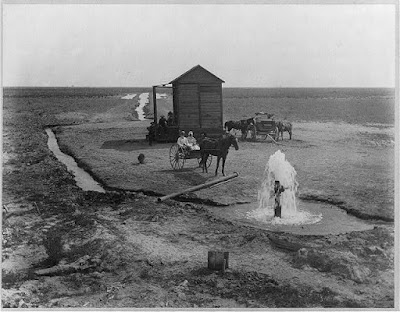
Carleton E. Watkins, Horse-drawn cart beside artesian well, Kern County. c. 1880

Thursday, March 3, 2022

Yellowstone at 150

Anna Price of the Library of Congress's In Custodia Legis recently posted on the 150th anniversary of the creation of Yellowstone National Park, the US's first. Price goes through the legislative history of the statute creating the park, as well as some of the legal issues that arose, including American Indian treaty rights and potential conflicts with settlers claiming preemption and homesteading rights. The latter issue, as the blog points out, also arose in the context of Yosemite Park in the 1872 US Supreme Court Case of Hutchings v Low (a.k.a. The Yosemite Valley Case).

poster designed by Don C. Powell (LOC)

Thursday, December 9, 2021

LA's water and history

Richard Frank recently posted at Legal Planet on "The Latest Chapter in Los Angeles’ Century-Long Water War With the Eastern Sierra’s People & Environment". Frank begins:

There LADWP goes again.

Recently the Los Angeles Department of Water and Power announced it was walking away from its longstanding obligation to provide Mono County residents and the environment with a tiny fraction of the water it transports from Mono County to LADWP’s urban customers in Los Angeles.  When efforts by county officials to resolve the dispute informally with LADWP failed, the County sued, arguing that LADWP’s unilateral action violates California’s most iconic environmental law, the California Environmental Quality Act (CEQA).  Earlier this year, a trial court agreed, ruling in the County’s favor.  The court found that LADWP’s decision to turn off the Mono County spigot without prior environmental review violates CEQA.  Now LADWP has chosen to appeal this adverse ruling to the California appellate court—where it is likely to lose again.

If LADWP’s action were an isolated incident, observers might well conclude that this is simply the latest chapter in California’s seemingly interminable water wars.  But it’s not.  To the contrary, LADWP has a sorry, 120-year history of treating the rural people and natural resources of the Eastern Sierra as a population to be exploited and an ecosystem to ravage.  Fortunately, the courts, state officials and environmental advocates have in the past repeatedly intervened to halt or moderate LADWP’s economic and environmental depredations.  Unfortunately, they need to do so again in order to stop LADWP’s announced water cutoff.

There's lots more legal history in this interesting and timely post.

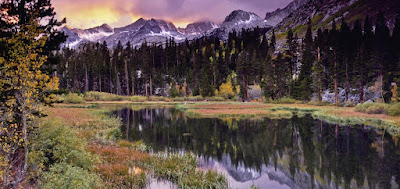
Weir Pond, Eastern Sierras

Monday, June 1, 2020

The environment in Dan Ernst's legal history exam

Dan Ernst (Georgetown Law) regularly posts a long exam question from his legal history course at Legal History Blog. This year's question was on federal grazing policy in the US. Some excerpts:
One of the Forest Service’s first projects was to subject stockmen used to roaming the mountains at will to the principles of forestry.  To develop and defend the new regulations, Pinchot hired, as chief legal officer of the Forest Service, an able and imaginative lawyer, who was personally indebted to him for, among other things, lending him money in the past.  The chief legal officer, who reported directly to Pinchot rather that the more politically connected Solicitor of USDA, soon worked out an ingenious constitutional justification for criminal enforcement of the grazing regulation, turning in part on the claim that the use of the public domain was not a private right but merely a privilege.  In 1908, Pinchot’s lawyer convinced the Department of Justice to bring a test case against a sheepherder named Pierre Grimaud.  A federal district judge ruled that the prosecution violated the nondelegation doctrine.  On direct appeal to the U.S. Supreme Court, the justices at first deadlocked, 4-4.  Pinchot was unfazed.  “I hold it to be the first duty of the public officer to obey the law,” he explained, “but I hold it to be his second duty, and a close second, to do everything the law will let him do for the public good.”  After Charles Evans Hughes and another justice joined the Court, Grimaud was reargued, and, in 1911, the Court upheld the prosecution.  The Forestry Service immediately brought scores of criminal prosecutions, and, by 1912, USDA could report that overgrazing in the forest reserves had ended.
*****
In 1934, the Colorado Cattleman’s Association sent [Farrington] Carpenter to Washington, DC, to lobby Congress to add beef cattle to the Agricultural Adjustment Act’s list of “basic agricultural commodities” and permit them to enter into marketing agreements controlling cattle prices.  Having succeeded, Carpenter stopped by his Congressman Taylor’s office to say his goodbyes, just as the grazing act was having a hearing.  Realizing that Carpenter would be an effective witness and learning that he did not think the public domain should be turned over to the states, Taylor asked him to testify.  (Carpenter was no fan of national power, but he believed that once the land was devolved to the states, different grazing interests would capture different state legislatures and produce an unworkable patchwork of regulation.)  Before the House committee, Carpenter spoke for small-scale cattle stockmen such as himself, plagued by nomadic sheep herds and pushed off public domain by larger cattle outfits.  Federal control was the small stockman’s only chance to avoid being “completely wiped out of existence,” he testified.
When, a few months later, [Secretary of the Interior] Ickes’s undersecretary offered Carpenter the directorship of the new Grazing Division created within the department to enforce the Taylor Grazing Act, Carpenter warned that sheep herders would object to his appointment because he was known as a champion of cattlemen in his corner of Colorado.  He claimed also to have said that he did not intend to create “a great centralized bureau” like the Forest Service, “run by Eastern people who know little about the public domain.”  After consulting a government official who once represented sheep herders, Ickes decided Carpenter would treat them fairly.  Whether Carpenter’s other warning registered with the Interior Secretary Ickes is not known. 

Friday, November 16, 2018

Why are California's fires worse than those in Baja California?

California's Camp Fire, November 2018
Peter Reich recently posted "What Happened to Hispanic Natural Resources Law in California?". The abstract:
Before the US annexation of California in 1848, the region’s Spanish and Mexican governments supervised a geographically-adapted legal system emphasizing communal water rights and public allocation of minerals, land, and coastal areas. While many post-takeover judges considered Hispanic legal principles, the overall trend was to reject these in favor of common law. The prior anti-developmental tradition was in most cases distorted, overridden, or procedurally blocked, and the jurisprudence replacing it facilitated resource degradation that has been only partially reversed by California’s modern environmental policy. As one example, the stark contrast between fire zone rules in Mexico’s Baja California and in US Southern California, and the resulting far more destructive conflagrations in the latter, demonstrate the advantages of the more managed, sustainable Hispanic approach.

Friday, August 31, 2018

Goodbye Abbey, hello intersectional environmentalism

Sarah Krakoff recently posted a critical take on Edward Abbey on Environmental Law Prof Blog. Some highlights:
Abbey’s love-letters to Utah’s red-rock country spawned generations of canyoneering backpackers, and still serve as the heart of aesthetic and political defenses of desert wilderness. Ever since, Abbey has been attacked and defended. Was he racist, misogynist, and anti-immigration? He was. His views of Black and Brown people were deplorable, and his descriptions of women were retrograde. And yet, his defenders inevitably retort, we need his irascible, cranky, and irrepressible voice today more than ever.  
But do we? I have come to (re)bury Edward Abbey, not to praise him. (Abbey died in 1989 at the age of 62; he was buried illegally on public lands.) Or more accurately, to make a pitch for putting Abbey in his place and moving on. That place should be in the context of what it means to protect those same dramatic and soul-stirring landscapes without perpetuating an alienating version of what it means to be “truly wild,” or “truly radical,” or “truly environmentalist.” The problem with re-lionizing Abbey in 2018 is not just that he was sexist, racist, and xenophobic. But also that those views were sewn into his brand of so-called radicalism. They constituted the lenses through which he saw the landscape he aimed to protect.
What Abbey saw were beautiful empty places where white men (quite specifically) could be free and wild. Their version of wilderness preservation, even supplemented by the occasional nod to the evils of growth-dependent and extraction-based economies, was oblivious to the structures that enabled their seemingly unmediated encounters with the desert. Those structures included brutal and unscrupulous campaigns to dispossess Native people of most of southeast Utah. They included the failure of post-Civil War efforts to democratize homesteading by including eligible African Americans eager to flee the South. And they included, time and again, the cultural acceptability of exploiting women, both by treating them as fungible sex toys and by relying on them to mind the homestead and raise the young’uns. Abbey’s version of radical environmentalism assumes away all of the inequalities baked into his ability to be a free man in canyon country. Abbey also managed to alienate lots of white men while he was at it. He scorned ordinary work as part of his critique of corporate and industrial interests and romanticized manual labor even while he railed against ranchers and farmers in his midst.

Sunday, July 29, 2018

The California ascendancy: Explaining world leadership in environmental law and policy

[A guest book review from Geoffrey Wandesforde-Smith:]

In the newest addition to the Studies in American Politics series from Princeton University Press, David Vogel in California Greenin’: How the Golden State Became an Environmental Leader (Princeton UP, 2018) asks how it is that California has had such success in protecting its environment and has become a world leader in making and implementing environmental policy and law.

Vogel sketches boldly on a large canvas:
This book describes what is in many respects a remarkable success story. It demonstrates how a state government has been able to overcome substantial obstacles and enact a wide range of regulations that have made measurable - though admittedly uneven – progress in protecting its environment and improving the quality of life of its residents. Although California has often seemed on the verge of ecological (as well as economic) catastrophe, it has proven remarkably resilient. The state’s ability to remain the most important source of environmental policy innovation in the United States over so many decades and across such a diverse range of policy areas is a significant accomplishment.  It is worth understanding why and how this particular state came to play such an important leadership role in this area, as well as the broader policy implications of such leadership [p. 6]. 
One of those implications, Vogel writes, is that the story of California’s ascendancy holds lessons for the world:
What happens in California…has a global impact.  During the 1980s, the relative stringency of California’s vehicle emissions standards was an important reason why Germany chose to support the adoption of similar standards by the European Economic Community… More recently, according to…a Nobel Prize-winning scientist from Mexico, “the rest of the global economy is looking to California, as one of the world’s largest economies, to take the lead” in addressing the risks of global climate change.  The state has come to play an increasingly active international role [p. 8, citations omitted].
When it comes to explaining how and why California has become such a successful and resilient law and policy leader Vogel focuses on three factors he considers to be interconnected in varying ways at different times in the state’s history, depending on the issues being addressed.  

One is the political mobilization of California’s citizens, most especially in the late 1960s and 1970s.  A second is the support for environmental policy initiatives provided at critical moments by least some important segments of an often divided business community.  And a third is the growth over time of the state’s capacity to design and implement programs of resource management and environmental regulation, in some cases in state agencies recognized as world leaders in the work they do [1].

This is obviously a provocative thesis and it may well keep students of the history of California environmental law and policy busy for some time to come.  But it also and immediately raises the question of why, if the story of California’s ascendancy, which on Vogel’s telling has its roots in the late nineteenth century, is so remarkable and potentially so influential, the story hasn’t been told before now.  

The answer is that the story has been told, at least in part, twice before, although Vogel chooses not to engage seriously with either prior account [2]. 

Monday, June 11, 2018

Before Trump

Today's "This Day in Water History" has this:

Judson Harmon, c. 1912
June 11, 1895: First day of tenure of Judson Harmon as U.S. Attorney General. “Harmon issued the most explicit statement of what became known as the American doctrine of absolute sovereignty, that “the rules, principles and precedents of international law impose no liability or obligation upon the United States,” in a case involving a claim by Mexico for damages from diverting the waters of the Rio Grande.” Or, as one source put it: “US Attorney General Judson Harmon tells Mexico that the US will ‘do whatever it pleases’ with water from the Rio Grande.”

Commentary: Even for those days, this was a pretty amazing statement.

Tuesday, February 13, 2018

Conference report: CARB's 50th Anniversary

UC Davis recently hosted a conference marking the 50th anniversary of the California Air Resources Board. Richard Frank reports at Legal Planet:

CARB convened for the first time in January 1968, following enabling legislation prompted by the chronic, crippling smog that enveloped Southern California, its residents and economy in the 1950’s and `60’s.  The Board quickly became a national and international leader in air pollution regulatory strategy and pollution control technologies for stationary and vehicular sources alike.  That leadership was reflected in the 1970 Clean Air Act, when Congress granted California–alone among the states–the authority to adopt vehicle emission standards more stringent than those promulgated by the federal government.  (Attendees were reminded at the “CARB at 50” conference that this longstanding federal deference to California auto emission standards is due in large part to strong and successful lobbying by then-California Republican Governor Ronald Reagan.) 
*****
The California Air Resources Board has achieved a truly remarkable record of success over the past half century.  California’s air quality today is roughly 95% better than it was when the Board first convened in 1968.  Air pollution control technologies pioneered by CARB in California have been replicated nationally and internationally.  In 2004, CARB enacted the world’s first GHG emission reduction standards for motor vehicles, which was only the start of a multitude of innovative and successful Board regulatory strategies to address the overarching environmental challenge of our time–climate change.  And, last but not least, CARB demonstrated that it is a regulator with considerable bite when the occasion requires it–as the Board amply demonstrated in responding to Volkswagen’s fraudulent “gaming” of emissions control systems in the diesel vehicles VW marketed in California and worldwide.
For more on Reagan the environmentalist see here.

The full conference proceedings are here.

Monday, December 25, 2017

The redwood wars

The latest American Historical Review has a review by Neil Maher of Darren Speece's Defending Giants: The Redwood Wars and the Transformation of American Environmental Politics (U. Washington Press, 2017). Some excerpts:
Speece begins with the conflict’s prehistory, describing the rise in the region during the late nineteenth and early twentieth centuries of a “corporatist” logging industry that was permitted, with encouragement from the California Board of Forestry, to self-regulate cutting practices on privately owned land. Redwood preservation during this period most often involved elite groups, such as San Francisco’s Bohemian Club, purchasing groves from timber companies. The next four chapters, which jump to the late twentieth century and the “Redwood Wars” themselves, follow local activists and their two-pronged strategy—involving lawsuits and direct action campaigns—that all but halted old-growth logging on the North Coast and, in doing so, weakened the corporatist reign over redwoods. The legal stalemate that resulted, Speece concludes, fostered “the Deal” orchestrated by President Bill Clinton, which not only protected the old-growth redwoods of the North Coast’s Headwaters Forest but also laid the groundwork for additional protection of endangered landscapes nationwide.
Defending Giants is about more than environmentalists, however, and in order to give voice to the lumber executives, loggers, and lawyers who also serve as foot soldiers in this conflict, Speece embraces a diverse set of historical methodologies. To understand the grassroots beneath his tall trees, he scours local newspapers, digs into unprocessed archival material from North Coast environmental groups, and, perhaps most importantly, conducts dozens of oral interviews with activists, timber workers, lumber company managers, and forest policy bureaucrats. Speece also skillfully navigates a torrent of legal cases initiated by environmentalists to halt redwood logging, and tracks a wide range of timber policy proposals through the hallways of capitols in both Sacramento and Washington, D.C. Finally, he carefully balances his narrative by analyzing the annual reports of the Pacific Lumber Company, which owned these redwood forests, of its successor, the Maxxam Corporation, and of several other timber businesses from the Pacific Northwest. The result, which successfully blends social, political, legal, and business history, will interest more than environmental historians. 

Sunday, December 24, 2017

Water rights V: Public rights

(Continuing the series on water rights:)

Whatever property regime applies to water, the public often retains certain rights in the resource. Thus, for instance, in American law, though a river's water may be owned by riparian landowners or appropriators, the federal government retains a "navigation servitude" in the water with which private owners (and states) cannot interfere (Trelease, 1965).

Joseph Sax
Recent decades have seen much discussion of the "public trust doctrine", rules that allow public interests, especially environmental ones, to trump the normal property rules in water. Though the doctrine has its roots in the traditional civil and common law, particularly with regard to tidelands (Selvin, 1980), its modern form was first articulated by Joseph Sax in a highly influential article (1970), in which he argued that the historical doctrine should be developed to encourage courts to subject actions that harm the environment to strict scrutiny. In the field of water rights the doctrine has been applied by American state courts in recent decades to push states to protect environmental values, even when this protection is in tension with private property rights (Craig, 2010). The best-known expression of this trend is the decision of the California Supreme Court in the Mono Lake case, in which the court ruled that longstanding water diversions from the lake by the city of Los Angeles might need to be limited by the state in order to protect ecological values being harmed by the lowering of the lake level. In recent years the doctrine has been adopted in additional countries around the world (Cullet, 2009; Blumm and Guthrie, 2012).

The public trust doctrine continues to receive support from many commentators, but it has also been criticized. On the one hand, it has been argued that the doctrine places undue reliance on an inflexible, property rule as applied by the judiciary, while environmental protection should be sought from progressive legislation (Lazarus, 1986). On the other, the doctrine has been criticizes as historically without basis, undemocratic, and invasive of private property rights (Huffman, 1989, 2007).

Next: A human right to water. The full article is here.

Wednesday, December 20, 2017

Water rights IV: Property in water: Empirical and historical evidence

(Continuing the series on water rights:)

The empirical work of Ostrom (1990; Ostrom and Gardner, 1993) and others on institutions for governing commons resources has shown that, in practice, common property can be highly successful in managing water resources, depending on the structure and functioning of the institutions involved. She and her collaborators summed up their conclusions (Ostrom et al., 2010):
Elinor Ostrom
Researchers usually distinguish four basic types of governance systems, defined in terms of who controls access to resources: private property, government property, common property, and open access (i.e., no one's property). Research has consistently shown the inefficient outcomes of open access since open access almost always leads to destruction of any resource that is in great demand. This is the problem identified in Hardin's famous essay, although he called open access "commons," which led to substantial subsequent confusion. The other three systems, however, have mixed records in terms of sustaining water resources, including both great successes and massive failures. Thus, the ability of a type of ownership to enhance sustainable resource management depends on a number of other factors…
Many legal and environmental historians have focused on historical transitions between property regimes in water, particularly two major developments in the Anglo-American legal world: the development of the "reasonable use" riparian regime in the early to mid-nineteenth century, and the rejection of riparian rights in favor of the system known as "prior appropriation" in the western United States in the second half of the same century.

Some historians' accounts, beginning with Walter Prescott Webb's "Great Plains Thesis" (Webb, 1931), have supported the economic view associating with aridity with private rights in water (Robert G. Dunbar (1985) 'The Adaptability of Water Law to the Aridity of the West', Journal of the West 24: 57; Percy, 2005). Yet aridity has also been associated with strict state control, as in Karl Wittfogel's (1957) hypothesis associating "hydraulic civilizations" with "oriental despotism", applied to the western American context by Donald Worster (1985).

Monday, December 18, 2017

California Air Resources Board’s 50th anniversary

On Friday, January 19, 2018, the University of California, Davis, will host a major conference commemorating the California Air Resources Board’s 50th anniversary.  The conference represents a three-way partnership between UCD School of Law’s California Environmental Law and Policy Center, UCD’s Institute for Transportation Studies and CARB.
Since its creation in 1967, CARB has been a model of environmental stewardship, pollution control innovation and public service.  Years before passage of the federal Clean Air Act, CARB pioneered the nation’s first air pollution emission limits and pollution control technologies for motor vehicles—accomplishments that served as a model for the nation and the world.  More recently, CARB has led California’s multifaceted strategy to curb the state’s greenhouse gas emissions, again serving as both an inspiration and model for the global community.
The January 19th conference at UC Davis will both celebrate CARB’s past accomplishments and—at least as importantly—identify the challenges and opportunities that lie ahead for CARB in the next half century.  Featured speakers will include California Governor Jerry Brown, former USEPA Administrator Gina McCarthy and current CARB Chair Mary Nichols.  Also on the agenda is a diverse panel of “young visionaries” who will venture predictions on CARB’s future course and priorities.
Registration for the event is now open.  You can register here.

Sunday, October 15, 2017

Colorado water law yet again

Colorado water law continues to spur scholarship. The recent issue of Environmental History has a review by Michael Weeks of  Robert Crifasi's A Land Made from Water: Appropriation and the Evolution of Colorado’s Landscape, Ditches, and Water Institutions (University Press of Colorado, 2015). From the review:
While the book presents no definitive argument, Crifasi is skeptical of claims that water management in the West has been synonymous with concentrated power. Rather, his often meandering narrative suggests that water developed roughly along practical and evolutionary lines, with users and institutions responding logically to changing water needs.
Most of the text centers on the period from Colorado’s 1858 Gold Rush to the early twentieth century. Heavy doses of environmental determinism appear throughout. Crifasi argues that failed adventures in ditchdigging and the need to move water across property lines pushed farmers to enlist the aid of the territory/state of Colorado to form water districts and employ water commissioners and state engineers to oversee water management. Shared need propelled farmers to pool their resources to form mutual irrigation companies. The evolution of Colorado’s Doctrine of Prior Appropriation was a commonsense response to shared need that enabled users to quantify and prioritize water rights as well as prevent property owners from hoarding the resource. In Crifasi’s telling, even corporate attempts to monopolize and privatize water in the late nineteenth century were a natural part of the region’s agricultural evolution since concentrated capital propelled the development of sophisticated canals that could bring uplands into production.
One of Crifasi’s most intriguing, yet underdeveloped sections addresses water measurement and distribution. Employing William Cronon (Nature’s Metropolis, 1991), he argues that for water to be fairly distributed in an arid climate, it had to become a commodity that could be broken down into discrete measurable units. This meant water users had to translate malleable units such as the miner’s inch into standardized ones such as cubic feet per second. It also explains why users employed Colorado State Water Engineers to monitor stream measurements, water priority, and the carrying capacities of canals and ditches, as well as why the state agricultural college produced some of the nation’s first irrigation engineers. With a fine attention to detail, Crifasi then shows how water, once commodified, enabled irrigation companies to call for water releases based on their shareholders’ water rights, the priority of their holdings, and the availability of the resource.
Within these strengths of the book lies two of its weaknesses.

Monday, September 25, 2017

Beach access and American conservatism

Bixby Creek Bridge near Big Sur, California
(Bill Lane Center for the American West)
The issue of public beach access has played a major role in the history of environmental law (see, e.g., here, here, and here). It also may be responsible for some of the backlash against environmental regulation. Last year the Journal of Policy History published Jefferson Decker's "Pacific Views: Property Rights, the Regulatory State, and American Conservatism". The article opens:
In November 1976, a bookkeeper named Viktoria Consiglio used money from an inheritance to purchase a plot of land overlooking the Pacific Ocean just south of Carmel, California. Two years later, Consiglio and her husband prepared to build a one-bedroom house for use during their retirement. They submitted applications for a building permit only to have their request denied. The impediment was the California Coastal Commission, a statewide regulatory agency that Californians had recently established in order to protect the state’s coastline from environmental damage and overcrowding. The commission ruled that Consiglio’s house would block the view of the ocean from a nearby highway, disrupt a path to a rocky cliff above the sea, and reduce public access to the beach below the development site. Using powers that had been delegated to it by the state legislature, the commission denied Consiglio’s application for a building permit. Consiglio could continue to own this scenic property overlooking the Pacific Ocean, but she would not be permitted to build a home there.
Consiglio eventually sought help from the Pacific Legal Foundation, a nonprofit, “public-interest” legal foundation established in 1973 by Ronald Zumbrun, a former aide to California governor Ronald Reagan, with help from several prominent California lawyers and businessmen. Zumbrun’s organization photographed the gray-haired woman, standing on a rocky cliff overlooking the Pacific surf, and put the image on the front page of its bimonthly newsletter. The accompanying article, titled “What Happened to the American Dream?” began: “Viktoria Consiglio, unhappy, confused, and angry, wonders what happened to her dream of owning a home by the sea. A dream that has turned into a nightmare of government red tape and legal costs that have taken a big chunk of her income from her job as a clerk-bookkeeper.” Lawyers at the foundation prepared to file suit, on the grounds that the Coastal Commission’s decision was inequitable, unjustified by law, and interfered with the woman’s property rights. The state of California may have certain powers to zone or plan for new development, the foundation argued, but it could not render this woman’s property nearly useless to her. 

Sunday, September 3, 2017

From Charlottesville to Yosemite

The Ahwahnee Hotel in 1980 (George Rose)
Daniel Duane has an interesting piece in yesterday's New York Times on genocide of the Yosemite Valley's natives and the replacement of their names with Anglo ones, and it all starts from a trademark dispute. After detailing the killing and renaming of places in Yosemite carried out by California militia, Duane explains both the legal dispute and the complexity of the name issue:
The recent furor over the name of the Ahwahnee began in 2015, when a subsidiary of the Delaware North Corporation, which operated the park’s hotels, restaurants and shops for more than two decades under a government concession contract, lost its contract to Aramark (no tragedy there — the burgers were criminal). The government says Delaware North quietly registered the trademarks for the names on the hotel and the other places and is now demanding payment for their use. The National Park Service came up with new names and told Delaware North to get lost. Now there’s a federal lawsuit.
I dearly hope Delaware North loses, but I also hope that the National Park Service sticks with the new names, however ridiculous — and, while they’re at it, changes dozens of others. My vote would be to change Tenaya Lake to Pywiack Lake, relabel Yosemite Valley itself Ahwahnee and sprinkle the park with new historical plaques saying things like “On this spot, in 1851, American militiamen shot Tenaya’s son in the back, let him bleed out in the grass, then dragged Tenaya up to have a look and enjoyed watching him weep.” 

Friday, September 1, 2017

Social justice and the historical development of water rights

Jill Robbie blogged this week at the University of Glasgow School of Law's blog, exploring connections between her work on the history of Scottish water law (see her Private Water Rights, 2015) and my own on the history of the appropriation doctrine in the western US. Jill writes:
In The Colorado Doctrine, David investigates the historical development of the prior appropriation doctrine of water rights, commonly associated with the western states of America. The traditional view of the evolution of this doctrine is that the riparian rights doctrine of the eastern states, which entitles all landowners along a river to reasonable use of the water, was unsuited to the arid climate of the west. Therefore, a “first in time, first in right” system of water rights was created under which rights are obtained through use and earlier users are preferred to those coming later. The water rights are severable from landownership and transferable. For some law and economics scholars, the evolution of the prior appropriation doctrine is explained due to the high value of water in the dry climate and the necessity of a private property regime to ensure maximum utilisation of this valuable natural resource. As a result, the history of prior appropriation is often used as evidence of the superiority of private property over a common property regime for scarce resources.
David challenges this traditional view by digging deep into archival material from the mid to late 19th century in Colorado. Using this material, he shows that the ideology prevalent in 19th century western America was stanchly set against speculation and corporate ownership. The development of prior appropriation, where water rights are restricted by actual use and made transferable was, David argues, motivated by principles of distributive justice rather than economic efficiency and wealth maximisation. Due to this finding, David argues that property regimes are often more nuanced and complicated than a strict distinction between private property and commons. He shows that the prior appropriation theory in Colorado grew from a system of public property and provided private rights to water which were transferrable in order to try and ensure as wide a distribution of rights among actual users as possible.
The findings contained in The Colorado Doctrine have interesting parallels in Scotland. The water rights regime in Scotland developed between the mid 17th and mid 18th centuries. Advocate, judge and jurist, Lord Kames was at the centre of this development and established the theory that as water is among the res communes, or communal things, it is outwith ownership and open to all humankind. Everyone has a right to appropriate a portion of water. If a landowner diverted a river, this would be depriving those downstream of their public right to appropriate the water and landowners were therefore prohibited from diverting the rivers running through their lands. This obligation on landowners was then developed by the courts into a correlative right held by landowners against any interference with the flow of a river. Landowners are allowed to take water for primary purposes, such as drinking, washing and cooking, but no other interference with the material flow is allowed. David’s argument regarding the inaccuracy of a strict divide between common and private property regimes is therefore demonstrated by the Scottish regime which derives from a system of commons but with the result that no one is entitled to use water for secondary purposes, such as agricultural or industrial purposes, unless they obtain agreement from the landowners along a river or they are in the position of having a river wholly contained within their own land.