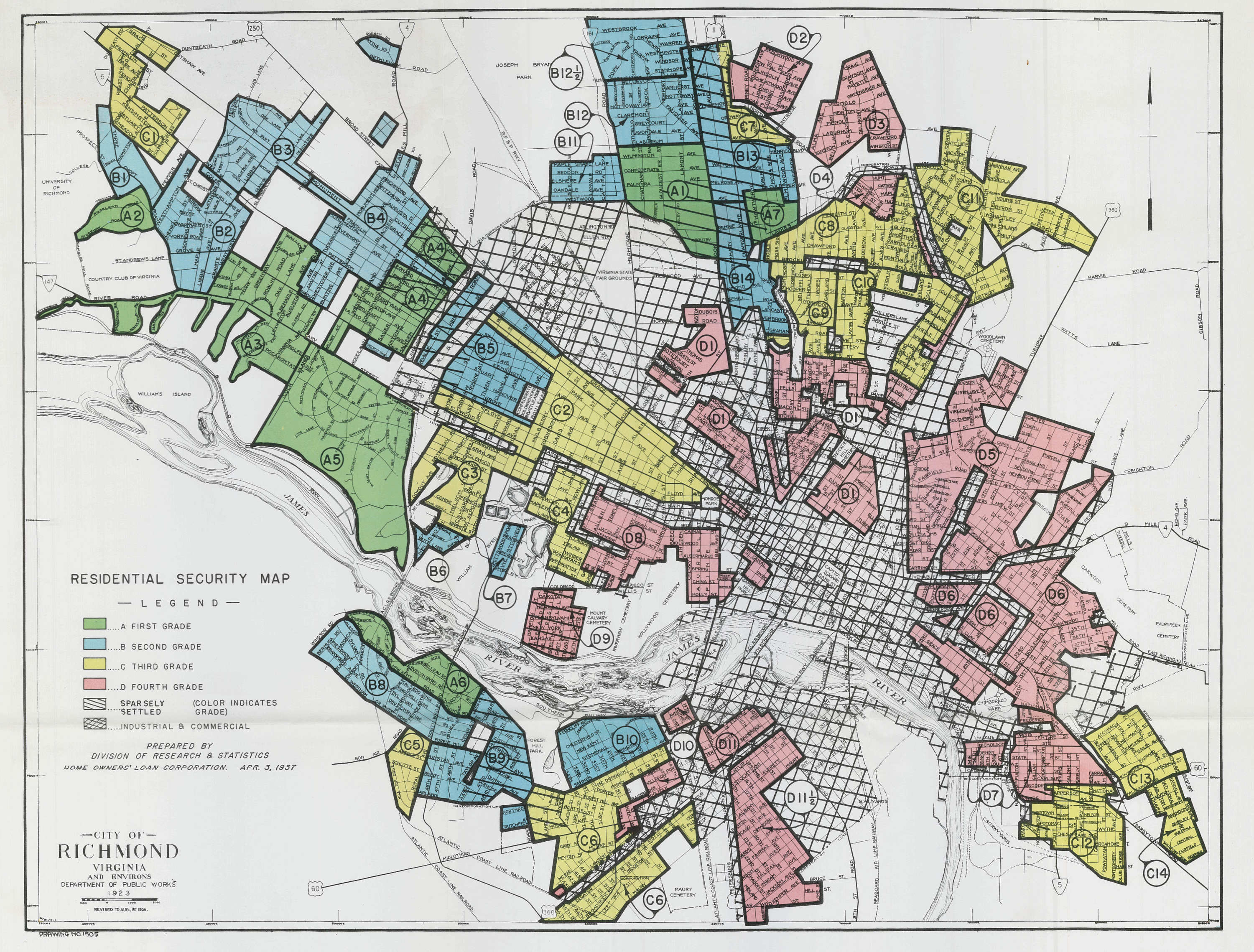
Although challenges in water and sanitation access are often assumed to be issues of low- and middle-income nations, more than 400,000 homes in the United States still lack access to complete indoor plumbing. Previous research has demonstrated that the remaining plumbing challenges are more prevalent in communities with high Black and Brown populations. This study hypothesizes that the 1930s practice of redlining by the Home Owners' Loan Corporation (HOLC), which systematically denied loans to minority populations, is linked to present-day inadequate plumbing access (i.e., defined as incomplete plumbing above the national average). Digitized HOLC maps for 202 urban areas across the country and U.S. Census data from the 2016 to 2020 American Community Survey were combined to interpolate the modern-day plumbing access for historical neighborhoods (n = 8871 communities). Analysis via binomial logistic regression demonstrated that nationally, redlined communities (HOLC Grade “D”) are significantly more likely to have a rate of incomplete plumbing above the national average compared with greenlined communities (HOLC Grade “A”) (0.1352; confidence interval = ±0.036). This finding was also observed for three of the nation's four census subregions (Northeast, Midwest, and West). Slight differences by region in relationships between the proportion of specific racial/ethnic populations on rates of incomplete plumbing demonstrate the need for targeted place-based interdisciplinary examinations of exclusionary practices. The demonstration of the present-day impacts of redlining after nearly 90 years emphasizes the need to intentionally mitigate past injustices to ensure modern-day equity.
Showing posts with label environmental justice. Show all posts
Showing posts with label environmental justice. Show all posts
Friday, August 25, 2023
Water access and historical redlining
Charles W. Sterling III recently published "Connections Between Present-Day Water Access and Historical Redlining" in Environmental Justice. The abstract:


Wednesday, January 25, 2023
Efficiency and equality in US environmental regulation
Kunal Parker recently reviewed Elizabeth Popp Berman, Thinking Like an Economist: How Efficiency Replaced Equality in U.S. Public Policy (Princeton UP, 2022). There's a lot here that's relevant to the history of environmental regulation. First, Parker's summary of Popp Berman's argument, with obvious implications for understanding historically some mainstays of environmental policy, such as cost-benefit-analysis and market tools for regulation:

The book explores the rise to prominence of an economic “style of reasoning” in U.S. policymaking in the post-World War II decades. Between 1950 and 1980, Popp Berman shows, this style pervaded realm after realm of policymaking, from social welfare programs to the regulation of markets to the management of the environment.
The chief institutionalizers of the economic style of reasoning were not neoliberals or libertarians (these would become truly prominent in government only after the election of Ronald Reagan in 1980). Instead, they were Democrat-appointed economists and the bureaucrats they worked with and influenced. Albeit not ideologically opposed either to social programs or to market intervention, these economists and bureaucrats insisted that social goals be met as efficiently as possible and that market solutions were generally preferable to interventionist ones. Wherever possible, they pushed cost-benefit analyses and reviews within administrative agencies, urged the dismantling of early-twentieth-century market controls, and sought to achieve ends by creating markets for entitlements rather than by imposing standards by fiat. In all this, they shared much with those further to their right.
By the time Ronald Reagan was elected president, the economic style introduced during the Kennedy and Johnson years had become thoroughly entrenched. Indeed, it had become the hegemonic approach to solving all manner of public problems, its ubiquity and self-evidence continually reinforcing each other. Reagan Republicans would employ the economic style, but the ground had been laid for them decades earlier by Democrats. Indeed, Popp Berman argues, Democrats proved far less strategic in using the economic style than Reaganites. Democrats privileged it as a method in context after context and allowed it to subsume their substantive ends. By contrast, Reaganites were more selective and often successfully subordinated it to their substantive ends.
Parker, though, queries whether equality was actually the guiding principle in the pre-efficiency era:
Sunday, September 18, 2022
Success on the commons
Last year Environmental History published a review by Frederica Bowcutt of Mexico’s Community Forest Enterprises: Success on the Commons and the Seeds of a Good Anthropocene, by David Barton Bray (U. Arizona Press, 2020). Some excerpts:
According to Bray, Garrett Hardin justified enclosure and centralized land management based on an ahistorical understanding; shared-pool commons have always been regulated by rules to prevent overuse. They are not, as Hardin suggested, a free for all. Ownership of land with valuable forest resources incentivizes rural Mexican communities to adopt, develop, and adhere to rules designed to prevent a tragedy of the commons. Results thus far indicate that community-based management of local forest resources “can be as effective as public protected areas in conserving forest cover and biodiversity, while also generating income for local communities” (p. 246).

Thursday, January 14, 2021
The origins of American environmentalism

In the second half of the nineteenth century... local municipalities were pressed to provide public health services or access to drinking water. The fight against pollution was one of the main issues of the urbanising nineteenth century, and this is the subject of the second chapter, which exposes different types of action to protect urban environments between 1870 and 1945. In particular, women, industrial workers and racial minorities began to claim environmental justice. As unions organised, and within the context of a wider social movement during this period, the working and lower classes managed to have their voices heard in order to improve their living conditions in an insalubrious urban environment. Often pressured by radicals, socialists and reformers, a number of communities took action to address local injustices. For example, between 1897 and 1904, under the directives of the radical Mayor Jones, Toledo, Ohio inaugurated a municipal service for garbage collection, as did Milwaukee, Wisconsin, which was led by a socialist-leaning mayor after 1898. It is particularly interesting that environmental activists also found themselves fighting for better industrial hygiene to protect the health of factory workers. It is in this milieu that the socialist John R. Commons, who established several health and safety measures in Milwaukee, participated in creating the American Association for Labor Legislation. His work, alongside that of Professor Alice Hamilton, resulted in a more protective regime for industrial hygiene in Chicago and in the whole of the State of Illinois. In this urbanising world, the desire for nature was not only a privilege of the upper classes, but the contemporary push for segregation was such that numerous conflicts emerged regarding the use of forests, beaches or the rural surroundings of cities for a day’s relaxation. In the middle of natural spaces, unions and local communities created educational camps that focused on learning about natural environments for urbanites otherwise confined to their city districts or to their factories. These different actions diffused a renewed sentiment of the need for nature which was well-rooted prior to the second World War, and Montrie highlights that this need was reinforced with the federal program for conservation during the New Deal.
Friday, August 31, 2018
Goodbye Abbey, hello intersectional environmentalism
Sarah Krakoff recently posted a critical take on Edward Abbey on Environmental Law Prof Blog. Some highlights:
Abbey’s love-letters to Utah’s red-rock country spawned generations of canyoneering backpackers, and still serve as the heart of aesthetic and political defenses of desert wilderness. Ever since, Abbey has been attacked and defended. Was he racist, misogynist, and anti-immigration? He was. His views of Black and Brown people were deplorable, and his descriptions of women were retrograde. And yet, his defenders inevitably retort, we need his irascible, cranky, and irrepressible voice today more than ever.
But do we? I have come to (re)bury Edward Abbey, not to praise him. (Abbey died in 1989 at the age of 62; he was buried illegally on public lands.) Or more accurately, to make a pitch for putting Abbey in his place and moving on. That place should be in the context of what it means to protect those same dramatic and soul-stirring landscapes without perpetuating an alienating version of what it means to be “truly wild,” or “truly radical,” or “truly environmentalist.” The problem with re-lionizing Abbey in 2018 is not just that he was sexist, racist, and xenophobic. But also that those views were sewn into his brand of so-called radicalism. They constituted the lenses through which he saw the landscape he aimed to protect.
What Abbey saw were beautiful empty places where white men (quite specifically) could be free and wild. Their version of wilderness preservation, even supplemented by the occasional nod to the evils of growth-dependent and extraction-based economies, was oblivious to the structures that enabled their seemingly unmediated encounters with the desert. Those structures included brutal and unscrupulous campaigns to dispossess Native people of most of southeast Utah. They included the failure of post-Civil War efforts to democratize homesteading by including eligible African Americans eager to flee the South. And they included, time and again, the cultural acceptability of exploiting women, both by treating them as fungible sex toys and by relying on them to mind the homestead and raise the young’uns. Abbey’s version of radical environmentalism assumes away all of the inequalities baked into his ability to be a free man in canyon country. Abbey also managed to alienate lots of white men while he was at it. He scorned ordinary work as part of his critique of corporate and industrial interests and romanticized manual labor even while he railed against ranchers and farmers in his midst.
Wednesday, December 6, 2017
Love Canal, CERCLA, and deregulation
This past summer H-Environment published a Roundtable Review of Richard Newman's Love Canal: A Toxic History from Colonial Times to the Present (OUP, 2016). An excerpt from Stephanie Malin's contribution:
While the Superfund Act [CERCLA] resulted from national awareness of Love Canal, and though Newman focuses on the success that legislation represents, we conclude with a troubling denouement. Love Canal is now Black Village Creek, filling up with a new round of working-class residents enticed by homes priced 10 – 20% below market value. Though former residents including Gibbs fought the relocation, they lost this battle. Developers won. The results have been tragic; as Newman recounts, health problems and toxic exposures have reemerged in this ‘remediated’ community, despite the extensive, state-of-the-art environmental engineering schemes used to filter leachate and otherwise remediate the site.

Newman’s Love Canal succeeds in highlighting for readers an exceptionally timely notion: before the institutionalization of the U.S. Environmental Protection Agency’s Superfund Program, the American landscape was riddled with unregulated, unmonitored, and often unknown chemical and industrial dumps from America’s dizzying participation in the Industrial Revolution. Communities like Love Canal that dealt with these historical mistakes, Newman shows, contended with rampant pollution, contested and rare health outcomes, and instances of deep disempowerment. Newman showcases for his readers the immense risks and voluminous unintended consequences that emerge when environmental regulations are absent and when the precautionary principle is eschewed in favor of industrial economic development, in one era after another. His historical details, and his careful examination of the numerous barriers faced by Love Canal activists, display that regulatory programs that protect public and environmental health are relatively new, have been hard won, and are constantly vulnerable to eradication. Indeed, these are the very programs that have most swiftly come under attack under the Trump Administration – which makes Newmans’s message so relevant and timely.
Sunday, July 23, 2017
Environmental racism, American exceptionalism, and Cold War human rights
 |
| OAS headquarters in Washington |
Environmental justice scholars and activists coined the terms “environmental racism” to describe the disproportionate concentration of environmental hazards in neighborhoods populated by racial and ethnic minorities. Having exhausted domestic legal remedies (or having concluded that these remedies are unavailable), communities of color in the United States are increasingly turning to international human rights law and institutions to challenge environmental racism.
However, the United States has ratified only a handful of human rights treaties, and has limited the domestic application of these treaties through reservations and declarations that preclude judicial enforcement in the absence of implementing legislation. Indeed, the U.S. has generally resisted scrutiny of its human rights record by domestic or international institutions on the basis of “American exceptionalism” -- the belief that the U.S. is unique in its commitment to freedom and equality and provides more robust protection of human rights than international law. What historical events triggered this resistance to international human rights law? What are the implications for human rights-based approaches to environmental protection?
This article explains how the struggle for racial justice in the United States at the height of the Cold War shaped U.S. attitudes to international human rights law. Using Mossville Environmental Action Now v. United States as a case study (currently pending before the Inter-American Commission on Human Rights), the article argues that international human rights law is far superior to U.S. domestic law as a means of addressing environmental injustice. However, its utility is constrained by legal doctrines developed over time but reinforced during the Cold War that restrict the enforcement of international human rights law in U.S. courts. Nevertheless, a victory for the Mossville petitioners would be immensely useful as part of a larger strategy to name and shame the United States, to bridge the gap between international law and domestic law, and to educate government officials and the public at large about the relationship between environmental protection and human rights.
Sunday, April 23, 2017
Offshoring environmental law
The latest issue of Environmental History just arrived, leading with an environmental-legal history article, M.X. Mitchell's "Offshoring American Environmental Law: Land, Culture, and Marshall Islanders’ Struggles for Self-Determination During the 1970s". The abstract:
This article explores the impact of environmental law in US-controlled Micronesia. Historians have suggested that US environmental legislation and legal activism during the 1960s and 1970s often overlooked issues of environmental racism and injustice. This article establishes the importance of these emerging environmental laws for Marshall Islanders living under American rule and subjected to the harms of nuclear weapons testing. In 1972 the displaced people of Enewetak Atoll—a former nuclear test site—sued the United States hoping to stop a new program of conventional weapons testing on their badly contaminated ancestral atoll. The capacious concept of the environment used in the National Environmental Policy Act of 1969 and the statute’s ambiguous territorial reach offered islanders important new opportunities to articulate their environmental values and to further their struggles for self-determination over ancestral lands and waters. This article argues that environmental law transcended the artificial territorial boundaries between the United States and its Pacific dependencies, opening up an important new venue of negotiation and conflict over the scope and environmental footprint of US offshore power.
Test of hydrogen bomb at Enewetak, 1952

Tuesday, December 20, 2016
Treaty rights, fish harvesting, and toxic risk
 |
| Symbolic Petition of Chippewa Chiefs, presented at Washington, January 28, 1849, headed by Oshcabawis of Monomonecau, Wisconsin |
Ojibwe Gichigami (“Ojibwa’s Great Sea”) is the spirit name for Lake Superior; it is also the homeland of the Keweenaw Bay Indian Community (KBIC) where Gichigami fishing has sustained the people for nearly a millennia. As signatories to the 1842 Treaty With The Chippewa, the KBIC retain rights for hunting, fishing, and gathering, and worship within ten-million acres of ceded land and water territory. However, due to elevated levels of toxics such as methyl-mercury and polychlorinated-biphenyls (PCBs), Lake Superior is currently under numerous fish consumption advisories that inform the public of harmful contamination levels. Thus, harvesting provides socio-cultural and spiritual wellbeing for the KBIC, and simultaneously, places their physical health at great risk. By using ethnographic methods and oral histories, this article illustrates how an intersecting history of KBIC treaty rights, tribal fish harvesting, and toxic risk is the center of their water story. Over the course of several decades, they have encountered dire consequences due to federal assimilation policies, state regulatory control over their harvesting, and environmental degradation and contamination. KBIC present-day perspectives of toxic risk are rooted in this history. In 1971, the Michigan Supreme Court presented a landmark decision: the People v. Jondreau reaffirmed 1842 treaty rights for the KBIC. This precedential decision was followed by Great Lakes states issuing the nation’s first fish advisories. The KBIC historical context is imperative to understanding present day environmental policy and its relevance (or irrelevance) for those most at-risk, emphasizing how social injustices are manifested through a people’s water history.
Sunday, March 20, 2016
Toxic injustice
The recent Environmental History has a review by David Stradling of Susan Rankin Bohme's Toxic Injustice: A Transnational History of Exposure and Struggle (UC Press, 2014). Stradling writes:
Environmental historians will be especially interested in the first two chapters, in which Bohme describes the development of the nematode problem and the chemical companies’ marketing of DBCP. Bohme describes, in great detail, how Dow and Shell manipulated the regulatory process that developed warning labels and guidelines for use but ultimately “projected a false image of DBCP’s safety”. What’s worse, most of the science came from laboratory tests on animals, which clearly indicated problems regarding sterility, but Shell decided to make health claims based on incomplete worker health data instead. The early chapters also describe well the transnational banana and chemical markets, and the limits of US regulation, which sought to protect American consumers but failed to protect foreign workers, even from threats that came from inside the United States.

These workers, the afectados who suffered health consequences and sought justice in court, are at the heart of the book. Bohme has employed the rich detail of legal documents generated by workers who sued in Texas courts for compensation for sterility caused by DBCP exposure on banana plantations in Costa Rica and Nicaragua. Exploited in the fields, these workers were not well served by the courts, suffering from translation problems, in which workers were doubly disadvantaged, as English was translated to Spanish and legalese was translated into layperson’s terms. The workers also suffered from location problems, as they sought justice in American courts, largely because they (and their lawyers) could expect a larger settlement in the United States.
While this is a truly transnational story, involving major corporations and court systems from several nations, as well as the international movement of goods and money, Bohme concludes that the outcome confirms the continuing importance of the state in our neoliberal age. The state remains the essential site of regulation and the arbitration of justice. The other arguments of the book are well anticipated: inequalities of power and knowledge left workers exposed. They were clearly exploited by their employers and by the companies that produced and sold chemicals that they knew to be health hazards. And later, after the lawsuits began to accumulate, the US judicial system seemed more concerned with protecting American corporations than in finding justice for those who were harmed. After a very long process many workers won modest settlements, but Bohme concludes, “The same deep and broad inequalities that shaped the contours of DBCP exposure also limited afectados’ success in holding corporations accountable”.
Tuesday, November 17, 2015
A pollution market in history

I recently came across a 2014 dissertation by Krystal Tribbett, "RECLAIMing Air, Redefining Democracy: A History of the Regional Clean Air Incentives Market, Environmental Justice, and Risk, 1960 -- present". The abstract:
Depending on whom you ask, the Regional Clean Air Incentive Market (RECLAIM), the nation's first regional smog market, is either a revolutionary approach to cleaning the air of the South Coast Air Basin, the most polluted region in the country, or a failed social experiment that put the interests of business and the marketplace above public health. In its original iteration, RECLAIM rules were intended to produce emissions reductions consistent with the command-and-control approach to compliance embodied in an Air Quality Management Plan, but with greater efficiency, effectiveness, and flexibility—a goal RECLAIM in large part met. In an ideal application of emissions trading, public welfare and economic growth should have been jointly protected, and previous studies of RECLAIM have focused on the normative implications of the program, condemning suspected environmental injustices or praising economic efficiency without exploring the significant historical roots of market-based solutions. A closer look at these historical roots reveals the ways in which RECLAIM actually succeeded in improving air quality through difficult compromises and negotiations by regulators, environmental activists, politicians, and businesses.
This dissertation recounts this fuller history. It is about the history of market-based mechanisms to control air pollution in Southern California, and, in a broader sense, the history of neoliberalism and the process of neoliberalising nature. It traces the history of American air pollution laws from the 1960s to the present and finds a symbiotic relationship between federal and state governing bodies that led to the establishment of RECLAIM. The history told here shows that the development of RECLAIM was not wholly neoliberal, imposed intentionally by policymakers, venture capitalists, or academics with a neoliberal agenda. What emerged out of the archives and newspapers was a story of the organic evolution of markets to address air pollution that was shaped both by political processes and academic/theoretical arguments intended to find a compromise between public demands for clean air, political concern about economic growth, and industry pushback against regulation. This dissertation thus argues that in the United States neoliberal policies to govern nature are outcomes of struggles to balance societal values (like clean air) with political, economic, and scientific realities.
Friday, November 13, 2015
Race and pollution
Brittany Fremion recently reviewed Ellen Griffith Spears, Baptized in PCBs: Race, Pollution, and Justice in an All-American Town (UNC Press, 2014) for H-Environment. From the review:
Even though scholars and activists did not begin identifying environmental racism until the 1980s, Spears reveals how the unequal allocation of environmental hazards extends across space and time. In the first four chapters, Spears explains how Anniston became a model city of the New South and home to the chemical industry, which developed close ties to the US military during the two world wars. In doing so, she unpacks the problematic relationship between the former by explaining how a lack of regulatory oversight led to the tragic contamination of human bodies and ecosystems. As the Cold War escalated, so too did the military’s involvement with chemical development and production, which found a new home at Anniston’s Fort McClellan in the 1960s, “the free world’s largest training center for chemical, biological, and radiological warfare” (p. 94). By placing the modern environmental justice movement within this historical context, Spears is able to show the ways in which privileged toxic knowledge developed among corporations and created hazardous landscapes in Anniston that reflected the legacy of social and environmental disparities in the United States.
*****

But Anniston’s residents were not passive victims. In chapter 5, Spears explores the tradition of nonviolent protest in the city to demonstrate that residents owed much to the civil rights movement, which shaped contemporary environmental justice campaigns by linking social justice to environmental issues. Prior to the campaign to hold Monsanto accountable for PCB contamination and the initiative for safe disposal of chemical weapons, Anniston attracted national attention with the burning of the Freedom Riders bus on Mother’s Day in 1961. White and black residents were versed in the language and experience of protest—be it in support of equality or not. Thus the Anniston campaigns also revealed important challenges created by racial and class differences: white middle-class and professional people dominated the anti-incinerator fight whereas the African American community spearheaded the PCB initiative, largely as a result of residential geography. When activists in both efforts joined forces, they did so uneasily. For instance, Spears reveals that the Monsanto campaign linked whites whose relatives and friends had been mid-century instigators of racial violence with residents of color who had sometimes been the targets of that violence. Despite these conflicts, legal victory over Monsanto and the emergence of a national campaign that forced the army to both provide residents with protective equipment and operate with greater transparency revealed the the power of grassroots activism.
In the remaining chapters, Spears explores the rise of PCB as the world’s most notorious chemical and the factors that drove chemical policy reform in the early 1970s, most important, the passage of the Toxic Substances Control Act, which led to the end of PCB production. But as Spears reveals, the aftermath of those reform efforts bred citizen action. In Anniston, Monsanto began burying its chemical wastes and the army announced plans to build a hazardous waste incinerator to dismantle outdated Cold War-era chemical weapons at the Anniston Army Depot. In the late 1980s people locally began to question those practices. Thus, a grassroots, cross-class, and ultimately biracial and bipartisan movement emerged to challenge environmental injustice—activists used coffins to block Monsanto’s bulldozers, staged die-ins, filed lawsuits, and donned hazmat suits at rallies. In her final chapter and epilogue, Spears offers an assessment of their achievements.
Friday, May 29, 2015
Desegregation of national parks
Another article from Environmental History's virtual issue on environmental justice (other were noted here and here), Terence Young's "'A Contradiction in Democratic Government’: W. J. Trent, Jr., and the Struggle to Desegregate National Park Campgrounds", brings together environmental history and the history of desegregation, at the same time reminding us that desegregation in various contexts took place by administrative action before Brown v. Board of Education. The abstract:
Camping began in the nineteenth century as an elite form of pilgrimage to the wild, but the arrival of inexpensive automobiles in the early twentieth century greatly expanded camping's social diversity. The change was not universally embraced, especially when African Americans were involved, and the issue came to a head during the 1930s after two racially segregated national parks were opened in southern states. As complaints flowed in, William J. Trent, Jr., became adviser for Negro affairs to Interior Secretary Harold L. Ickes. He had no special interest in the outdoors or national parks, but Trent championed increased African American access to the parks and an end to discrimination in them. NPS leadership resisted Trent's efforts until Secretary Ickes ordered them to create one nonsegregated demonstration area in Shenandoah National Park in 1939. The policy was extended to other areas in 1941 and the next year, with World War II shifting into high gear, campground and other forms of segregation were ended throughout the park system.
 |
| Shenandoah National Park (National Park Service) |
Thursday, May 21, 2015
From NIMBY to civil rights
A couple of weeks ago we posted on the first article in Environmental History's virtual issue on environmental justice. The second is Eileen Maura McGurty's 1997 "From NIMBY to Civil Rights: The Origins of the Environmental Justice Movement". The article begins:
The article goes on to discuss the Warren County protests and the foundation of the environmental justice movement.
In the summer of 1978, Robert Burns and his two sons drove liquid tanker trucks along rural roads in thirteen North Carolina counties and through remote sections of the Fort Bragg Military Reservation. Driving at night to avoid detection, they opened the bottom valve of the tanker and discharged liquid contaminated with polychlorinated biphenyls (PCBs) removed from the Ward Transformer Company in Raleigh onto the soil along the road shoulders. This violation of the Toxic Substance Control Act (TSCA) continued for nearly two weeks until 240 miles of road shoulders were contaminated. Robert Ward had hired the Burnses to illegally dispose of the contaminated liquid in an attempt to avoid the escalating cost of disposal that was due, in part, to increasing regulation of hazardous waste. Since the contamination occurred on state-owned property, North Carolina was responsible for remediation. Within a few months after detecting the contamination, the state devised a plan calling for the construction of a landfill in Warren County, a rural area in northeastern North Carolina with a majority of poor, African-American residents. Warren County also suffered the most contamination of any of the thirteen counties effected by the illegal disposal. A farmer in the small community of Afton, facing a foreclosure and bankruptcy, sold his property to the state for use as a final resting place for the contaminated soil.
Saturday, May 16, 2015
Post-industrial agriculture
Patrick O'Donnell has posted an updated version of his bibliography, "The Sullied Science & Political Economy of Post-Industrial Agriculture (Or: ‘Toward Agroecology & Food Justice’)".


Wednesday, May 6, 2015
Melosi on environmental justice
Environmental History recently posted a "virtual issue" on "Race, Justice, and Civil Rights", in which they republish some previously published pieces from the journal. First up is Martin Melosi's "Equity, Eco-racism and Environmental History", originally published in 1995. Melosi surveys the then-young environmental justice movement in the US, its points of departure from the mainline environmental movement, and its implications for the writing of environmental history. Melosi writes:
 Melosi goes on:
Aside from the intrinsic importance of race as an issue for further inquiry, the current public debate over questions of environmental equity, environmental justice, and eco-racism are changing the focus of the environmental discourse in the United States and in other parts of the world. Just as the environmental movement of the 1960s and 1970s helped to shape the burgeoning field of environmental history, the current public dialogue over equity and environmental justice ultimately may have a similar impact.It's interesting to thing about to what extent that has indeed happened, and also how different American environmental history writing is from American legal history writing in this respect.
The Environmental Justice Movement, because of its controversial stances on race, class, and the environment, and its skepticism about the goals and objectives of mainstream environmentalism, is playing a historic role in reintroducing "equity" into the public and academic debate over environmental policy. Equity, however, has been transformed into "environmental justice," with a particular focus on the traditional American underside caught beneath the wheels of an avaricious economy. From the historian's vantage point, this is but one aspect of a larger issue-an issue already addressed broadly by philosophers, as well as by social scientists-especially sociologists and economists-concerned mainly with distributional effects.
Wednesday, January 7, 2015
Worster on the Wilderness Act
The last year has seen a lot of reflection of the US Wilderness Act of 1964, including a symposium, a special issue of Environmental Law, a website, and books. The October issue of Environmental History includes several pieces on the Act as part of its Reflections and Gallery sections. First is environmental historian Donald Worster's "The Higher Altruism", which moves from history to thoughts on ecocentrism and environmental justice:
Further on:
Only the human species could mourn another creature’s extinction or work to protect earth’s ecosystems. It is our unique contribution to conservation. The conservation of energy and matter for the sake of survival are common behaviors throughout the plant and animal kingdoms, but not the conservation of otherness, of wholeness and balance, of endangered communities of life. Those require the evolution of what we might call the higher altruism, an intentional selflessness that may have an element of self-interest but expands to find moral purpose in the act of preservation. Aldo Leopold called it a “land ethic,” but we can also call it a more thoughtful and ambitious preservation of diversity, ecological integrity, and wildness on the planet.
America reached a high point of ecological altruism in 1964 with the passage of the Wilderness Act. Like most moral visions, this one was layered over with vestigial language from the past: wilderness as a “resource,” wilderness as a place to “use and enjoy,” wilderness as an opportunity for “solitude or a primitive and unconfined type of recreation.” Those well-worn justifications were the result of more than sixty revisions needed to gain the approval of two houses of Congress, as well as various conservationist groups, who often were still thinking in anthropocentric and utilitarian terms. But unmistakably the act changed the focus of conservation, away from human needs and material demands to the needs of the other than human world.
 |
| Signs in Kalmiopsis Wilderness (Rene Casteran, wilderness.net, reproduced on front cover of Environmental History) |
The moral cause of preservation remained politically strong until the presidency of Ronald Reagan, who led a backlash that tried to brand preservation as a kind of selfishness that would prevent the majority of Americans from improving their standard of living. True, Reagan signed bills adding nearly 11 million acres of protected wilderness. At the same time, however, he appointed to office people who worked relentlessly to open all public lands to oil, gas, and coal development, to tree cutting, mineral extraction, road building, and motorized recreation, who were determined to block the change in moral perspective that wild lands preservation signified. The subsequent rise of neoconservatism in American society has tended to accept conservation for narrow economic purposes while rejecting conservation for more altruistic ends. The Reagan legacy has often forced preservationists to reemphasize more human-centered goals (e.g., wilderness protection for its tourist potential) and to pursue their more radical goals on private instead of public lands.
More surprisingly, the moral vision of the preservation movement, its commitment to saving and freeing the earth’s community of life, has recently come under fire by critics on the left, who make strange bedfellows with the neoconservatives. Preservationists, we are now told by a growing number in the “save the humans” party, lack a sense of social justice. They want to protect nature from exploitation not only by capitalist ranchers, oil companies, and real estate developers but also by those who are relatively weaker in terms of power or money, whether they are American Indians or peasant farmers in Africa. Anyone who pursues a preservationist vision stands accused of indifference toward the economic needs of the world’s poor. Protecting wilderness and wildlife has become, by this reasoning, an act of aggression against vulnerable people who want and need to exploit the oil, wood, or game that nature offers. To exclude people from any part of the natural world, it is argued, is to deny those people’s rights and to collude in their mistreatment.
Friday, December 5, 2014
Environmental justice in India
Environmental Justice recently published Ravi Rajan's "A History of Environmental Justice in India". The abstract:
Indian environmentalism has, for the most part, been about social justice. During the 1970s and 1980s, it was concerned with differential access to natural assets and ecosystem services. The Bhopal Gas Disaster of 1984 raised new issues, pertaining to industrial risk and safety. This article traces the history of environmental justice from the 1970s onward. It describes the perspective of Indira Gandhi, India's Prime Minister from 1967 to 1984, and her attempts at reconciling the environment with development and economic justice; discusses the emergence of a red-green environmentalism during the 1980s and 90s; and explores Bhopal and its implications; before addressing the issues that are front and center today, in the early twenty-first century.The article has some trenchant quotes from Indira Gandhi's speech, "Man and Environment", at the United Nations Conference on Human Environment at Stockholm in 1972. Here's one:
Rajan writes:The extreme forms in which questions of population or environmental pollution are posed, obscure the total view of political, economic and social situations…It is an over-simplification to blame all the world's problems on increasing population. Countries with but a small fraction of the world population consume the bulk of the world's production of minerals, fossil fuels and so on. Thus we see that when it comes to the depletion of natural resources and environmental pollution, the increase of one inhabitant in an affluent country, at his level of living, is equivalent to an increase of many Asian, Africans or Latin Americans at their current material levels of living…All the “isms” of the modern age—even those which in theory disown the private profit principle—assume that man's cardinal interest is acquisition. The profit motive, individual or collectives, seems to overshadow all else. This overriding concern with self and today is the basic cause of the ecological crisis.
Indira Gandhi's Stockholm speech was not just a one-off rhetorical flourish in an international forum. It also came to signify the codification of India's approach to development in the second half of the twentieth century. The essence of this approach was that India would strive to harness its natural resources, and invest in modern technology to raise the quality of economic life of the average person. At the same time, efforts would also be made to conserve the environment and preserve its vital forces. Indira Gandhi recognized that there were many shades of gray, and that this grand strategy was easier to talk about rhetorically than implement in practice. For example, she grappled with the consequences of development upon India's tribal peoples and their cultures, only to reconcile the inevitability of development. Again, despite her vehement critique of Western population control advocates, she ended up presiding over an extremely coercive, government-sponsored, forced sterilization program. She lamented the increasing monocultures that resulted with the pursuit of industrial forestry by the government's own forest department but appeared frustrated that her own government did not heed her concerns. In many speeches she repeated the argument in Stockholm that Western industrialism was not a paradigm for countries like India; and articulated the need for balance and alternatives, including, for example, appropriate technology and renewable energy. Yet, she offered no concrete alternatives or pathways for environmental governance.
Friday, October 3, 2014
Early environmental justice
Legal Planet's Jonathan Zasloff recently noted the publication of Josiah Rector's "Environmental Justice at Work: The UAW, the War on Cancer, and the Right to Equal Protection from Toxic Hazards in Postwar America" in the Journal of American History. The article greatly enriches our knowledge of the history of the environmental justice movement; indeed, of the history of environmental law as a whole. Rector writes:
Despite the amplitude of the literature, occupational health historians have devoted surprisingly little attention to the relationship between health and safety activism and the post–World War II civil rights and feminist movements, or the role of health and safety activism in the rise of the environmental justice movement.
Rector's article focuses on occupational cancer in American auto plants as a case study. I hope we'll continue to see more work by him and others (see for example recent articles by Gregory Alexander and Stefania Barca) on working class environmentalism and environmental law.Meanwhile, the nascent historiography of the environmental justice movement, largely written by social scientists, has tended to ignore labor's contributions, with the important exception of the United Farm Workers 1968–1971 campaigns against pesticide exposure. Most books about environmental justice, including many brilliant and formidable works of scholarship, present a brief, potted history of the movement, beginning with the struggle over polychlorinated biphenyl (PCB) dumping in Warren County, North Carolina, in 1982. Scholars of the topic have neglected the fact that as early as 1970 occupational health and safety activists used the term environmental justice to refer to the right to protection from toxic hazards codified by the Occupational Safety and Health Act (OSH Act) and the National Environmental Policy Act (NEPA). Few scholars, moreover, have noted that the UAW's 1976 Working for Environmental and Economic Justice and Jobs National Action Conference in Black Lake, Michigan, helped popularize environmental justice. This elision is ironic, since the disproportionate exposure of workers and people of color to toxic hazards was a major theme of the conference—one of the first to gather civil rights, feminist, labor, and environmental activists for sustained dialogue.
Ford's River Rouge Plant (1931)


Sunday, March 30, 2014
A transnational history of asbestos
Perhaps the most litigated environmental issue in US history is harm from asbestos. In the latest issue of Environmental Justice James Rice's "Asbestos and the Globalization of an Occupational and Environmental Hazard, 1960–2011" takes a global view of the subject. The abstract:
 |
| Anthophyllite asbestos, Georgia (USGS) |
Asbestos is a natural mineral with observable, repeatable effects that have long been observed and repeated. Despite experiential and scientific evidence illustrating its deleterious impact on human health the worldwide production and consumption of asbestos remains substantial. The objective of the present study is to highlight the global decline and resurgence of asbestos over the period 1960–2011. This history is characterized by the predominance of asbestos in the industrialized countries until 1970, decline thereafter, but the precipitous increase of asbestos consumption in the developing countries, particularly the industrializing middle-income nations. In turn, global asbestos consumption in 2011 approximates that observed in 1960; notwithstanding voluminous evidence illustrating it is associated with asbestosis, lung cancer, and mesothelioma. Further, I highlight the rhetoric of denial consistently employed by the industry to generate uncertainty and sustain the demand for asbestos. The conclusion reiterates the need for environmental justice scholars and activists to consider the transnational movement, or risk transference, of recognized occupational and environmental hazards.I would add that there is room for comparative legal research here, as well: Why has tort law put asbestos companies out of business in the US, but apparently allowed them to flourish in other countries?
Subscribe to:
Posts (Atom)