Showing posts with label sewage. Show all posts

Sunday, April 8, 2018

Baltimore's sewers

Yesterday's This Day in Water History had the following (apparently originally from here):
Baltimore was one of the last major cities on the east coast to construct a proper sewer system. The City’s inability to install sanitary sewers until 1915 tarnished the appeal of what was otherwise a successful city. Several commissions throughout the nineteenth century formulated plans for a sewer system for Baltimore, but were unsuccessful because of economic conditions and fighting between political parties.
Lacking a sewer system, Baltimore relied primarily on privy vaults (cesspools) for waste disposal until the early twentieth century. Privy vaults are holes dug 3 to 75 feet deep, though most were quite shallow. Baltimore’s sandy soil was ideal for privy vaults, making the method the most economically viable form of waste disposal. It was estimated that in 1880, with a population of 350,000, over 80 thousand privy vaults were in use in the City.
The Great Fire of 1904 proved to be the final factor in the construction of a sewer system in Baltimore. A new spirit among the residents arose from the ashes of Baltimore and there was a drive to rebuild and improve the city. On April 7, 1904, the Sewage Enabling Act passed in the Maryland legislature. It provided ten million dollars for a new sewer system in Baltimore. Construction began in 1907 and the sewage treatment plant was operational in 1915. Public health improved, as did the image of the City. Today, the Back River and Patapsco wastewater treatment plants serve 1.6 million people and treat up to 250 million gallons of sewage per day.

Sunday, February 11, 2018

Digital library II: A Treatise on the Law Relating to the Pollution & Obstruction of Watercourses (1877)

Following up last week's post on Michael Lobban's piece on the British Rivers Pollution Prevention Act, 1876, the second work to be added to our digital library of historical environmental law is Clement Higgins's A Treatise on the Law Relating to the Pollution & Obstruction of Watercourses, published in London by Stevens and Haynes in 1877 (a year after enactment of the water pollution legislation). (An 1882 advertisement for the work is here.)

Just as the treatise on game law covered here last week emphasized the inherent conflict of interest between different social groups and the distributive effects of the law, Higgins writes in the Preface:
It is to the interest of the public, and to the majority of riparian proprietors, to protect the purity of our rivers, whereas it is generally to the convenience of sanitary authorities and of manufacturers to pollute them.
An attempt is made in this book to place before the protectors of our rivers the nature of their rights and how they may best be protected, and before the polluters of our rivers the extent of their liabilities and how they may best be met.
The author was apparently not only a barrister but also a scientist, "formerly Demonstrator of Chemistry at King's College, London".

The treatise is divided into two parts: Part I covers the 1876 statute, organized around different types of pollution: solid matter, sewage, manufacturing effluents, and so on. Part II, entitled "Riparian Rights and Their Protection", covers the common law of water rights with an emphasis on issues of pollution.

A long appendix reproduces statutory provisions on the subject, a useful resources for any historian wanting to understand the environmental regulation of the time, anchored in laws that we might not recognize as "environmental" today, such as the Metropolis Management Act, 1855.

Monday, January 18, 2016

Oliver Wendell Holmes and water pollution

Yesterday's edition of This Day in Water History notes the anniversary of a historic interstate lawsuit over water pollution, Missouri v Illinois (1906). See my own take after the jump.
January 17, 1900: Fifteen days after Chicago opened the Sanitary and Ship Canal and reversed the course of the Chicago River to discharge sewage into the Mississippi River, Missouri sued Illinois, “…praying for an injunction against the defendants from draining into Mississippi River the sewage and drainage of said sanitary district by way of the Chicago drainage canal and the channels of Desplaines and Illinois river.”
The Bill of Complaint alleged in part:
“That if such plan is carried out it will cause such sewage matter to flow into Mississippi River past the homes and waterworks systems of the inhabitants of the complainant…
That the amount of such undefecated [huh?] sewage matter would be about 1,500 tons daily, and that it will poison the waters of the Mississippi and render them unfit for domestic use, amounting to a direct and continuing nuisance that will endanger the health and lives and irreparably injure the business interests of inhabitants of the complainant…
That the water of the canal had destroyed the value of the water of the Mississippi for drinking and domestic purposes, and had caused much sickness to persons living along the banks of said river in the State of Missouri.”
The opinion in the case was written by Supreme Court Justice, Oliver Wendell Holmes and read in part:
“The data upon which an increase in the deaths from typhoid fever in St. Louis is alleged are disputed. The elimination of other causes is denied. The experts differ as to the time and distance within which a stream would purify itself. No case of an epidemic caused by infection at so remote a source is brought forward and the cases which are produced are controverted. The plaintiff obviously must be cautious upon this point, for if this suit should succeed many others would follow, and it not improbably would find itself a defendant to a bill by one or more of the States lower down upon the Mississippi. The distance which the sewage has to travel (357 miles) is not open to debate, but the time of transit to he inferred from experiments with floats is estimated at varying from eight to eighteen and a half days, with forty-eight hours more from intake to distribution, and when corrected by observations of bacteria is greatly prolonged by the defendants. The experiments of the defendants’ experts lead them to the opinion that a typhoid bacillus could not survive the journey, while those on the other side maintain that it might live and keep its power for twenty-five days or more, and arrive at St. Louis. Upon the question at issue, whether the new discharge from Chicago hurts St. Louis, there is a categorical contradiction between the experts on the two sides.”
Commentary: In effect, Justice Holmes ruled in favor of Chicago. The experts for St. Louis had failed to prove their case.
Reference: Leighton, Marshall O. 1907. “Pollution of Illinois and Mississippi Rivers by Chicago Sewage: A Digest of the Testimony Taken in the Case of the State of Missouri v. the State of Illinois and the Sanitary District of Chicago.” U.S. Geological Survey, Water Supply and Irrigation Paper No. 194, Series L, Quality of Water, 20, Department of the Interior, Washington, D.C.: U.S. Government Printing Office.

Monday, July 14, 2014

Revisionist English nuisance law history: Part 2

[by Ben Pontin]

As explained in Part One, interpretations of English nuisance law’s contribution to environmental protection during the industrial revolution are changing. That is to say, increasing attention is being given to those instances where victims of industrial nuisance obtained remedies from the courts. Previously, emphasis had been placed on the doctrinal (notably in Joel Brenner’s account) and institutional limitations (in John McLaren’s) of victims of industrial nuisance obtaining a remedy. One of the turning points has been the close study of Adderley’s action against Birmingham Corporation in 1858 (the ‘Great Birmingham Sewage Case’), discussed in my book Nuisance Law and Environmental Protection.

In order to make sense of Adderley’s (and nuisance law’s) achievements – and why they do not fit within the traditional account of nuisance law failure – it is necessary to embrace a level of complexity in the social and economic backdrop of nineteenth century nuisance law that is lacking in the earliest leading studies of this subject. Thus, whereas Victorian Britain in Brenner’s account is characterised as dominated by urban and manufacturing interests in the face of which the courts daren’t say ‘no’ (McLaren is more nuanced), Adderley’s case suggests a power structure far more sympathetic to the plaintiff than hitherto contemplated by historians in this field. A power structure, that is, in which the landed aristocracy spun a persuasive enough (at the time) narrative of noble, honourable and authoritative resistance to the materialist excesses of industrialisation.

Sunday, July 13, 2014

Revisionist English nuisance law history: Part 1

[The first in a series of posts by Ben Pontin:]

English nuisance law is a tort to land that has attracted considerable – some would say disproportionate - interest within circles of environmental law history. In Coventry v Lawrence [2014] UKSC 13 (at [176]), Lord Carnwath commented on part of my contribution to the field as follows:
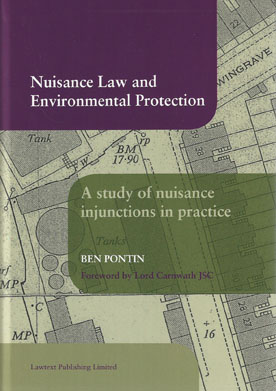
Ben Pontin in his valuable recent book Nuisance Law and Environmental Protection (2013) shows how since the middle of the 19th Century common law nuisance has played an important complementary role to regulatory controls, on the one hand stimulating industry to find better technical solutions to environmental problems, and, on the other, stimulating the legislature to fill gaps in the regulatory system. He sees the present appeal as an important opportunity for the Supreme Court to review the proper role of this part of the law of nuisance in the modern world. (p 184)
Coventry concerned the relationship between nuisance law and regulation, which is a topic that has been central to nuisance law history since the pioneering studies of Joel Brenner and John McLaren in the 1970s and 80s.

Brenner and McLaren argue in different ways to the conclusion that effective legal remedies for revolutionary pollution awaited statutory regulation later in the nineteenth century. Prior reliance on nuisance law, as it had evolved since antiquity, substantially (so the argument goes) failed to remedy industrialisation’s legendary ‘monster nuisances’. The explanation for nuisance law’s weakness provided by Brenner lies with courts moving away from ‘pre-industrial’ strict liability to favour the ‘wealth generating polluter’ in their disputes with neighbours seeking to protect their property and its amenity (Brenner, ‘Nuisance Law and the Industrial Revolution’ (1974) Journal of Legal Studies 403). McLaren’s explanation differs in its focus on litigation costs and similar ‘institutional’ limits of nuisance law in the face of the vast scale of industrial pollution (McLaren, ‘Nuisance Law and the Industrial Revolution – Some Lessons from Social History’ (1983) Oxford Journal of Legal Studies 155).

The Chancery Court claim in
AG v Birmingham
By contrast, my book offers a revised portrayal of nuisance law, as a success. It does so with reference to a small selection of in-depth case studies of specific instances of industrial nuisance litigation, beginning with Attorney General v Birmingham Corporation (1858) 4 K & J 528. Contextual records relating to the litigation underpinning this case reveal some intriguing events, and ultimately a remarkable practical achievement. Over the course of forty years of litigation, affecting hundreds of thousands of people, involving tens of millions of pounds of investment (on today’s currency calculation), the enjoined municipal defendant invented and adopted a sewage purification technology that satisfied the plaintiff (Sir Charles Bowyer Adderley) and led to the injunction’s lifting. The case inspired others to litigate sewage pollution, and thus it is understandable that Lord Robert Carnwath (again) in a recent article refers to the ‘Great Birmingham Sewage Case’ (in ‘Judges and the Common Laws of the Environment – at Home and Abroad’ (2014) Journal of Environmental Law doi: 10.1093/jel/equ009).

‘Great’ litigation in this and other fields of industrial pollution cannot be divorced from its complex social and economic backdrop, characterised by a territorial elite under threat from capitalism reinventing itself as a the nation’s guardian of ‘Nature’s treasures’. How gothic revivalism shaped nuisance law’s achievements is the subject of a blog to follow.