Early modern water management was as much a social and political endeavour as an environmental one. This paper explores this assertion by analysing the different forms of knowledge used by English Commissions of Sewers in the governance of flood defence and drainage in the sixteenth and seventeenth centuries. Using examples drawn primarily from Gloucestershire and Lincolnshire, in south-west and eastern England respectively, this paper traces the rise and decline of popular influence over water management. Where Commissions of Sewers operated harmoniously, they were staffed by significant numbers of local people, who valued their right to participate in water management. With the involvement of large numbers of 'ordinary' people, Commissions of Sewers, and particularly the minutes of Courts of Sewers, became repositories of oral and customary knowledge about the functioning of local drainage networks and flood defence schemes. However, the paper argues that, over time, as customary knowledge that was divulged and negotiated orally became codified, and decisions about water management became founded on textual precedent, those who lacked access to textual resources lost influence over water management decision making.
Showing posts with label public participation. Show all posts
Showing posts with label public participation. Show all posts
Sunday, September 30, 2018
Regulation and representation in Commissions of Sewers
The English Commissions of Sewers remain a fertile source of scholarship (for earlier posts see, e.g., here and here.) Last year Environment and History published John Emrys Morgan's "The Micro-Politics of Water Management in Early Modern England: Regulation and Representation in Commissions of Sewers". The abstract:


Friday, December 9, 2016
Ecology and procedure in the history of ecosystem management
A while ago we noted a review of James Skillen's book on the US Bureau of Land Management. Now American Historical Review has a review by Leisl Carr Childers of Skillen's latest book, Federal Ecosystem Management: Its Rise, Fall, and Afterlife (University Press of Kansas, 2015). Childers writes:
Divided into two parts and featuring three case studies, Federal Ecosystem Management examines the historical contexts of ecological science and public administration from which ecosystem management emerged in the 1960s and 1970s and analyzes its implementation during the George H. W. Bush and William J. Clinton presidential administrations. According to Skillen, the National Environmental Policy Act (NEPA, 1969) and the Endangered Species Act (ESA, 1973) formed the cornerstones of ecosystem management. These legislative mandates did not systematize ecosystem management; rather, they allowed federal land management agencies to implement two competing versions of the paradigm. Ecosystem management, undergirded by the ESA, focused on achieving substantive goals that married ecosystem protection with resource development and provided a dynamic process through which land managers could respond to the constantly shifting complex of ecological systems by continually adapting their management plans to reach a specific goal. In contrast, ecosystem management relied on NEPA and concentrated on achieving procedural goals by using scientific assessment and open, democratic deliberation. In this version, gathering scientific information and using public input to shape management decisions continued to ensure sustained yield in natural resource development.

Yet without a clear legislative mandate to guide the process, the application of both versions of ecosystem management was as varied as the missions and cultures of the land management agencies that employed them. In case studies on the Greater Yellowstone Ecosystem, where the Forest Service and National Park Service first attempted collaborative projects that utilized the paradigm, and the Northwest Forest Plan and the Interior Columbia Basin Ecosystem Management Project, which emphasized the substantive and procedural versions of the paradigm respectively, Skillen deftly demonstrates the political difficulties surrounding the actual implementation of ecosystem management. In no context was either version of the paradigm truly operational, and the tension between the two variations has perpetrated increasing political polarization. Nevertheless, Skillen leaves readers with the sense that despite its failure, the basic tenants of ecosystem management remain.
Sunday, July 3, 2016
Resource extraction and property rights in Guyana
 |
| Joshua Bryant, Rainbow over a Plantation (Demerara, early 19th century) |
The consequences of State claims to, and controls over, the territories of Guyana's Indigenous Peoples (Amerindians) are traced through successive Dutch and British colonial to post-Independence governments. From the mid-eighteenth century, a numerically small sugar plantocracy wielded influence within local government and ensured that colonial policy served its interests located on the coastland. Hinterland policies extended the capitalist approach to natural resources extraction and favoured the dominance of the small stratum of monied interests over the majority of Crown licences for forestry, mining and ranching, which were superimposed on claimed Indigenous lands. The colonial governments' approach to Amerindians was protectionist, but the Amerindian land rights were not codified in law. Authoritarian post-Independence governments have used the discretionary power in the legislative framework inherited from the colonial times to expand the numbers of, and areas covered by, logging and mining licences. The State is aided by the lack of a participatory reservation process for forests and/or a formal settlement process to determine and codify pre-existing customary rights of Indigenous Peoples, twin processes that were instituted in the majority of British colonies. Indigenous rights and privileges on their customary lands have been steadily eroded in law, policy and practice. Amerindians receive few economic benefits from natural resources operations on either their legally titled communal lands or customary lands.
Sunday, August 9, 2015
Landscapes of my youth
 |
| Sligo Creek |

I have fond memories of a hot, humid summer, when I turned 7, collecting tadpoles and algae in the Northwest Branch of the Anacostia. As an even younger child my favorite weekend activity was to ride the miniature train around Pine Lake, and as a teenager my friends and I spent endless hours biking and walking along shady Sligo Creek. I was thus happy to see this under-appreciated corner of the world (the multicultural and middle-class east side of Montgomery County, Maryland is overshadowed by the more glamorous, western neighborhoods of Bethesda, Potomac, and environs) receive some attention in an article, "The Social-Ecological Resilience of an Eastern Urban-Suburban Watershed: The Anacostia River Basin", authored by Craig Arnold and four others. The abstract:
This article develops a new framework -- the institutional-social-ecological dynamics framework (ISED) -- to assess the relationships among institutional change, societal change, and ecological change in evaluating the current and likely future resilience of a small, Eastern, urban-suburban watershed: the Anacostia River watershed in DC and Maryland. A historical case study of the watershed explores the transformations of the watershed across key thresholds, including how legal, governance, and social institutions changed since European colonization and how these changes have affected the ecosystem functioning and social dynamics in the basin. Major drivers of change are identified, including the potential for climate change impact on the watershed and 3 possible futures for the watershed, ranging from hydro-ecological collapse to a greening of the watershed. Finally, watershed governance in the basin is evaluated to determine whether it is adaptive to change. The necessary features of adaptive governance in this particular basin, include watershed-focused governance, restoration and green infrastructure, land use regulation, public engagement, social justice, and monitoring and feedback loops. Law and planning play critical roles in all of these features. Whether the basin will continue to develop and improve its emerging elements of adaptive governance remains to be seen, but several key variables to watch are identified.
Thursday, March 27, 2014
More foundation stories
Environmental Law Prof Blog has the text of Nicholas Robinson's recent tribute to Professors Joseph Sax and David Sive at the Pace U. School of Law Garrison Lecture, compellingly describing, among other things, the 1960s environmental litigation over development in the Hudson River Valley and expansion of the Sierra Club to the eastern US. Robinson also mentions Lloyd Garrison's involvement in the Storm King litigation. Robinson writes that "public interest litigation to safeguard the environment was born in these cases".
Robinson also reflects on the worldwide influence of Sax and Sive:
 |
| Robert Rodriguez, Jr., View of Storm King Mountain from Breakneck Ridge (Scenic Hudson) |
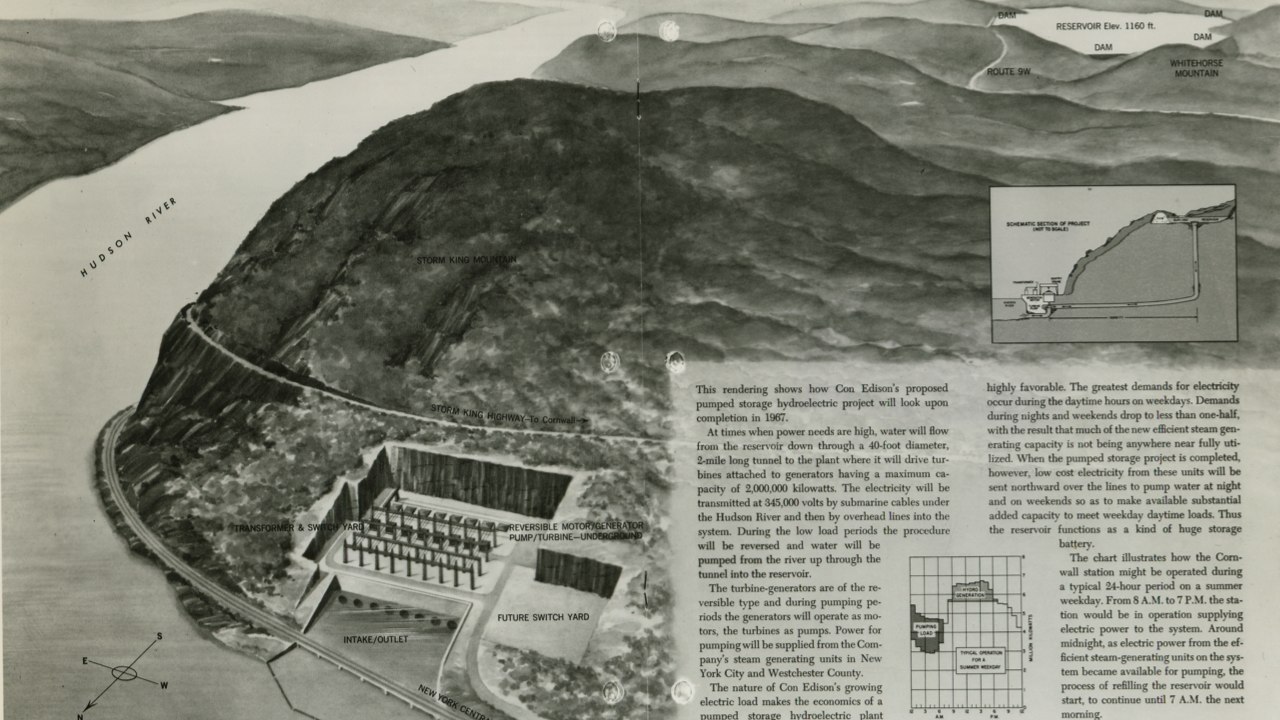 |
| Con Ed's Proposal for Storm King Mountain Power Plant (Scenic Hudson) |
Robinson also reflects on the worldwide influence of Sax and Sive:
The ripples from their professional work have spread far and wide. It is fair to observe that the reforms that Sive and Sax engendered in time produced Principle 10 of the Declaration of Rio de Janeiro on Environment and Development, adopted by the UN 1992 Earth Summit. This principle embodies many of the reforms that they urged in the 1970s and beyond: rights of access to environmental information, to pubic participation in environmental decision-making and to access to the courts. These are today recognized as global norms. The combined legacy of their lives is global.
Subscribe to:
Posts (Atom)