Showing posts with label protected areas. Show all posts

Sunday, May 15, 2022

Before Yellowstone

Dan Farber recently posted at Legal Planet on "The Arkansas Origin of National Parks". Farber writes:

The origins of the national park system is usually traced back Lincoln’s 1864 signature of the Yosemite Grant Act.  But Congress had actually had the idea of protecting extraordinary places over thirty years earlier, in Arkansas of all places. Hot Springs isn’t high on the list of American places to see, which may be one reason this episode had been forgotten. But it deserves to be remembered as a milestone in federal policy.

*****

On April 20, 1832, Andrew Jackson signed legislation to set the springs and surrounding mountains from development.  The legislation provides that the township surrounding the springs “shall be reserved for the future disposal of the United States, and shall not be liable to be entered, located, or appropriated, for any other purpose whatever.” The law also authorizes the governing to use the revenue from short-term leases of the spring to fund “the opening and improving such lands in said territory, as said legislature may direct, and to no other purpose whatever.”

Unfortunately, Congress didn’t appropriate any money to supervise the area, and the result was helter-skelter private developments. The private owners later sued to establish title to the land they were using, under a law that Congress passed specifically to authorize federal litigation on the issue. The Supreme Court ruled against them in In re Hot Springs cases, 92 U.S. 698 (1875). That ruling cleared the way for active federal management of the land by the Interior Department. The land is now a National Park.

Yellowstone is in some ways a clearer story about preserving nature. Hot Springs began with the different but related goal of ensuring that valuable public resource was used for the benefit of the public.  That may be one reason why the Hot Springs story hasn’t gotten as much attention.  Hot Springs did set an important precedent, however, about keeping land of public value out of the hands of developers. That’s a story worth telling.


Friday, March 11, 2022

International environmental law panel for ASLH

Reposting from H-Environment:

Dear all,

I am a doctoral candidate at Rutgers University New Brunswick, and I am currently seeking co-panelists for the American Society of Legal History conference to be held in Chicago, Illinois, November 10-12, 2022. The conference welcomes papers dealing with legal history from any time period or geographical area, but is only accepting panel proposals. I am seeking to put together a panel dealing with international environmental law in the 20th century, in the broadest possible sense. My paper specifically will talk about the interplay between international conservation efforts and French national interests in the creation of a "French Antarctic national park" in the subantarctic Kerguelen Islands in 1924.

Here is a link to the ASLH website For more information: https://aslh.confex.com/aslh/2022/cfp.cgi

Panel submissions are due March 18th. I know this is a short turn around but I hope to find interest through this forum. The ASLH is a great organization that offers a helpful forum for discussing a broad range of legal history topics, and is especially supportive of graduate students and early career scholars.

Please feel free to contact me at kms557@history.rutgers.edu if you are interested in joining this panel.

All best,

Katherine Sinclair

Bruno Navez, Remains of vats and boilers at Port-Couvreux, Kerguelen Islands, used for the making of elephant seal oil at the beginning of the XXth century

Thursday, March 3, 2022

Yellowstone at 150

Anna Price of the Library of Congress's In Custodia Legis recently posted on the 150th anniversary of the creation of Yellowstone National Park, the US's first. Price goes through the legislative history of the statute creating the park, as well as some of the legal issues that arose, including American Indian treaty rights and potential conflicts with settlers claiming preemption and homesteading rights. The latter issue, as the blog points out, also arose in the context of Yosemite Park in the 1872 US Supreme Court Case of Hutchings v Low (a.k.a. The Yosemite Valley Case).

poster designed by Don C. Powell (LOC)

Friday, August 2, 2019

The Adirondacks in the seventies

Just out in the Journal of Policy History: Peter Siskind's "'Enlightened System' or 'Regulatory Nightmare'?: New York's Adirondack Mountains and the Conflicted Politics of Environmental Land-Use Reform During the 1970s". The abstract:
This exploration of the politics of land-use reform in New York's vast Adirondack Mountains provides a revealing window onto the ambiguities, evolution, and importance of environmental liberalism during the 1970s. A distinctive set of circumstances, featuring forceful advocacy by Governor Nelson Rockefeller and propitious political timing, led to the creation in the early 1970s of one of the most ambitious state-level environmental reforms in modern American history. But implementation during the mid- and late 1970s proved challenging. Environmental management by a new regional agency that possessed powerful regulatory authority over all public and private lands in the region produced discontents, distrust, and organized opposition among both developers and property-rights advocates on the right and environmental advocates on the left. The result was an uneasy, enduring legacy: the new regulatory institution and key environmental planning ideas of the early 1970s and the later, wide-ranging discontents would coexist in similar forms for decades to come.

Friday, August 31, 2018

Goodbye Abbey, hello intersectional environmentalism

Sarah Krakoff recently posted a critical take on Edward Abbey on Environmental Law Prof Blog. Some highlights:
Abbey’s love-letters to Utah’s red-rock country spawned generations of canyoneering backpackers, and still serve as the heart of aesthetic and political defenses of desert wilderness. Ever since, Abbey has been attacked and defended. Was he racist, misogynist, and anti-immigration? He was. His views of Black and Brown people were deplorable, and his descriptions of women were retrograde. And yet, his defenders inevitably retort, we need his irascible, cranky, and irrepressible voice today more than ever.  
But do we? I have come to (re)bury Edward Abbey, not to praise him. (Abbey died in 1989 at the age of 62; he was buried illegally on public lands.) Or more accurately, to make a pitch for putting Abbey in his place and moving on. That place should be in the context of what it means to protect those same dramatic and soul-stirring landscapes without perpetuating an alienating version of what it means to be “truly wild,” or “truly radical,” or “truly environmentalist.” The problem with re-lionizing Abbey in 2018 is not just that he was sexist, racist, and xenophobic. But also that those views were sewn into his brand of so-called radicalism. They constituted the lenses through which he saw the landscape he aimed to protect.
What Abbey saw were beautiful empty places where white men (quite specifically) could be free and wild. Their version of wilderness preservation, even supplemented by the occasional nod to the evils of growth-dependent and extraction-based economies, was oblivious to the structures that enabled their seemingly unmediated encounters with the desert. Those structures included brutal and unscrupulous campaigns to dispossess Native people of most of southeast Utah. They included the failure of post-Civil War efforts to democratize homesteading by including eligible African Americans eager to flee the South. And they included, time and again, the cultural acceptability of exploiting women, both by treating them as fungible sex toys and by relying on them to mind the homestead and raise the young’uns. Abbey’s version of radical environmentalism assumes away all of the inequalities baked into his ability to be a free man in canyon country. Abbey also managed to alienate lots of white men while he was at it. He scorned ordinary work as part of his critique of corporate and industrial interests and romanticized manual labor even while he railed against ranchers and farmers in his midst.

Tuesday, May 2, 2017

A history of the EPA

The EPA Alumni Association recently published online Protecting the Environment: A Half Century of Progress. There's an Overview, as well as seven reports on topics such as air pollution, water pollution, toxic substances, and so on. From the introduction:
Over the past half century, our country has made enormous strides improving the environment. The laws that were passed to protect the environment and the public policy decisions that were made have yielded substantial progress. The air is demonstrably cleaner, our waterways are getting cleaner, our drinking water is safer, there are lower levels of exposure to toxic chemicals affecting people and wildlife than would have occurred, toxic waste sites are being cleaned up, and millions of acres of the most scenic and valuable parts of our country’s landscape — parks, wilderness areas, and wildlife refuges — are being protected.
None of this has come easily. There have frequently been significant costs. The decision-making process has often been protracted — sometimes by lengthy litigation. Still the progress is undeniable.
This progress is a result of laws that Congress passed and federal, state, tribal, and local agencies implemented. It is a result of investments of government and private sector dollars and the hard work of many communities, companies, and citizens across the land. They have reduced their environmental footprint and improved the way they do business and live their lives. It is the result of technological and policy innovations and the entrepreneurial spirit built into the DNA of the American people. Most of all, it is the result of Americans’ ongoing support for clean air and water, as we recognize that protection of public health and the environment benefits millions of our fellow citizens.
It is essential to understand this history and the lessons and insights learned if we as a country are to tackle some of today’s formidable challenges, such as:
  • the adverse impacts of climate change,
  • the effects of nonpoint source (runoff) pollution on our waterways,
  • issues raised by changing technology, such as biotechnology and nanotechnology, and
  • safeguarding the natural resources that are the foundation of our economic and recreational activities. 

Friday, April 21, 2017

Parks and Jim Crow

H-SHGAPE recently published a review by Nancy Murray of William O'Brien's Landscapes of Exclusion: State Parks and Jim Crow in the American South (U. Mass. Press, 2015). Murray writes:

Advocates for wilderness recreation viewed national parks as a means to prevent black criminality. As early as the 1920s, officials argued that recreational areas and parks for African Americans would help to address stereotypical problems of crime and juvenile delinquency. In October 1925, while introducing a speaker at the Twelfth Recreation Congress in Asheville, North Carolina, Chairman Robert Lassiter stated that, “with proper attention to recreational facilities, they [African Americans] will make good citizens. Improper attention to that, and neglect and abuse of it, will make a criminal population” (p. 34). These assumptions about black criminality knew no color line. The following year, Ernest Attwell, director of the Parks and Recreation Association (PRA) Bureau of Colored Work and a Tuskegee Institute graduate, reiterated Lassiter’s views.
*****
O’Brien’s book spans a period of time beginning with the origins of state park development in the 1930s to the turbulent civil rights era in the 1960s and relates how the development of state parks reflected the political and racial conflicts of these decades. Throughout, Landscapes of Exclusion emphasizes how local, state, and federal agencies adhered to what was called “customary” practices to justify using public funds to build and maintain segregated state parks. By the 1930s and 1940s, even as state park officials acknowledged African Americans’ need for state parks, Jim Crow laws and the hostility of white residents meant that most southern states refused to provide them.
*****
After World War II, in the face of mounting challenges to segregation, southern states proposed a more expansive network of segregated parks for African Americans and the leasing of whites-only parks to private entities in an attempt to prevent integration. Despite these attempts to preserve Jim Crow, civil rights activists nonetheless persisted. In 1951, four African American beachgoers were denied entry into Seashore State Park on Cape Henry in Virginia. When attorneys from the National Association for the Advancement of Colored People (NAACP) filed a lawsuit, the Virginia Department of Conservation offered to build a park for African Americans near Seashore State Park with similar amenities. When the NAACP rejected this offer, they filed suit in Tate v. Department of Conservation.   

Tuesday, April 18, 2017

More on the Antiquities Act

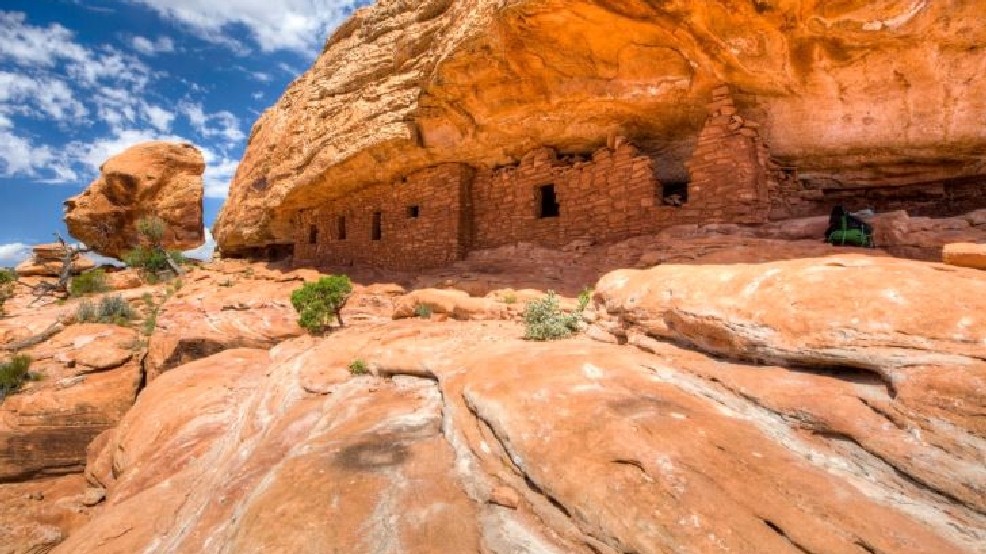
Bears Ears National Monument designated by President Obama
Following up Sunday's post on the Antiquities Act, I'd like to note an interesting post on the topic by Nick Bryner at Legal Planet. There's a lot of straght legal analysis, but a large dose of legal history as well. Bryner takes on an AEI "white paper" written by John Yoo and Todd Gaziano:
First, Yoo and Gaziano seek to re-frame the history and past judicial decisions on the Antiquities Act in order to make an argument about the purpose of the Act. The authors raise the argument that the Act has been “abused” for the purpose of effectively creating new, large national parks, and that the large size of some monuments designated throughout the Act’s history runs counter to the statute. Their claim purports to be rooted in textual analysis of the Act, but relies on an assumption due to the context of “earlier and contemporaneous bills” that would have “limited monument designation to 320 or 640 acres (page 3). The Act instead provides that monuments “shall be confined to the smallest area compatible with the proper care and management of the objects to be protected.” Yoo and Gaziano posit that the lack of a size limit “provide[s] flexibility for special situations and not to allow a million-acre designation” (page 3). Contemporaneous history, however, also points to officials in the Interior Department who favored broad empowerment of the President to set aside public lands, and suggests that these officials had a hand in adding the Act’s more expansive language of “other objects of historic or scientific interest” to meet this goal. No court has ever invalidated a presidential designation of a national monument — from the Grand Canyon under Teddy Roosevelt (its status as a national monument, prior to conversion to a national park, was upheld by the Supreme Court against mining claims in Cameron v. United States), to the Giant Sequoia NM under Clinton (upheld by the DC Circuit in Tulare County v. Bush).
*****
The purpose and context of the Antiquities Act, including congressional action and inaction over the past century, suggest that a one-way ratchet — presidential designation, with significant reduction or revocation only by Congress — is exactly what was intended. Congress was concerned that historical, archaeological, and natural or scenic resources could be damaged or lost, and devised a delegation to the President to act quickly when needed to preserve those resources, leaving Congress the opportunity to deliberate on a longer-term solution for the area in question, if it so decided. On 10 occasions, Congress has reversed those presidential decisions; far more often, it has concurred or built upon the President’s actions by expanding monuments or re-defining them as national parks. This is how the process is supposed to work. Antiquities Act designations do not, as critics say, cut off debate or circumvent the democratic process. They simply alter the status quo in favor of conservation — a precautionary approach. If Congress studies the matter and decides to change or abolish the monument to allow for different uses of the land, it has the power to do so through the usual legislative process; until that action is taken, objects of historic or scientific interest are protected.

Sunday, April 16, 2017

The Antiquities Act

Grand Canyon National Park
Current politics continues to provoke interest in the history of environmental law. John Leshy's and Mark Squillace's recent column in the New York Times on "The Endangered Antiquities Act" notes:
The act has been used more than 150 times, by nearly every president, Republican and Democrat, from Theodore Roosevelt on, to protect hundreds of millions of acres for the inspiration and enjoyment of present and future generations. Five of the nation’s 10 most-visited national parks — Grand Canyon, Zion, Olympic, Teton and Acadia, each attracting millions of people a year — were first protected by presidents using the Antiquities Act.

*****

Some dislike the law because presidents have tended to use it late in their terms to sidestep opposition to their designations. But would anyone today seriously question the wisdom of Theodore Roosevelt’s using the act to protect what is today the core of Olympic National Park in Washington two days before he stepped down in 1909? Or Herbert Hoover’s safeguarding what are now three national parks, including Death Valley in California (1.3 million visitors last year), in his last three weeks in office in 1933? Or Dwight D. Eisenhower’s setting aside what is now the Chesapeake and Ohio Canal National Historical Park (five million visitors last year) two days before John F. Kennedy’s inauguration in 1961?

Because these presidential actions change the status quo and prevent development, they have sometimes incited local opposition. But over time, the growing popularity of these places often led Congress to recast them as full-fledged national parks.

That’s what happened after Franklin D. Roosevelt established the Jackson Hole National Monument in 1943 on land fronting the magnificent Teton mountain range in Wyoming. Outrage ensued. Senator Edward Robertson of Wyoming called the president’s action a “foul, sneaking Pearl Harbor blow,” and locals led a cattle drive across the new monument in protest. But by 1950, the monument’s benefits to local life and the economy persuaded Congress to incorporate it into Grand Teton National Park, and President Harry S. Truman agreed. In 1967, Cliff Hansen, a leader of the cattle drive protest who became a United States senator, acknowledged he had been wrong to oppose Roosevelt’s action. He called the expanded Teton Park one of his state’s “great assets.”
More on the current debate over the law soon.

Thursday, September 29, 2016

When loggers were green

The Forest History Society awarded its 2016 Blegen Award for the best article on forest and conservation history to Erik Loomis for his "When Loggers Were Green: Lumber, Labor, and Conservation, 1937-1948", published in Western Historical Quarterly.

Soleduck Falls shelter, Olympic National Park, constructed 1939
(M. Stupich, courtesy of National Park Service, Pacific Northwest Region)
The IWA was a strong supporter of the creation of the park for protecting old-growth forest

There's a lot of law in the article, though the union was often on the losing side. The opening paragraphs:
In April 1939, Harold Pritchett, president of the International Woodworkers of America (IWA), went on radio station KIRO in Seattle to explain his union’s program for forest conservation. Pritchett bluntly attacked the timber industry for its wasteful practices, noting, “under the present policy of timber destruction three feet of Northwest timber is being used for every new foot being grown.” Saying the nation’s forests were too important to serve corporate masters, Pritchett demanded a government-led reforestation program that would hire unemployed loggers and recharge the timber resource. He argued for federal policies mandating selective logging rather than clear-cutting large patches of forest. Pritchett justified federal intervention by comparing it to the New Deal’s expansion of government authority into public utilities and banking as well as the passage of the Social Security Act. Only through “initiating a forest program that is based on the needs and also the responsibilities of the forest land owners” under “federal control of forest cutting practices,” Pritchett declared, could the forests of the Northwest remain productive for future generations.

Friday, September 2, 2016

National parks in the Netherlands

Wolff en Hoeck in de Purmer: Jan van der Heijden (1678) (courtesy SKBL)
Over at Environmental History Resources, Jan Oosthoek recently posted "Cultured nature: The Nature Scenery Act of the Netherlands", based on his podcast interview with Wybren Verstegen, whose article, "The Nature Scenery Act of 1928 in the Netherlands", was published last year in Forest History Today. There's also a video. Oosthoek writes:
When thinking of national parks most people think of famous examples like Yellow Stone and Yosemite in the United States or the Serengeti in Tanzania. These parks are large in scale with an emphasis on wild life conservation and the preservation of scenic landscapes. Human activity and presence are restricted and regulated and people are visitors.
In smaller and densely populated countries like Britain or the Netherlands, the creation of large national parks is complicated. In these countries landscapes are far from natural and humans are part of the fabric of the landscape. For this reason, it is difficult to restrict human access and activities to create national parks.
In the Netherlands nature and human activity are almost inseparable because about half of the country is at or below sea level and is reclaimed or drained. Consequently, the landscape of the Netherlands is mostly the product of human intervention and can therefore be described as a cultural artefact. As a result, formal protection of landscapes and wildlife came late. One of the early attempts to create protected conservation areas came in 1928 with the Natuurschoonwet, freely translated as Nature Scenery Act. This Act was mostly about protecting country houses set in park like settings.
As Oosthoek himself notes in the video, even in the US park landscapes are far from natural. But, as anyone who has visited parks in the US and in Europe knows, there is a big difference in the degree to which parks aspire to a wild or "natural" aesthetic on the two continents, with European parks tending to distinguish far less sharply than their American counterparts between nature and culture.

Sunday, January 24, 2016

Legal history and the takeover of the Malheur Wildlife Refuge

Three weeks ago antigovernment gunmen took over Malheur Wildlife Refuge in Oregon, USA, and they have been in a standoff with law enforcement officials since then. The gunmen (from out of state) are demanding that the land be "returned" to the local county. Some background is provided by Alan Feuer in the New York Times, who explains that the gunmen are echoing the claims of the "Wise Use movement":
Wise Use answers the question of who should own the West by granting moral primacy to natural resource companies and to logging and ranching families....
Though composed of many activists and scores of organizations, Wise Use found its voice in the late 1980s when a timber industry adviser named Ron Arnold published “The Wise Use Agenda.” The manifesto offered an expansive plan to gut environmental regulation, increase private ownership of public land and compel the federal government to open its holdings to mining, oil and logging companies and to the unrestricted use of off-road vehicles.
Mr. Arnold adopted the phrase “wise use” from Gifford Pinchot, the first head of the United States Forest Service (who said that “conservation is the wise use of resources”). In 1988 he held a conference, bringing together the likes of Exxon and the National Cattlemen’s Association, with the goal of seeding the West with grass-roots groups that could wrest control of federal land and give a local flavor to his Reaganite aims.
“Arnold sent organizers into distressed rural communities to set up front groups with environmentally friendly sounding names that whipped up hostility against the government,” said Tarso Ramos, the executive director of Political Research Associates, a research group that studies right-wing movements. What resulted, Mr. Ramos said, was a “coalition of natural-resource companies, property developers and conservative activists working with a network of community organizations.”
This coalition achieved success in pushing its agenda. By the early 1990s, politicians friendly to the Wise Use cause had introduced or passed legislation in nearly 30 states giving local governments and citizens expanded powers to lay claim to federal land. Among those politicians was Representative Helen Chenoweth-Hage, an Idaho Republican, who became notorious for mocking the Endangered Species Act by holding what she called “endangered salmon bakes.” There was also Gale A. Norton, the interior secretary under President George W. Bush, who once worked as a lawyer for the Mountain States Legal Foundation, which has billed itself as “the litigation arm of Wise Use.”
Legal Planet's Jonathan Zasloff provides some other background:

Tuesday, October 13, 2015

William Colby, first environmental law prof?

Ansel Adams, William E. Colby (from Carl P. Russell, One Hundred Years in Yosemite (1947))
In a new twist on the search for the first environmental law course, Dan Farber at Legal Planet says he has identified the first environmentalist law teacher:
I’m pretty sure that William E. Colby (1870-1964) qualifies as the nation’s first environmentalist law teacher, if only because environmentalism was very young at the time..  Colby was a lecturer on mining law and water law at Berkeley for twenty-one years, retiring in 1936.  (That doesn’t make him the first natural resources teacher;  Judge Lindley had taught mining and water law before him.) Colby was a close friend of John Muir. He joined the Sierra Club in 1898 and, except for two years, was the Secretary of the Sierra Club from 1900 to 1946.  The Sierra Club credits him with contributing substantially to saving redwoods, enlarging Sequoia National Park, and establishing Kings Canyon and Olympic national parks.  He was also the first Chair of the California State Parks Commission.
I was originally going to call Colby the first “environmental law” professor, but it’s not clear how much his environmental concerns entered into his teaching or scholarship about environmental law.  Even then, the environmental impacts of mining were not unknown or without a legal dimension: a federal judge in the Nineteenth Century had halted hydraulic mining in California because of its devastating impacts on the state’s rivers.  His Sierra Club bio does link his legal and environmental work, saying that his”notable eminence as an attorney who specialized in mining and water law . . . . served him well in his conservation work.”  He did represent environmental interests in a couple of cases.
At the outset, I called Colby the nation’s first environmentalist law professor.  Obviously, I’d be very interested to learn if there were others from the era, but I’m guessing the title will stand.  (I’d also love to hear from anyone who knows more about Colby). Either way, it’s nice to know that law teachers became involved in environmental issues at such an early stage.

Tuesday, September 8, 2015

Olmsted and Park Police

Growing up in the DC suburbs, park police were just part of the scenery, like like ornamental cherry trees and squirrels. I never stopped to think about their origins, or why there are park police alongside regular police. David Thacher's "Olmsted's Police", published in the latest Law and History Review, provides some answers.

Central Park, 1875 (click image to enlarge)
Thacher explains that Frederick Law Olmsted, Central Park's co-designer and superintendent, rejected the deterrence model of policing as unsuited for an urban park, its values, and the harms that threatened it. Writing in 1872, Olmsted explained:
On the park there are no stores of private property, no walls or doors to be guarded, and respectable women and well nurtured children are much more tempted to the class of acts which it is the chief business of the park police to prevent than rogues or ruffians.
The service for which there is the most frequent need on the Central Park is, in fact, that of quietly and civilly pointing out to visitors, and mainly to women and children, how they can best obtain what they desire, so far as it is to be found in the park, and cautioning them in a respectful, courteous, and propitiating way when they may seen to be going wrong, either ignorantly or carelessly, or thorough an inadequate appreciation of the harm which would result in the park from actions which elsewhere often pass as venial, if not harmless. Such, for example, would be the picking of way-side flowers or the hunting of birds’ nests in thickets.
His 1873 General Order to the park police further set out his views:
The danger ... is chiefly this, that a few persons, perhaps one in ten thousand of all who pass near any such place, will tramp across it, and in so doing, stamp out the life of the plants, or will, one by one, pick and misappropriate the flowers to private use. They have no more right to do either than to pick their neighbor’s pockets, throw stones at his windows or vitriol at his coat. Yet, of the comparatively small number of visitors who will crush out the life of the ferns, or steal the flowers, it will certainly be still a very much smaller number who are capable of being led intentionally to do any such wrong to their neighbor... . Much the larger part are capable of being tempted to it only because having had no occasion, under ordinary circumstances, in walking along the streets, or when in the country, through the woods and fields, to consider the rights of others in the way that is necessary in the park, it fails to be clear to their minds that they will be wronging others.

Friday, August 7, 2015

Death Valley

I've been harping on the weather a lot lately, but it's at least a small comfort to know that it's probably hotter somewhere else. Like Death Valley. April's Environmental History had a review by Kevin Brown of Death Valley National Park: A History, by Hal K. Rothman and Char Miller (U. Nevada Press, 2013). Some excerpts:
Based on Rothman’s administrative history of the park written under contract with NPS in the early 2000s and then revised posthumously by Miller, this concise and well-researched volume shows how the agency repeatedly struggled to reconcile its evolving mission and legal obligations with the past human uses of the desert and ongoing social and environmental changes beyond the park’s borders. While many of the issues that confronted NPS in Death Valley have been considered in the extensive literature on the national parks, Rothman and Miller’s focused study is a reminder that when considering a bureaucratic agency largely defined by particular landscapes, it is important to note how the peculiarities of place help to create variations in policy.
Conflicts over existing claims to land and water within the park form a crucial part of Rothman and Miller’s work. Native Americans had lived in and around Death Valley for thousands of years, seasonally migrating through the region to take advantage of resources at a variety of elevations. At the founding of the national monument, those Timbisha Shoshone remaining in the park were “caught in limbo” and denied control over lands on which their lives had depended but to which they did not hold legal title (p. 69). Until the 1990s, when the Timbisha finally gained some measure of control over tribal lands in the park, this tension was reflected through NPS (shamefully) ignoring or exacerbating conditions of substandard housing at a community built near park headquarters in the 1930s.
*****
Rothman and Miller’s study also shows how the 1960s and 1970s reshaped the management of Death Valley’s natural and cultural resources. The suite of environmental laws passed in those decades collectively pushed NPS (sometimes reluctantly, sometimes willingly) to designate wilderness, establish protection plans for animals that had been in the park for a very long time (desert bighorn and pupfish), while also working to curtail those invasive species relatively new to the park (burros and tamarisk). NPS also belatedly began to take stock of its archeological sites and developed a plan for preserving historic structures. While some of these planning efforts have been successful, Rothman and Miller suggest that the growth and development of the Southwest has also brought new resource challenges to Death Valley, especially in the form of groundwater withdrawals, air pollution, and crime. 

Sunday, August 2, 2015

Agrarian politics and American parks

The environmental history of slavery is a topic that has gotten much attention recently. Thanks to Legal History Blog for pointing out a new angle on this: H-War recently posted a review by Eric Burke of Adam Wesley Dean's An Agrarian Republic: Farming, Antislavery Politics, and Nature Parks in the Civil War Era (UNC Press, 2015). Some excerpts from the review:
Historians have long attributed the ascendance of the Republican Party during the late 1850s to its broad appeal with Northern farmers, especially in the Midwest. The political ideology of the party was weighted heavily toward lauding the benefits of the proliferation of small-plot family farming throughout the nation. Indeed, as Eric Foner has pointed out, though Republicans are often connected in historical memory to their efforts to champion industrialization during the Gilded Age, antebellum and wartime Republicans emphatically insisted that America could (and should) remain "a society of family farms and small towns, while still experiencing the benefits of industrialization," and constructed their platform and policies accordingly.
*****
In 1864, Congress... debated the fate of the Yosemite territory in California—a gem of natural beauty that many hoped "would 'civilize' the average person and improve his or her intellectual abilities" upon the mere sight of its splendor, and thus could best serve the public good preserved in its natural state (p. 7). Consistent with their near deification of the smallholding farmer however, radical Republicans disagreed. "The Constitution and the laws are for the protection of citizens and not for the creation of fancy pleasure grounds by Congress," one radical remarked, aptly summarizing the sentiments of many Republicans like George Julian of Indiana (p. 109). Radicals instead argued that the territory should be opened up for settlement by small farmers at once, thus fostering the spread of "freedom, union, and an improved society" (p. 126). The situation was complicated by the presence of "squatting" farmers already productively working the soil of the territory, forcing Republicans to decide whether or not to evict their beloved yeomen in order to preserve the territory's natural beauty for the enjoyment of the public at large—a plan supported by ardent Republican and landscape architect Frederick Law Olmsted. As Dean shows, Republicans fractured on these lines during the Yosemite debates of 1864, with the Olmsted project finally prevailing. But more important, Dean argues, the debates themselves offer a glimpse into the prevailing agrarian ideology of radical Republicans, suggesting that such "environmental controversies were not about preservation versus destruction," but rather were directly "connected to the main political currents of the time" (p. 8).
Also connected to these currents were Republican endeavors to reconstruct the South in the aftermath of victory and "civilize" Native Americans on western reservations. In his final chapter, Dean argues against the tendency of historians to find "inconsistency in [Republicans] promoting African American land rights in the South while curtailing Native American freedoms in the West." Republicans perceived no such inconsistency. "Both groups, they believed, would become small farmers and, in doing so, adopt white cultural values," Dean explains. "Since most northerners lived in rural communities and celebrated the environmental and political benefits of small farming, converting others to their lifestyle seemed natural" (p. 186). By emphasizing this factor, Dean ably supports his claim that "Northern policy makers did not want to industrialize the South and the West," but rather "intended to promote farming communities and strengthen the yeomanry that provided the foundation for republican government" (p. 136). Although perpetual violent resistance and the ever-decreasing tenability of small farming across the late nineteenth century gradually dismantled dreams of "civilizing" the Republic, Dean's approach highlights the continuity of Republican projects across the Civil War and Reconstruction era and "allows historians to make new connections between seemingly different topics" (p. 186).

Sunday, July 26, 2015

Property and the Appalachian Trail

Maybe some of you are out hiking right now. When you get back you may want to read Sarah Mittlefehldt's Tangled Roots: The Appalachian Trail and American Environmental Politics (U Washington Press, 2014), reviewed in January's Environmental History by Margaret Brown. Brown writes:
The Appalachian Trail (AT) is a remarkable story of volunteerism because in the early years no government agencies were involved in its creation and maintenance. Local hiking clubs sought permission of landowners to develop the trail and negotiated the rough terrain of property rights. “The AT maintainer had to be one-third trail worker, one-third organizer of other trail workers, but one-third diplomat among the landowners” (p. 38). Not until 1945 was a bill proposed to incorporate the AT under federal authority, and it took the 1968 National Trails Act to create the concept of a distinct corridor of protected landscape under the care of state agencies, the US Forest Service, and the National Park Service. According to Mittlefehldt, the 1968 law did not simplify the story of the AT; rather, it polarized landowners because the protected corridor required additional takings at the same time that the Sagebrush Rebellion and the property rights movement were gathering momentum. The conflict between environmentalism and property rights resulted in the unique contemporary position of the trail: the entire management of the AT was given in 1984 to a nongovernmental nonprofit—the Appalachian Trail Conservancy (ATC)—with both a professional staff and a prodigious number of volunteers.

Friday, May 29, 2015

Desegregation of national parks

Another article from Environmental History's virtual issue on environmental justice (other were noted here and here), Terence Young's "'A Contradiction in Democratic Government’: W. J. Trent, Jr., and the Struggle to Desegregate National Park Campgrounds", brings together environmental history and the history of desegregation, at the same time reminding us that desegregation in various contexts took place by administrative action before Brown v. Board of Education. The abstract:
Camping began in the nineteenth century as an elite form of pilgrimage to the wild, but the arrival of inexpensive automobiles in the early twentieth century greatly expanded camping's social diversity. The change was not universally embraced, especially when African Americans were involved, and the issue came to a head during the 1930s after two racially segregated national parks were opened in southern states. As complaints flowed in, William J. Trent, Jr., became adviser for Negro affairs to Interior Secretary Harold L. Ickes. He had no special interest in the outdoors or national parks, but Trent championed increased African American access to the parks and an end to discrimination in them. NPS leadership resisted Trent's efforts until Secretary Ickes ordered them to create one nonsegregated demonstration area in Shenandoah National Park in 1939. The policy was extended to other areas in 1941 and the next year, with World War II shifting into high gear, campground and other forms of segregation were ended throughout the park system.
Shenandoah National Park (National Park Service)

Friday, May 8, 2015

Hetch Hetchy in the courts

Richard Frank recently blogged at Legal Planet on a lawsuit on which he's working:
A new lawsuit, filed by conservationists on the 177th anniversary of  John Muir’s birth, asserts that the City of San Francisco’s continued operation of O’Shaughnessy Dam and Hetch Hetchy Reservoir on the Tuolumne River within the Park violates Article X, section 2 of the California Constitution.  Specifically, Restore Hetch Hetchy, the organization that brought the lawsuit against San Francisco, claims that continued maintenance of the dam and reservoir in one of Yosemite’s most spectacular areas, constitutes an “unreasonable method of diversion” of water that violates state constitutional standards.
The 1913 federal Raker Act "authorized the City of San Francisco to build a dam across the Tuolumne River that would flood the Hetch Hetchy Valley in Yosemite National Park in order to deliver water supplies to San Francisco residents and businesses."

Hetch Hetchy Valley in Early 1900’s, Before Valley’s Inundation
Passage of the Raker Act marked the greatest political defeat of John Muir, America’s most famous conservationist and founder of the Sierra Club.  Some historians and biographers go so far as to attribute Muir’s death in 1914 to his heartbreak over Muir’s inability to keep his beloved Hetch Hetchy Valley from being flooded.
Fast forward to 2015.  Bay area businesses and residents have for a century enjoyed the cheap water provided by the dam and reservoir that have inundated the Hetch Hetchy Valley.  At the same time, no one today would seriously propose the flooding of a key part of one of America’s most famous and revered national parks for such offsite uses.  That’s especially true when studies show that San Francisco can fully meet its water demands through relatively modest modifications to the much larger New Don Pedro Dam and reservoir downstream on the Tuolumne–outside Yosemite’s boundaries.
In sum, Restore Hetch Hetchy’s lawsuit provides a welcome forum for a long-overdue debate over whether O’Shaughnessy Dam and Hetch Hetchy Reservoir should be removed from Yosemite and the Hetch Hetchy Valley restored to its original splendor and ecological health.  (Muir and others of his generation observed that the Hetch Hetchy Valley was an equally-stunning counterpart to Yosemite Valley, located just to the southeast and the most heavily-visited portion of Yosemite National Park.)

Saturday, January 24, 2015

Latin America and the US Wilderness Act

Joining pieces by Donald Worster and Libby Robin in Environmental History's roundtable on the US Wilderness Act of 1964 is one by Emily Wakild, "Acts of Courage, Acts of Culture: The Wilderness Act and Latin America". Wakild writes that the history of parks in Latin America defies the social critiques of wilderness that have been advanced in recent years:
In 1940 Mexico had more national parks than any country in the world. Nestled among pine and fir forests, sprawling across volcanoes in the shadow of Mexico City, these parks bore the mark of a particular kind of conservation. Linked to the Mexican Revolution, a vibrant and widespread battle for social justice from 1910 to 1940, the most representative government in the nation’s history created parks as one of many components of a pervasive policy transformation that sought to elevate and empower working Mexicans by providing labor protections, redistributing land, invigorating education, and implementing meaningful political reforms in accord with the Constitution of 1917. While these parks protected natural scenery and had wild components (forests, lakes, glaciers), they were emphatically parks designed for people—places for rural and urban workers to relax or to find new livelihoods in tourism. At their creation, no wilderness whispered in these woods and no wildlife ran in these ecosystems; this was conservation in service of the poor and vulnerable, conservation with social objectives, conservation with people at the center. Today, nearly every remaining swath of greenery gasping for air in the Valley of Mexico is one of these emblems of the revolutionary movement—social justice stitched into the landscape as conservation.
Nahuel Huapi Park, Argentina, the first national park (1903) in South America
*****
Critiques of wilderness have become rote in the past twenty years, perhaps overly so. Consider the history of Mexican national parks in reference to the rise of “new conservation” laid out most emphatically (and hubristically) by Peter Kareiva, Robert Lalasz, and Michele Marvier in 2011. They called for conservation to move beyond parks and protected areas and into programs for rural development and human well-being. They argue that “the modern protection of supposed wilderness often involves resettling large numbers of people” and that “ecologists and conservationists have grossly overstated the fragility of nature.” Both claims play into a classic trope, one that places indigenous and non-Western peoples at the mercy of Northern scientists and overlooks their own agency to build and create rather than to merely react. Not only is there little new about proposals to merge working and natural landscapes—a move Mexicans (and likely others) pioneered in the 1930s—but there is little to show that this will result in improved livelihoods or more vibrant natural spaces. Has conservation alone solved problems of poverty, inequality, and uneven development? No, and that is not what it set out to do. But to assert that conservation has caused these problems, or even has been complicit in them, is to ignore conceptions of conservation and wilderness that do not translate into a US-centered narrative of nature protection. 
There's lots more of interest here.