Showing posts with label litigation. Show all posts

Tuesday, March 14, 2023

The history of Sierra Club v Morton

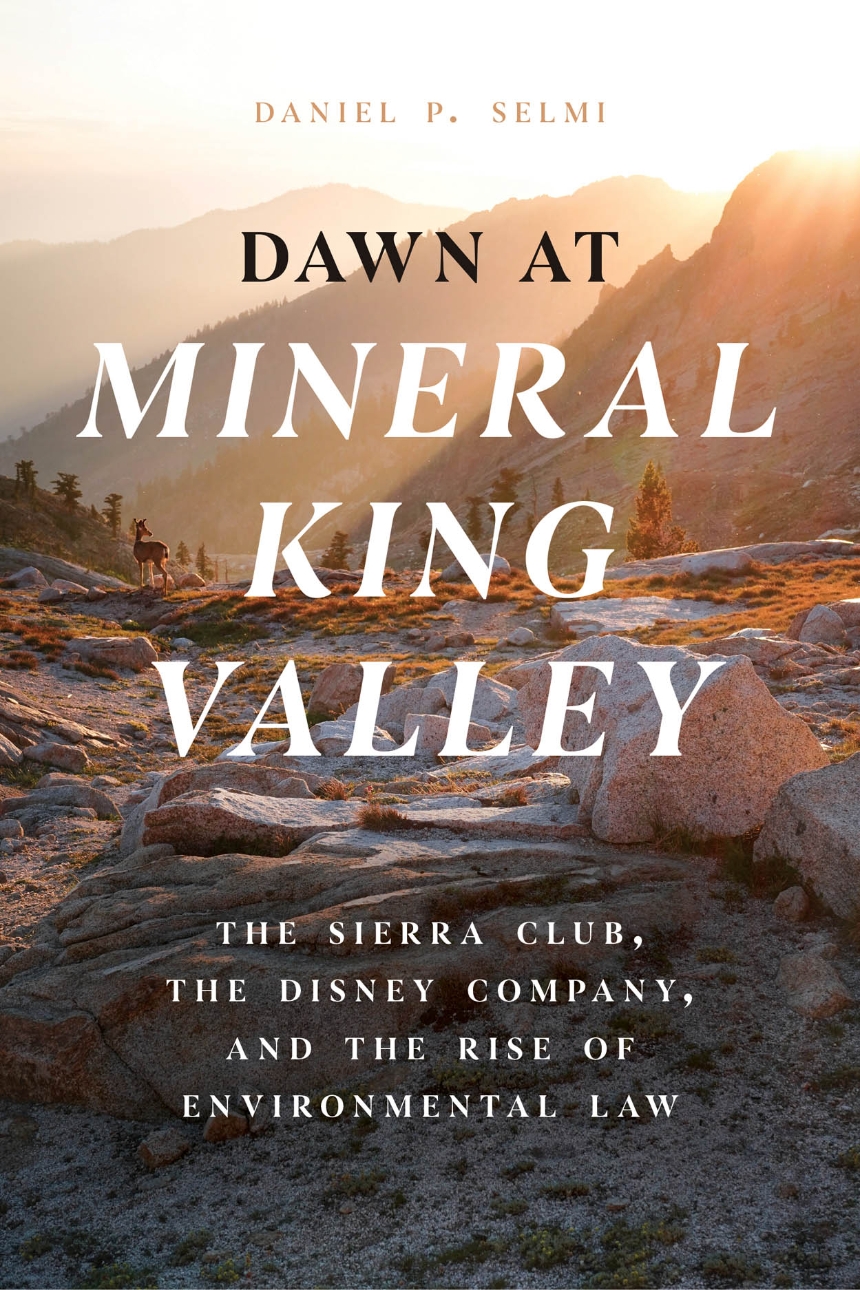
Jotwell recently ran a review by Angela Fernandez of Daniel P. Selmi's Dawn at Mineral King Valley: The Sierra Club, the Disney Company, and the Rise of Environmental Law (U Chicago Press, 2022). Fernandez writes:
Sierra Club v. Morton [known to some as the "Should Trees Have Standing" case - DS] is a seminal 1972 U.S. Supreme Court case on standing, the essential procedural question of who has a legal right to initiate a lawsuit based on a plaintiff’s alleged injury traceable to a defendant’s unlawful conduct. Daniel Selmi’s new book provides a deep dive into the history and context of this famous case, showing that it was about much more than the majority decision’s denial of the Sierra Club’s standing. And it was not, as some have claimed, launched as a test case to establish standing for environmental groups or the entities themselves, the possibility William O. Douglas went into in his famous dissent dear to the hearts of those interested in the Rights of Nature.
*****

Despite the fact that Selmi seeks to de-center standing in his history of the case, or at least destabilize the understanding that standing was what Sierra Club v. Morton was always meant to be about, he presents an excellent and thorough discussion of the issue. Selmi explains that the Sierra Club insisted on its general interest in a case that would impact the environment of concern to its members rather than Club members’ actual use of the area, which the Supreme Court indicated it would have accepted. As Justice White reportedly put it: “Why didn’t the Sierra Club have one goddamn member walk through the park and then there would have been standing to sue.” (P. 204.)

Friday, June 17, 2022

Crusader riparian rights

The latest issue of Water History has an article by Tobias Hrynick, "The mills of god grind slowly: the Na’aman River milling dispute and the thirteenth-century hydraulic crisis in the Crusader States", that looks into a dispute over water rights between neighboring water mills that seems a precursor to the riparian-rights disputes that were so numerous in the nineteenth century. The abstract:

In the mid-thirteenth century, the Hospitaller and Templar military orders engaged in a long-running dispute over the supply of water to two hydraulic gristmills outside the city of Acre in the Crusader Kingdom of Jerusalem that prompted international scandal, royal and papal intervention, and mutual attempts at sabotage. This article examines this dispute in the context of a broad survey of milling operations in the Crusader States and argues that this dispute was representative of a widespread hydraulic shortfall in the Latin East by the thirteenth century, when the kingdom’s military collapse and the increased cultivation of sugar cane aggravated a pre-existing shortage of water-power in the relatively labor-poor eastern Mediterranean. The efforts of local landholders like the military orders to maintain access to hydraulic resources provide an instructive example of a pre-modern society’s efforts to accommodate an environmental crisis.

The Templar mill on the Na'aman today (photo: Liorca)

Wednesday, February 17, 2021

The conservation constitution

A recent issue of Perspectives on Politics has a review by Richard Andrews of Kimberly K. Smith's The Conservation Constitution: The Conservation Movement and Constitutional Change, 1870–1930 (University Press of Kansas, 2020). Andrews writes that while existing works on the history of US conservation policy "focus on the policies expressed in statutes and regulations and on the actions of the administrative agencies, with only limited mention of the legal and constitutional arguments that were battled out in the courts", Smith's book "provides a valuable new complement to these studies by presenting a far more detailed history of the legal and constitutional arguments presented to and ultimately decided by the courts during the period from 1870 to 1930". Andrews continues:

Smith’s primary aim, well summarized in the final chapter (pp. 254ff.), is “to explain how lawyers and judges reworked constitutional doctrine to accommodate the expansion of state power over the natural environment during the Progressive era; and more specifically, how legal decisionmakers conceptualized the natural environment, its relation to human society, and the public interests at stake to create the constitutional ‘common sense’ that federal and state governments have authority to protect natural resources and the integrity of ecosystems in the interest of future generations.” In the process, she discusses the interweaving of principles such as the public trust doctrine, the police power, public nuisance doctrine, parens patriae standing, the interstate compacts clause, and federal constitutional arguments based on the interstate and foreign commerce, property, war, treaty, spending, and eminent domain powers, as well as the interstate nuisance doctrine. She argues that even though many of these issues continue to be argued in the modern era, the sheer number of these constitutional foundations, once accepted by the courts, has ultimately made governmental environmental management authority strongly resilient to challenges. She also urges greater recognition of the roles of skilled lawyers and judges, along with the better-known politicians and citizen advocates, in achieving this stronger role for the state in environmental conservation. Finally, she notes the continuing need for further evolution of our understanding of the Constitution: the Progressive understanding did not address the distributive imperfections of environmental regulation, nor the implications of administrative processes for procedural justice, nor—perhaps most problematic today—the absence of effective capacity for national economic and environmental planning, particularly in international cooperation to address global environmental challenges such as climate change. 

 After some minor criticisms, Andrews adds: 

Tuesday, February 2, 2021

Environmental dispute resolution 4,500 years ago

Fragment of the Stele of the Vultures, c. 2450 BCE
The latest Yearbook of International Environmental Law has an interesting contribution by Peter Sand, "Environmental Dispute Resolution 4,500 Years Ago: The Case of Lagash v Umma". Sand begins:

Legal historians sometimes contend—albeit tongue-in-cheek—that ‘environmental law has no history’ or that the origins of international treaty law in this field, at any rate, hardly date back more than two centuries. It is true of course that the very term ‘environmental law’ etymologically did not come into use, in any language, until the mid-twentieth century. Yet it is equally true that the earth’s natural resources have been a subject of claims for human exploitation and societal management (including law) for millennia before, as this brief note will aim to illustrate.

(The first quote is from my own chapter in the Oxford Handbook of Legal History, "Historical Analysis in Environmental Law". Let me note that I meant this contention not tongue-in-cheek but in the sense more felicitously captured by Éric Naim-Gesbert, cited by Sand: environmental law has a past without a history. See the abstract of my chapter.)

Sand continues (footnotes omitted):

The Musée du Louvre in Paris and the British Museum in London hold tangible evidence of the world’s first known legal agreement on boundary water resources—that is, the Mesilim Treaty, which was concluded in approximately 2550 BC between the two Mesopotamian states of Lagash and Umma—‘the oldest international treaty of which there is a reliable record.’ The terms of the treaty have been preserved in cuneiform inscriptions on limestone cones and a ‘stele’ commemorating Lagash’s victorious battle enforcing the interstate agreement....

Mesilim (or Me-salim, born circa 2600 BC) was the ruler of Kish, a kingdom further to the north of Lagash and Umma, which held a traditional ‘hegemonial’ position in the loose alliance of small neighbouring Sumerian states in the region between the Tigris and Euphrates rivers, south of what was to become Babylon. In that capacity, he served as arbiter in a protracted dispute between the two city states of Lagash and Umma, and it is the text of the arbitral award attributed to him, accepted under oaths by the litigants to their respective deities, that then appears as Mesilim’s rules in the cuneiform inscriptions preserved. The main subject of the award was the inter-state boundary between the two states, alongside a major irrigation canal.... The dispute concerned both water resources (with Umma upstream and Lagash downstream) and a strip of adjoining agricultural land in the fertile Guedin valley... that was cultivated by Umma under lease from Lagash for barley production.

Sand goes on to describe the breakdown of the treaty and compare it to the modern Lake Lanoux Arbitration and ensuing agreements. More on this in an earlier guest post by Sand here.

Wednesday, January 2, 2019

Climate science, history, and the law

Bill Kovarik recently posted at "Environmental history timeline" on a lawsuit against Exxon-Mobil, raising some interesting questions. Some highlights:
The lawsuit is based in part on an investigation by the Center for International Environmental Law which accused Exxon-Mobil Oil Corp. of working to dismiss climate change science and political action despite having had a scientific understanding of climate change “as early as” three or four decades ago, (or sometimes 1977, or 1968). The research grew into an “Exxon Knew” campaign. It was greeted with enthusiasm by environmentalists like Al Gore and Bill McKibben and with skepticism by Independent Petroleum Association of America and by Exxon-Mobil itself.
The key issue seems to be when Exxon knew climate change involved C02 from fossil fuels. Many of the Exxon Knew stories start along these lines: “In the 1960s, the American Petroleum Institute (and / or Exxon) made a troubling discovery.”
From an historical standpoint, the question ought to involve the broader context of scientific research. If API and Exxon researchers knew about climate change, what about the rest of the engineering and scientific community?
The fact is that the topic was a constant source of concern and research across the related scientific communities for a century and a half. Scientists concerned with climatology and glaciology and many associated geophysical sciences have studied climate change for generations. 
As seen here, the Washington Post carried an article May 4, 1953 on a Gilbert Plass paper at American Geophysical Union, quoting him specifically pointing to fossil fuel use as increasing climate warming.  Plass and other climatologists regularly published on these and related topics, with much of that generation’s research converged in the International Geophysical Year (1957-58).
Kovarik goes on to discuss many other scientists and others who warned about greenhouse gas induced climate change beginning in 1856.
So, clearly, Exxon knew, but so did everyone else.
In confining the discussion to Exxon’s own knowledge and actions, for example in a series of Inside Climate News articles, we have a legal strategy rather than an appreciation for the history of science. When we say “Exxon knew” as early as the 1970s or 80s, we ignore the long trail of scientific discovery beforehand, and we leave the field open to highly selective interpretations of trends.

Monday, June 11, 2018

Before Trump

Today's "This Day in Water History" has this:

Judson Harmon, c. 1912
June 11, 1895: First day of tenure of Judson Harmon as U.S. Attorney General. “Harmon issued the most explicit statement of what became known as the American doctrine of absolute sovereignty, that “the rules, principles and precedents of international law impose no liability or obligation upon the United States,” in a case involving a claim by Mexico for damages from diverting the waters of the Rio Grande.” Or, as one source put it: “US Attorney General Judson Harmon tells Mexico that the US will ‘do whatever it pleases’ with water from the Rio Grande.”

Commentary: Even for those days, this was a pretty amazing statement.

Friday, March 23, 2018

Leaded

January's Environmental History has a review by Leif Fredrickson of Michael Mix's Leaded: The Poisoning of Idaho’s Silver Valley (OSU Press, 2016). From the review:
The poisonous history of the Bunker Hill Company should be as well known to environmental historians as the Battle of Bunker Hill is to historians of the American Revolution. Located in the Silver Valley in northern Idaho, Bunker Hill mining and smelting operations polluted the surrounding area and poisoned residents and workers with lead for a century. In the 1970s, Bunker Hill’s operations wrought “the worst community lead exposure problem in the United States,” according to the Centers for Disease Control and Prevention. The silver lining to the Silver Valley disaster was that it fueled new and stronger national regulations for lead pollution.
In Leaded, Mix seeks to unearth the “root causes” of mining and smelter pollution in the Silver Valley. He argues that pollution went unabated for most of the twentieth century because the government sought to empower Bunker Hill in the pursuit of economic development and western settlement. Countervailing forces were either too weak or too dependent on the company to resist the massive pollution externalities the company foisted on others. Workers and Silver Valley residents often spurned criticism of the company—“Uncle Bunker” as locals called it—for fear of losing the area’s key employer. Similarly, state politicians feared losing a thriving business and a source of taxes. Bunker Hill’s economic and political power produce favorable legislation and the company benefited from judges and regulators who sided with the industry over labor and those harmed by pollution. Bunker Hill’s power was also rooted in knowledge. The state government lacked the resources to know much of what Bunker Hill knew, or could have known, about the poisoning of workers and the community.
Until the 1970s, the federal government did nothing to change this situation. Federal courts doled out, at best, piddling compensation for land and livestock poisoned by mines and smelters. Federal environmental laws were weak until President Richard Nixon created the Environmental Protection Agency (EPA) and Congress passed legislation that could force states to meet air and water pollution standards. Meanwhile, in 1973, a fire destroyed part of Bunker Hill’s already outdated pollution control system. But with lead prices soaring, the company chose to continue operating its smelter anyway. The resulting widespread poisoning of children in the community, which came to light over the 1970s, catalyzed the EPA’s first air lead standard, promulgated in 1977, and provided evidence for a relatively low acceptable lead level. According to Mix, the air lead standard, along with more stringent occupational health standards, “signified an end for most western lead smelters,” since they could not profitably meet the new technology requirements. Bunker Hill shut down in 1981.

Sunday, February 18, 2018

Digital library III: Compendium of Water Pollution Laws (1959)

This week's installment in the digital library of environmental law moves ahead to the twentieth century with Carl E. Geuther's Compendium of Water Pollution Laws, published in 1959 by the Manufacturing Chemists' Association, headquartered in Washington, DC. This was the fifth in a series of "Water Pollution Abatement Manuals" published by the trade organization, evidently with a target audience of engineers, managers, and other non-lawyer employees of the chemical industry.
Geuther, a lawyer, worked at the time for Du Pont Chemicals; he also seems to have represented them and other chemical companies in court at various times.

The Preface explains that the manual is:
a compendium of the laws of the forty-nine states (including the District of Columbia, the Territory of Hawaii, Puerto Rico, and the federal laws of the United States as they pertain to water pollution and water pollution abatement). Statutes and regulations of archaic vintage that are ignored by the water pollution control agencies of the various states are not referred to or set forth herein. Effort has been directed to preparing a practical analysis of the so-called working laws and regulations as they are now being enforced.
As one might suspect, in 1959 it was the states (and in some cases their subdivisions) that had primary responsibility for the issue, though Geuther does briefly survey some federal legislation on the subject, including the Water Pollution Control Act, passed in 1948 and expanded in 1956. (Compare the situation in 1909 here).

Among the states the leaders seem to have been New York and Maryland. The latter's  prominence might at first seem surprising, but it probably reflects the leadership of Abel Wolman in the field. Geuther thought that Mayland's effluent standards were too strict and inflexible. He cites the state's Water Pollution Control Commission's Regulation 4 (enacted in 1948 and revised in 1953):

Friday, February 9, 2018

Irrigation rights in medieval Islam

Barada River in Damascus
Yehoshua Frenkel, a professor at University of Haifa and member of our local environmental history forum, recently pointed me to a 2011 chapter by Boaz Shoshan on water law, "Mini-Dramas by the Water: On Irrigation Rights and Disputes in Fifteenth-Century Damsacus". The abstract:
Apart from discussions of matters of irrigation in legal works, medieval sources provide us with little information on the human dynamics and social interaction that are an integral part of irrigation systems. Some cases involving water were straightforward, whereas others were not. A laconic statement about a settlement (ṣulḥ) that was reached in Muḥarram 886/March 1481, in the presence of the viceroy of Damascus and the chief qāḍīs, between one Kamāl al-Dīn and Shihāb al-Dīn al-Muḥawjib concerning water that was coercively (zulman) diverted from the al-Manshīya river canal, provides us with only a faint echo about such conflict. Fortunately, on other occasions of water disputes Ibn Tawq paints a more detailed picture that allows some idea about their nature. This chapter discusses such disputes.
Shoshan is mostly interested in the social dynamics of the water disputes, but he also notes this information about the law "in the books":
That codifying regulations of water supply was a desideratum in the medieval Islamic world may be concluded from the Persian Kitāb-i Qāni ("The book of Qānāt"), written possibly in the eleventh century A.D., which purpose was to protect owners of subterranean aqueducts, that is, sub-surface canals that were engineered to collect ground water and direct it through a gently sloping underground conduit to surface canals.

Tuesday, February 6, 2018

Tort law, regulation and river pollution

One of the prices those of us who publish chapters in edited collections pay is that our writing often does not get the exposure it would were it published in a journal. So I'd like to bring special notice to a piece by Michael Lobban, "Tort Law, Regulation and River Pollution: The Rivers Pollution Prevention Act and its Implementation, 1876-1951", published in Tort Law and the Legislature: Common Law, Statute and the Dynamics of Legal Change, edited by TT Arvind and Jenny Steele (Hart, 2013). From the introduction:
By 1850, the massive urbanisation and industrialisation which Britain experienced over the previous century had generated unprecedented problems of pol­lution. The mid-century laissez-faire state, with its small central government and fragmented local regulatory bodies, was largely unprepared for these problems, and environmental pro­tection was left in the hands of private litigants - usually wealthy landowners - invoking the common law. However, reform at both local and central level led to new regulatory systems being put in place from the 1870s, which promised to play a larger role in reducing pollution. The Rivers Pollution Prevention Act 1876... was part of this reform. It was a pioneer­ing piece of legislation, the first general statute to deal with river pollution. Yet it has often been seen as a weak measure, which did little to improve river quality. Indeed, some historians have taken the view that it was drafted in such a way as to allow public authorities to hinder the more effective remedies against polluters which were available at common law.
How effective the common law could be in controlling pollution has long been debated among historians. According to JF Brenner, common law judges had no interest in using the law of nuisance to restrict industry, but rather sought to remould it - and emasculate it - to permit industry to develop. Brenner's view has been challenged by John McLaren. In his view, judges were far more divided on issues of policy than Brenner acknowledges. The predominant approach was one which recognised that the common law protected the right to clean water, but which also applied injunctions flexibly, given the practical difficulties of dealing with urban pollution. McLaren acknowledges the relative rarity of common law actions, but he attributes this to social and cultural factors, as well as the technical and financial difficulties faced by those who went to court, rather than to any doctrinal impedi­ments imposed by the judiciary. McLaren's own view that the common law was not par­ticularly effective has in turn been challenged by Ben Pontin, who argues that injunctions obtained by private law litigants could play a crucial role in forcing recalcitrant local authorities to spend money to improve sewage facilities. Leslie Rosenthal also argues that the common law could produce efficient outcomes, by inducing parties to enter into post­litigation negotiations.

Sunday, December 31, 2017

Historical analysis in environmental law I: Introduction

This past summer I noted that I posted a draft of my "Historical Analysis in Environmental Law" (on SSRN and Academia), forthcoming in the Oxford Handbook of Historical Legal Research, edited by Markus Dubber and Chris Tomlins. I believe there's still some time for modifications, so I'll post a series on it now, and hope some of you will have some helpful comments!

Environmental law has no history.

This is not to say environmental law has no past; indeed, scholars are beginning to uncover its historical roots. What I mean by having no history is, first, that there is a general feeling, common to legal historians and environmental lawyers (particularly in the United States), that environmental law is something new under the sun, having emerged in the 1970s from the environmental crises of the preceding decade (such as the Cuyahoga River catching fire) and a contemporaneous sharpening of ecological consciousness (spurred, most prominently, by Rachel Carson's Silent Spring). Modern environmental law lacks of connection both to earlier periods and to the great themes and trends of legal history.

The general view of environmental law's history is that before circa 1970 environmental regulation as we think of it today—a branch of public law in which the regulator sets standards for activities with environmental impacts—was insignificant. Rather, it is taught, the environment was regulated through nuisance law—a system relying on private parties, or sometimes the government, bringing a lawsuit to enjoin environmentally harmful activities or obtain damages for environmental harm: "Prior to the explosion of environmental legislation in the 1970s, the common law was the legal system's primary vehicle for responding to environmental problems.... The common law relied largely on nuisance law doctrines to resolve environmental controversies..." (Percival et al, 63) Some look to this period as a lost golden age; others see it as having been a workable system for its time; while yet others condemn it as a failure.

This view of modern environmental law being created ex nihilo in a moment of crisis is, first and foremost, inherently implausible.

Sunday, November 5, 2017

London's smoke regulation

The Court of Aldermen and Common Council of the City of London (1780)
Last week's Reviews in History posted a review by Elly Robson of William Cavert's The Smoke of London: Energy and Environment in the Early Modern City (Cambridge UP, 2016, recently out in paperback). (For an earlier review see here.) From the review:
Cavert is particularly strong on the complex role of political and legal institutions – both local and national – in managing coal supply and regulating smoke. In his account, the politics of coal and smoke was a politics of governance. Chapter five, ‘Nuisance and neighbours’, deals with the legal category of ‘nuisance’ to cast light on how conflict over pollution was defined and mediated. In it, Calvert investigates a smorgasbord of relatively ineffective litigious avenues for pursuing redress against industrial polluters who infringed on royal or individual property and health. Law Reports form the mainstay of the chapter and Cavert’s frustration is evident when he describes searching for nuisance cases in Westminster court archives, including 10,000 pleas in King’s Bench, as akin to ‘looking for needles in large and messy haystacks’. Yet he casts his net wide, examining an impressive array of London institutions, including the Fishmongers Company, the Court of Aldermen, and the Wardmote Courts. He consequently has an acute sense of the regulative capacity of different, interlocking jurisdictions, but does not present them as totalising in influence. Instead his emphasis falls on their limitations. Private contracts by landlords were far more effective than common law courts in excluding noxious trades from certain parts of the city, particularly in creating an elite non-industrial zone in genteel west London. This chapter tells us more about institutions and their limits than it does about the ways in which smoke sparked neighbourly negotiation. Royal and aristocratic attempts to limit air pollution in their vicinity have left a more prominent archival trace. However, further light may be cast on environmental conflict between more lowly urban neighbours through further examination of legal depositions, which tend to be well catalogued and have provided a rich lens for early modern historians examining rural disputes over resources.
A concern with governance recurs in part three, where several chapters examine the role of the state in regulating London’s coal supply and mediating the competing claims of civic governors, coal suppliers, the military, the urban poor, merchants, and industries. Efforts to ensure a constant flow of coal to the capital were more energetically pursued than attempts to alleviate pollution, because the former aligned with the priorities of the fiscal-military state: taxation, naval power, social stability, and economic development. Although there was never a state monopoly over the coal trade, the state gathered information through taxes on coal imports and intervened in markets by granting and revoking charters. Tensions could arise, however, between state revenues and economic growth, as merchants mobilised to lobby against rising coal taxes. Similarly, in times of war, able seamen transporting coal down the coast became a valued resource and were vulnerable to naval impressment, forcing the government to balance external military dangers with the threat that fuel scarcity posed to internal social order. 

Monday, September 25, 2017

Beach access and American conservatism

Bixby Creek Bridge near Big Sur, California
(Bill Lane Center for the American West)
The issue of public beach access has played a major role in the history of environmental law (see, e.g., here, here, and here). It also may be responsible for some of the backlash against environmental regulation. Last year the Journal of Policy History published Jefferson Decker's "Pacific Views: Property Rights, the Regulatory State, and American Conservatism". The article opens:
In November 1976, a bookkeeper named Viktoria Consiglio used money from an inheritance to purchase a plot of land overlooking the Pacific Ocean just south of Carmel, California. Two years later, Consiglio and her husband prepared to build a one-bedroom house for use during their retirement. They submitted applications for a building permit only to have their request denied. The impediment was the California Coastal Commission, a statewide regulatory agency that Californians had recently established in order to protect the state’s coastline from environmental damage and overcrowding. The commission ruled that Consiglio’s house would block the view of the ocean from a nearby highway, disrupt a path to a rocky cliff above the sea, and reduce public access to the beach below the development site. Using powers that had been delegated to it by the state legislature, the commission denied Consiglio’s application for a building permit. Consiglio could continue to own this scenic property overlooking the Pacific Ocean, but she would not be permitted to build a home there.
Consiglio eventually sought help from the Pacific Legal Foundation, a nonprofit, “public-interest” legal foundation established in 1973 by Ronald Zumbrun, a former aide to California governor Ronald Reagan, with help from several prominent California lawyers and businessmen. Zumbrun’s organization photographed the gray-haired woman, standing on a rocky cliff overlooking the Pacific surf, and put the image on the front page of its bimonthly newsletter. The accompanying article, titled “What Happened to the American Dream?” began: “Viktoria Consiglio, unhappy, confused, and angry, wonders what happened to her dream of owning a home by the sea. A dream that has turned into a nightmare of government red tape and legal costs that have taken a big chunk of her income from her job as a clerk-bookkeeper.” Lawyers at the foundation prepared to file suit, on the grounds that the Coastal Commission’s decision was inequitable, unjustified by law, and interfered with the woman’s property rights. The state of California may have certain powers to zone or plan for new development, the foundation argued, but it could not render this woman’s property nearly useless to her. 

Tuesday, September 12, 2017

Environmentalism of the Rich

Public Books recently ran a review by Max Holleran of  Peter Dauvergne's Environmentalism of the Rich (MIT Press, 2016). Holleran writes that the book
traces the shifting tactics of mainstream environmentalism from the radicalism of the 1970s to the corporate partnerships of the 1990s, in which companies accomplished incremental changes through in-house consultations with groups like the Sierra Club. It details how many green groups began as firebrand protectors of the earth, deeply inspired by indigenous movements that opposed the sale and commodification of nature, but have since morphed into something akin to compliance departments for large companies.
*****
Green movements of the Global North and the Global South are markedly different; within that divide, unique national experiences have produced a variety of environmentalisms, some of which do not even use the name and prefer to align with indigenous rights or class-based movements. The 1970s environmental movement came of age during a time of decolonization, and many pioneers of the movement were allies of nations in the Global South seeking both political independence and more autonomy within the global economy. Dauvergne shows that most resource extraction has imperial roots, when European powers saw the wider world as a zone for the collection, and often pillage, of raw materials. The “green” decolonization movement was fundamentally anti-capitalist; it suffered when many Global North environmentalists chose to advocate for a green economy, rather than a new economy based on rethinking global trade.
Holleran writes that the book argues that increased environmental awareness has not necessarily translated into increased regulation. Rather,

Sunday, September 3, 2017

From Charlottesville to Yosemite

The Ahwahnee Hotel in 1980 (George Rose)
Daniel Duane has an interesting piece in yesterday's New York Times on genocide of the Yosemite Valley's natives and the replacement of their names with Anglo ones, and it all starts from a trademark dispute. After detailing the killing and renaming of places in Yosemite carried out by California militia, Duane explains both the legal dispute and the complexity of the name issue:
The recent furor over the name of the Ahwahnee began in 2015, when a subsidiary of the Delaware North Corporation, which operated the park’s hotels, restaurants and shops for more than two decades under a government concession contract, lost its contract to Aramark (no tragedy there — the burgers were criminal). The government says Delaware North quietly registered the trademarks for the names on the hotel and the other places and is now demanding payment for their use. The National Park Service came up with new names and told Delaware North to get lost. Now there’s a federal lawsuit.
I dearly hope Delaware North loses, but I also hope that the National Park Service sticks with the new names, however ridiculous — and, while they’re at it, changes dozens of others. My vote would be to change Tenaya Lake to Pywiack Lake, relabel Yosemite Valley itself Ahwahnee and sprinkle the park with new historical plaques saying things like “On this spot, in 1851, American militiamen shot Tenaya’s son in the back, let him bleed out in the grass, then dragged Tenaya up to have a look and enjoyed watching him weep.” 

Tuesday, August 8, 2017

Tort and environmental regulation

Douglas Kysar recently posted "The Public Life of Private Law: Tort Law as a Risk Regulation Mechanism", which, among other things, takes issue with the supposed inability of tort law to deal with complex environmental issues; or as the New York Court of Appeals put it in the leading case of Boomer v. Atlantic Cement Co., "the judicial establishment is neither equipped... nor prepared to lay down and implement an effective policy for the elimination of air pollution".

Kysar argues that "rather than common law litigation being displaced by more sophisticated regulatory approaches, the latter instead may well have depended on the former for their sophistication", and backs up his claim with a case study (in order not to spoil the suspense in his article, after the jump):

Thursday, June 15, 2017

Property in water and urban water supply

"New" Jersey City reservoir, c. 1880
Yesterday's This Day in Water History posted an interesting story on a 1919 fine handed down to Jersey City for using too much water, but both the original report and the commentary reflect some misunderstandings. The blog quotes an editorial on "Public Control of Water" from the Municipal Journal of June 14, 1919:
Water companies and departments have appealed to consumers from time to time to restrict consumption in order to avert a water famine in the city, and meters are used largely to prevent waste; but we believe it is something new to impose a penalty for excessive consumption. As told last week, Jersey City, N. J., has been fined by the state $22,285 for using from the Rockaway river more than the 100 gallons per day per capita which had been allotted to it. 

Monday, June 12, 2017

Indian water rights, federal water rights, and state courts

Ed Mendoza of the Gila River Indian Community, Arizona (photo: Monica Almeida/NYT)
Dylan Hedden-Nicely recently posted "The Legislative History of the McCarran Amendment: An Effort to Determine Whether Congress Intended for State Court Jurisdiction to Extend to Indian Reserved Water Rights", published in Environmental Law. The abstract:
The year 1976 marked a sea change in federal policy regarding the treatment of American Indian tribes and their water rights. In that year, the Supreme Court of the United States was called upon to determine the scope of the McCarran Amendment, a rider on a federal appropriations bill that waived the sovereign immunity of the United States in state court general stream adjudications “where it appears that the United States is the owner or is in the process of acquiring water rights by appropriation under State law, by purchase, by exchange, or otherwise.” The Supreme Court, in what has been called a “clear example of judicial legislation,” interpreted that language to grant state court jurisdiction for the determination of Indian reserved water rights. In so doing, the Court abandoned the “deeply rooted” federal policy of “leaving Indians free from state jurisdiction and control,” and has subjected the tribes to “hostile [state court] forums in which [the tribes] must be prepared to compromise their [water right] claims.”
The purpose of this Article is to examine the legislative history of the McCarran Amendment ― the available Congressional Record, the Senate Report, as well as the Hearing Minutes ― in an effort to ascertain whether it was Congress’s intent to include Indian reserved water rights within the scope of the McCarran Amendment.
The legislative history indicates that “the McCarran Amendment was meant to be interpreted narrowly, not broadly.” It demonstrates that the Senators’ actual concern had not to do with federal reserved water rights but instead that the United States, acting in a proprietary rather than sovereign capacity, had been acquiring an ever-increasing number of state law water rights but was refusing to enter state court proceedings to either adjudicate or administer those rights. As the presence of the federal government increased in the river basins of the West, the proponents of the McCarran Amendment became increasingly alarmed that federal claims of sovereign immunity would effectively preclude state courts from enforcing state water law, thereby causing “the years of building the water laws of the Western States . . . [to] be seriously jeopardized.”
Far from a general waiver, the legislative history reveals that the sponsors of the McCarran Amendment intended to address only this narrow but politically explosive problem where the United States was claiming a “privilege of immunity that the original owner wouldn’t have.” Indian reserved water rights, which are reserved by the federal government in its sovereign capacity for the benefit of Indian tribes that have sovereign immunity independent of the United States, do not appear to have been considered or intended to be included by Congress as the McCarran Amendment was passed into law.
For more on Indian water rights, see here.

Friday, April 21, 2017

Parks and Jim Crow

H-SHGAPE recently published a review by Nancy Murray of William O'Brien's Landscapes of Exclusion: State Parks and Jim Crow in the American South (U. Mass. Press, 2015). Murray writes:

Advocates for wilderness recreation viewed national parks as a means to prevent black criminality. As early as the 1920s, officials argued that recreational areas and parks for African Americans would help to address stereotypical problems of crime and juvenile delinquency. In October 1925, while introducing a speaker at the Twelfth Recreation Congress in Asheville, North Carolina, Chairman Robert Lassiter stated that, “with proper attention to recreational facilities, they [African Americans] will make good citizens. Improper attention to that, and neglect and abuse of it, will make a criminal population” (p. 34). These assumptions about black criminality knew no color line. The following year, Ernest Attwell, director of the Parks and Recreation Association (PRA) Bureau of Colored Work and a Tuskegee Institute graduate, reiterated Lassiter’s views.
*****
O’Brien’s book spans a period of time beginning with the origins of state park development in the 1930s to the turbulent civil rights era in the 1960s and relates how the development of state parks reflected the political and racial conflicts of these decades. Throughout, Landscapes of Exclusion emphasizes how local, state, and federal agencies adhered to what was called “customary” practices to justify using public funds to build and maintain segregated state parks. By the 1930s and 1940s, even as state park officials acknowledged African Americans’ need for state parks, Jim Crow laws and the hostility of white residents meant that most southern states refused to provide them.
*****
After World War II, in the face of mounting challenges to segregation, southern states proposed a more expansive network of segregated parks for African Americans and the leasing of whites-only parks to private entities in an attempt to prevent integration. Despite these attempts to preserve Jim Crow, civil rights activists nonetheless persisted. In 1951, four African American beachgoers were denied entry into Seashore State Park on Cape Henry in Virginia. When attorneys from the National Association for the Advancement of Colored People (NAACP) filed a lawsuit, the Virginia Department of Conservation offered to build a park for African Americans near Seashore State Park with similar amenities. When the NAACP rejected this offer, they filed suit in Tate v. Department of Conservation.   

Sunday, April 9, 2017

Water pollution lawsuits

This Day in Water History recently reproduced a 1916 article from the Municipal Journal:
Three Sue City for Typhoid Deaths. Milwaukee, Wis.-Three suits brought against the city of Milwaukee as a result of the recent typhoid epidemic, have been filed in circuit court, by two men for the deaths of their sons, and by a woman for the death of her husband. They are for $10,000 each. The complainants claim that the victims contracted the disease from the use of lake water, alleged to be unfit to drink because of the sewage which is being constantly emptied into the lake. The suits charge negligence in allowing the water to become polluted and at the same time supplying it to drink. It is claimed that at various times during the last ten years the city officials have been notified of the condition of the water, but that no attention has been paid to the warnings.
Michael McGuire comments:
The typhoid fever epidemic in Milwaukee was caused by a city employee turning off the chlorine disinfection system for about 10 hours. The epidemic resulted in 513 cases and 59 deaths from typhoid fever. As filtration and chlorination became more widely installed to protect water supplies, it became harder for cities to claim that contaminated water supplies were not responsible for typhoid fever deaths. The combination of engineers wanting to do the right thing and lawsuits resulted in an accelerated introduction of the new technologies.