Showing posts with label urban. Show all posts

Tuesday, February 7, 2023

Negotiating the maritime commons

Another chapter from the previously-noted book, Greening Europe, is "Negotiating the Maritime Commons: Protecting the Baltic Sea in a European Context", by Simo Laakkonen and Tuomas Räsänen. The abstract:

The environmental history of the seas and oceans has generally remained a relatively unexplored theme. This chapter addresses the environmental history of the Baltic Sea, which is a European sea par excellence and the only sea that is entirely located within the continent. We will examine the links between wider historical currents in Europe and the marine environmental history of the Baltic Sea by focusing on three environmental regimes from the end of the nineteenth century until the 1990s. The first environmental regime was developed on an urban level and prevailed from the late nineteenth century until the Second World War. The second environmental regime was developed from the 1960s until the 1970sonaninternational level in the Baltic Sea region. The third environmental regime, spanning the 1980s and 1990s, consisted of developing wider European cooperation. These three different environmental regimes continue to cooperate in the region even today.

Sunday, February 13, 2022

More on water by-laws in Mandate Palestine


I recently posted a piece on H-Empire, based on my article, "Horizontal and vertical influences in colonial legal transplantation: water by-laws in British Palestine" (open access) (see also my recent post on this blog). An excerpt:

Zoltan Kluger, Dizengoff Square Circle in Tel Aviv, 1938 (National Photo Collection)
I ask two questions about the local bylaws enacted in the Mandate period (mainly in the last decade and a half of British rule, which ended in 1948) in the field of water supply and sewage (I'm working on a wider project on this history of water law in Mandate Palestine): Did the initiative for these bylaws, as well as the legal norms and language embodied in them, come from the residents of Palestine and their elected local governments or was it primarily the result pressure applied by the British rulers? And did legal influence cross communal boundaries, between Jewish and Arab local authorities, or did Arab towns tend to copy from other Arab towns, and Jewish from Jewish? The first question I conceptualize as one of "vertical" influence; the second as "horizontal".

Wednesday, January 19, 2022

Charging for water in Mandate Palestine

The American Journal of Legal History recently published my article, "Horizontal and vertical influences in colonial legal transplantation: water by-laws in British Palestine". Due to space constraints of the publisher, I was not able to include in the article some sources that I think are interesting from an environmental-legal perspective. Here are two of them, both penned by engineers serving as head of the water department of the of the Jerusalem Municipality in support of the city's policy of requiring water metering (while most Palestine local authorities also allowed charging flat rates). I think they call to mind current debates about water pricing in various places around the world, explicitly raising issues of efficiency, equity, conservation, and public health:

A. In 1927 Jerusalem's Water Engineer, Andrew (Andor) Koch, was hired by the Tel Aviv Municipality to consult on its system of water supply. In his report to the Tel Aviv Municipal Council (Report on the Tel Aviv Municipal Water Supply, 25th Dec. 1927, Tel Aviv Municipal Archives file 835/04-1029B), Koch explained why he supported metering over flat charges:

I wish to mention that throughout the whole world, now the metered system, as the only correct means for charging Consumers is gaining ground.- There used to be a conception before that water is not a saleable good, but a public property, obtained from nature and therefore the selling of same per volume as any other merchandise, is not justified.- A more close study and moreover the practical results of such an assumption have clearly shown however that earlier or later the free use of water is leading to unnecessary, even expensive (especially concerning the disposal of waste water) waste on the one hand, and inevitably, to the undue exhaustion of the  available sources of supply on the other hand.

Water tower in Tel Aviv, built 1924

Thursday, July 23, 2020

Control of outdoor advertising

The Historical Journal recently published James Greenhalgh's "The Control of Outdoor Advertising, Amenity, and Urban Governance in Britain, 1893–1962". The abstract:
This article examines the control of outdoor advertising in Britain, tracking its development as a mirror of the practices of spatial governance. It evidences both a largely forgotten, yet radical change in the urban environment, whilst also functioning as a lens through which we might examine local government's role in driving change in the visual environment of cities and towns. The article argues that, despite important early work by preservationist organizations, local corporations and councils were the principal drivers of legislation, altering attitudes in central government that ultimately led to stringent control of outdoor advertising in urban space. Beginning in the nineteenth century, but coming to the fore during the interwar period, corporations and councils pushed for ever greater controls over the size and siting of billboards, hoardings, and posters. In doing so, they deployed a language of amenity, and conjured with seemingly social democratic notions of citizens’ rights to push their agenda. The study is thus revealing of the ways in which town planning, patterns of holistic control in the visual environment, and the philosophy of urban modernism shaped even the most mundane, extant urban areas and left a lasting impression on the urban landscape.

Friday, December 13, 2019

Hartog on property in land and water

Monk's Ditch in the Gwent Levels, Wales, land reclaimed in the Roman period
As part of his stint as a guest blogger at Legal History Blog, Dirk Hartog recently blogged about his own early work on waterfront development in New York City and his encounter with Debjani Bhattacharyya’s Empire and Ecology in the Bengal Delta: The Making of Calcutta. Some excerpts, followed by a quibble of mine:
I spent many hours reading and rereading those waterlot deeds [granted by the eighteenth century Corporation of the City of New York]. I wrote many pages that unpacked much of the arcane property law doctrine that waterlot grants incorporated. In the end, I managed to put together what at the time felt to me like a satisfying portrait of how a waterlot grant exemplified early modern governance. I argued that corporate leaders were solving a fundamental problem of the time: about how to achieve necessary public purposes — like building wharves and docks for a seafaring city and also street construction and cleaning —without either a municipal workforce or a capacity to levy taxes. By exchanging waterlots for services and development by individual proprietors, the corporation enlarged the borders of the city, and it laid the foundation for what would become a global port, a world city.
In those days, I relentlessly situated those waterlot grants within the history of the corporation, implicitly situating the “municipal corporation” of New York City within the history of the business corporation. My attention was always focused on the public-private split, and little else. Which is not really surprising, given how much attention the public-private split held at that time in what I was reading, in the contemporary and argumentative field of legal history.

Friday, October 5, 2018

The roots of Ostrom's commons work

Continuing the series on "The Tragedy of the Commons at 50" (the last post is here), Fabien Locher's "Historicizing Elinor Ostrom: Urban Politics, International Development and Expertise in the U.S. Context (1970-1990)" provides interesting historical context for the work of Ostrom and the huge body of commons studies she inspired. The abstract:
The goal of this article is to write a social and political history of the now preeminent approach to the ‘commons’ institutions, by focusing on Elinor Ostrom’s contributions to its development. My methodology is that of Science and Technology Studies (STS). I focus here on the materiality of E. Ostrom and her team’s research practices (fieldwork, data collecting, indexing and analysis), on their intellectual and institutional strategies, their networking practices, how their research was funded, and their interactions with administrative and academic institutions and actors (USAID, NSF, National Academy of Sciences). I analyze the history of the Workshop in Political Theory and Policy Analysis, the research center that E. Ostrom and her husband Vincent founded and animated for some 40 years at Indiana University, Bloomington. By doing so, I hope to be able to analyze the close ties between the form and content of the Ostromian theories on the commons and the main lines of tension in the U.S. society of the 1970s and 80s that saw their emergence: urban crisis and “neighborhood revolution”, increasing distrust of modernization and centralization ideals, mutations in U.S. development policies and doctrines, rise of neoliberalism.

Sunday, April 8, 2018

Baltimore's sewers

Yesterday's This Day in Water History had the following (apparently originally from here):
Baltimore was one of the last major cities on the east coast to construct a proper sewer system. The City’s inability to install sanitary sewers until 1915 tarnished the appeal of what was otherwise a successful city. Several commissions throughout the nineteenth century formulated plans for a sewer system for Baltimore, but were unsuccessful because of economic conditions and fighting between political parties.
Lacking a sewer system, Baltimore relied primarily on privy vaults (cesspools) for waste disposal until the early twentieth century. Privy vaults are holes dug 3 to 75 feet deep, though most were quite shallow. Baltimore’s sandy soil was ideal for privy vaults, making the method the most economically viable form of waste disposal. It was estimated that in 1880, with a population of 350,000, over 80 thousand privy vaults were in use in the City.
The Great Fire of 1904 proved to be the final factor in the construction of a sewer system in Baltimore. A new spirit among the residents arose from the ashes of Baltimore and there was a drive to rebuild and improve the city. On April 7, 1904, the Sewage Enabling Act passed in the Maryland legislature. It provided ten million dollars for a new sewer system in Baltimore. Construction began in 1907 and the sewage treatment plant was operational in 1915. Public health improved, as did the image of the City. Today, the Back River and Patapsco wastewater treatment plants serve 1.6 million people and treat up to 250 million gallons of sewage per day.

Tuesday, January 30, 2018

LBJ's environmental legislation

A recent issue of Federal History has an article by Nancy Germano, "Negotiating for the Environment: LBJ's Contributions to the Environmental Movement". From the article:
Environmental historian Martin V. Melosi refers to the Johnson administration as "a transitional force in the evolution from old-style conservation to modern environmentalism." This article presents evidence in support of Melosi's statement by showing that the Johnson presidency, typically associated with civil rights, the War on Poverty, and the Vietnam conflict, also created an environmental legacy. In addition to a record number of federal laws directed at protection of natural resources, Johnson's rhetoric and actions set the stage for American environmentalism. He, along with Lady Bird Johnson, initiated new conversations and approaches for natural resource protection and shaped environmental advocacy for the nation. In the process, Johnson generated an enduring conviction that environmentalism and individualism-the individual's claimed freedoms and property rights-could thrive hand-in-hand.
This article explores two legislative campaigns during the Johnson administration-urban beautification and protection of wild and scenic rivers-that exemplified the president's stance on natural resource conservation. These campaigns demonstrated the priorities of environmental "restoration," cleanup, and stewardship later adopted by the environmental movement. By generating public participation in environmental programs and fiercely negotiating the possible outcomes, Johnson's approach and recommended strategies prefigured the work of environmental activists.
Germano notes:
In addition to those discussed in this article, laws relating to the environment signed by Johnson include the Clean Air Act (PL 88-206), Pesticide Control Act (PL 88-305), Wilderness Act (PL 88-577), Land and Water Conservation Fund Act (PL 88-578), Fire Island National Seashore (PL 88-587), Canyonlands National Park Act (PL 88-590), Water Resources Planning Act (PL 89-80), Water Quality Act (PL 89-234), Solid Waste Disposal Act (PL 89-272), Water Pollution Control Act (PL 89-753), Guadalupe Mountains National Park Act (PL 89-667), Endangered Species Act (PL 89-669), Indiana Dunes National Lakeshore Act (PL 89-761), San Gabriel Wilderness Act (PL 90-318), and Great Swamp Wilderness Area Act (PL 90-532).

Sunday, November 5, 2017

London's smoke regulation

The Court of Aldermen and Common Council of the City of London (1780)
Last week's Reviews in History posted a review by Elly Robson of William Cavert's The Smoke of London: Energy and Environment in the Early Modern City (Cambridge UP, 2016, recently out in paperback). (For an earlier review see here.) From the review:
Cavert is particularly strong on the complex role of political and legal institutions – both local and national – in managing coal supply and regulating smoke. In his account, the politics of coal and smoke was a politics of governance. Chapter five, ‘Nuisance and neighbours’, deals with the legal category of ‘nuisance’ to cast light on how conflict over pollution was defined and mediated. In it, Calvert investigates a smorgasbord of relatively ineffective litigious avenues for pursuing redress against industrial polluters who infringed on royal or individual property and health. Law Reports form the mainstay of the chapter and Cavert’s frustration is evident when he describes searching for nuisance cases in Westminster court archives, including 10,000 pleas in King’s Bench, as akin to ‘looking for needles in large and messy haystacks’. Yet he casts his net wide, examining an impressive array of London institutions, including the Fishmongers Company, the Court of Aldermen, and the Wardmote Courts. He consequently has an acute sense of the regulative capacity of different, interlocking jurisdictions, but does not present them as totalising in influence. Instead his emphasis falls on their limitations. Private contracts by landlords were far more effective than common law courts in excluding noxious trades from certain parts of the city, particularly in creating an elite non-industrial zone in genteel west London. This chapter tells us more about institutions and their limits than it does about the ways in which smoke sparked neighbourly negotiation. Royal and aristocratic attempts to limit air pollution in their vicinity have left a more prominent archival trace. However, further light may be cast on environmental conflict between more lowly urban neighbours through further examination of legal depositions, which tend to be well catalogued and have provided a rich lens for early modern historians examining rural disputes over resources.
A concern with governance recurs in part three, where several chapters examine the role of the state in regulating London’s coal supply and mediating the competing claims of civic governors, coal suppliers, the military, the urban poor, merchants, and industries. Efforts to ensure a constant flow of coal to the capital were more energetically pursued than attempts to alleviate pollution, because the former aligned with the priorities of the fiscal-military state: taxation, naval power, social stability, and economic development. Although there was never a state monopoly over the coal trade, the state gathered information through taxes on coal imports and intervened in markets by granting and revoking charters. Tensions could arise, however, between state revenues and economic growth, as merchants mobilised to lobby against rising coal taxes. Similarly, in times of war, able seamen transporting coal down the coast became a valued resource and were vulnerable to naval impressment, forcing the government to balance external military dangers with the threat that fuel scarcity posed to internal social order. 

Monday, July 25, 2016

City smoke ordinances

The Library of Congress webpage The Evolution of the Conservation Movement, 1850-1920 has quite a bit of legal material from the period:
The collection consists of 62 books and pamphlets, 140 Federal statutes and Congressional resolutions, 34 additional legislative documents, excerpts from the Congressional Globe and the Congressional Record, 360 Presidential proclamations, 170 prints and photographs, 2 historic manuscripts, and 2 motion pictures.
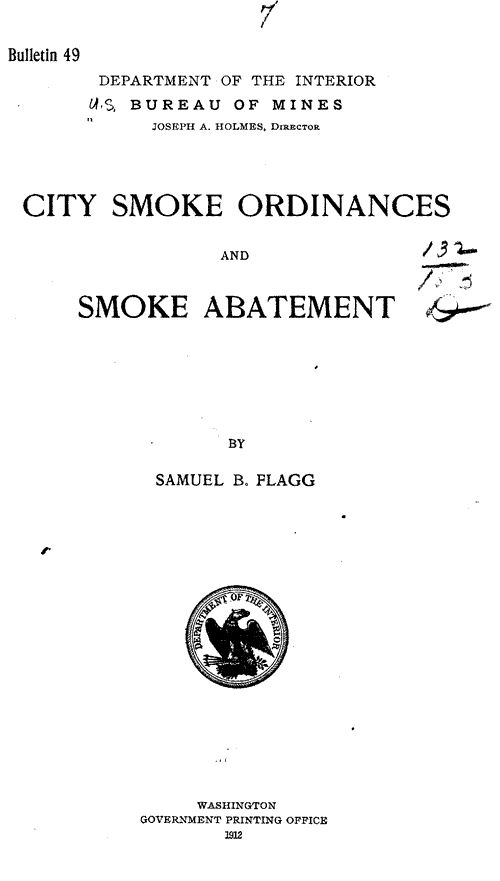
There are some unexpected treasures here, for instance Samuel Flagg's 1912 booklet, City Smoke Ordinances and Smoke Abatement, published by the Bureau of Mines (see title page below). The website explains:
Although concern for the effect of human environmental activity on human welfare did not move to the center of what is now called the environmental movement until the 1960s, the turn-of-the-century conservation movement did include something contemporaries referred to as "human conservation:" an attempt to improve the quality and quantity of human life, particularly in the nation's burgeoning urban centers, through attention to certain kinds of environmental management, particularly technological intervention. Within this framework, engineers, scientists and public policy-makers sought to determine how natural resources, such as mineral fuels, could be used with both maximum efficiency and minimal detriment to the human environment. This brief survey by the U.S. Bureau of Mines provides a concise and systematic overview of contemporary anti-air-pollution efforts as reflected in the smoke-abatement ordinances of cities throughout the country, and prescribes the essential characteristics of ordinances appropriate for municipalities of different sizes. An Appendix reprints actual ordinances from Chicago, Pittsburgh, Des Moines, Milwaukee, Los Angeles, and Boston by way of example. It should be noted that the problems caused by urban smoke are defined (p. 8) in terms of economic waste, damage to buildings, loss of light, dirt, and injury to vegetation, but not as a direct threat to human health.
For more environmental law treatises of the period, see here. For more on smoke regulation, see here and here.

Wednesday, June 15, 2016

Public ownership of water

Yesterday's "This Day in Water History" had the following historical editorial, including not only the record of enforcement action for exceeding a water allocation but also some historical justification for public control and ownership of water resources:
June 14, 1919: Municpal Journal and Public Works editorial. Public Control of Water. “Water companies and departments have appealed to consumers from time to time to restrict consumption in order to avert a water famine in the city, and meters are used largely to prevent waste; but we believe it is something new to impose a penalty for excessive consumption. As told last week, Jersey City, N. J., has been fined by the state $22,285 for using from the Rockaway river more than the 100 gallons per day per capita which had been allotted to it.
The right of state or federal government to guard the quality of river waters has been recognized and become familiar, and western states have long controlled the amount that could be withdrawn for irrigation; but limiting the amount that cities can use for their public supplies is a novelty. There is every reason, however, why power to limit the amount that can be used should rest in a central authority and be exercised on occasion. No one city has a right to monopolize a water supply because it “saw it first.” The water flowing in the rivers of a country comprises the run-off from every square foot of land in that country; and as the entire area yielded it, the entire area has a right in it. Moreover, to permit one or a few cities to monopolize all the water available in a state would be fatal to the growth in population and industrial development of the state outside of such cities.
The New Jersey plan seems to be a rational one and one that all states must adopt in some form, sooner or later; and the sooner, the less will be the confusion and individual hardship and the greater the benefit resulting therefrom.”
Rockaway River (Capture the Moment)

Monday, May 2, 2016

Indian water rights

Continuing coverage of the special issue of Western Legal History on Southern California water: Tanis Thorne's contribution is "Indian Water Rights in Southern California in the Progressive Era: A Case Study." Thorne writes:
The consensual opinion of water rights historians is that piecemeal legal transfer of Indian water rights to the non-Indian majority progressed unabated, decade after decade, throughout the arid American West. The water rights of Southern California Native people remained ill defined well into the twentieth century....
This study departs from the consensus position, which has argued that Indian water rights were ignored until the 1960s. In the case of the Capitan Grande Indian people of San Diego County in the early twentieth century, Indian rights were hardly ignored; they were, in fact, a subject of considerable importance to the federal government. In 1919, the El Capitan Act gave the city of San Diego the right to build the El Capitan Dam and create the El Capitan Reservoir as a city storage site. The transfer of Indian land, held under federal trust, required complicated local, state, and federal negotiations both in the 1910s and in 1932, when the El Capitan Act was amended. The Department of the Interior made a concerted effort to define and protect the Capitan Grande people's riparian rights using the state prior appropriation doctrine. The terms of transfer negotiated in 1919 anticipated  the quantification measures based on "practicably irrigable" acreage set in Arizona v. California.

Tuesday, April 26, 2016

Some historical background on the Flint crisis

Yesterday's This Day in Water History provides some legal-historical background to the Flint water crisis (for more, see here and here). An excerpt:
Where did the LSLs in Flint come from and why were they installed? I found an 1897 City of Flint Ordinance that required the use of lead pipe to connect water mains to homes. I have found dozens and there must be hundreds of ordinances for other cities like this in the literature. Lead was the preferred material because other materials such as iron and steel pipes corroded away. Ironically, lead was considered a more durable material for service lines. Copper and plastic pipes were not commercially available until much later.
*****
What about LSLs? Should they be replaced? Yes. NOW. A big mistake was made in 1991 with the adoption of the Lead and Copper Rule that did not require the replacement of all LSLs in the U.S. Also, the allowance of partial replacement of LSLs made lead exposure of the public far worse. Everyone involved in drinking water and public health should demand that the federal Lead and Copper Rule Long-Term Revisions include an accelerated schedule for replacing LSLs. Also, we should not get confused about who foots the bill. Society made the decision in the 19th and 20th centuries to use lead pipe. The homeowners and utility personnel who installed lead pipes are long dead. The total cost for LSL replacement should be paid for by utilities (with cost recovery from increased water rates) with some help from state and federal governments to seed the process and get it done. Society caused the problem and it is up to all of us to fix it. There are 6.1 million LSLs in this country and they need to be ripped out and completely replaced without delay. 

Tuesday, February 23, 2016

Fighting Westway

The latest Environmental History has a review by Sarah Elkind of William Buzbee's Fighting Westway: Environmental Law, Citizen Activism, and the Regulatory War That Transformed New York City (Cornell UP, 2014). Elkind writes:

In 1973 portions of an elevated highway on Manhattan’s West Side collapsed. A powerful coalition of local business, real estate, and government leaders proposed Westway, a four-mile long, six-lane, underground highway, built entirely on landfill. The project included parks and new space for real estate development; federal highway funds would pay 90 percent of construction costs. But Westway was never built. The Army Corps of Engineers approved landfill for Westway but only after ignoring evidence that Westway would devastate Hudson River striped bass. In 1985 after a federal court excoriated the Army Corps and enjoined the landfill, New York City officials “traded in” the proposed highway for a modest surface road, riverside bike path, and over a billion dollars for mass transit. In New York, Westway remains a symbol of antidemocratic overreach (for opponents) or excessive regulation (for proponents). As environmental history, the “regulatory war” over Westway reveals how the Clean Water Act (CWA), Clean Air Act (CAA) and National Environmental Protection Act (NEPA) transformed regulatory and environmental politics in the late twentieth century.
*****
When the New York State Urban Development Corporation proposed Westway, most New Yorkers assumed that the shallow waters slated for landfill were a biological wasteland. The Army Corps of Engineers’ first draft Environmental Impact Statement (EIS) on Westway landfill concluded that the area was so polluted that filling it would have no negative ecological consequences. The Environmental Protection Agency and other natural resource offices contested this, but the 1977 final EIS asserted the biological wasteland theory even more strongly. When a storm of protest forced the Army Corps to reexamine the ecology of the areas slated for landfill, preliminary results showed that these areas were vitally important habitat for young striped bass. The Army Corps cut the fish survey short and granted the permit for Westway landfill in violation of the CWA. Opponents sued. Court testimony revealed that the Army Corps manipulated and ignored the results of fish studies, and made no effort to explain why their final EIS insisted that Westway would have no adverse effects when the evidence clearly showed it would.
Buzbee provides an excellent explanation of regulatory processes and the limitations of both the CAA and NEPA. He explains “regulatory war,” court procedures, legal standing, the requirements and strengths of specific environmental regulations, and other critical features of environmental policymaking. His biographies of key players demonstrate how expertise and political connections contributed to the Westway controversy. But the real heart of the book is Buzbee’s able and compelling explanation of the legal strategy, evidence, and reasoning behind the Westway verdicts. So the Westway story is a sound case study of the impact of local priorities on federal policies, and environmental regulations on federal agencies like the Army Corps. Buzbee does engage opponents’ arguments and strategy with more nuance and detail than he does Westway’s supporters. His insistence that the outcome was not inevitable does not seem all that important in the face of this careful legal and regulatory history. These are small faults in a very interesting book that is exceptionally well suited to undergraduate courses on environmental law and politics. Fighting Westway may not do precisely what Buzbee says it does, but it will give readers a clear understanding of how regulations work, how government institutions interact, and why it can be so difficult to stop a big project once it is underway. 

Tuesday, October 6, 2015

Arnold Reitze and environmental law in the sixties

Continuing the thread on early environmental law courses, Prof. Arnold Reitze has kindly allowed me to post his recollections of his work at Western Reserve in the 1960s, a demonstration of the interesting work that was being done in environmental law in this period in the academy and at a variety of governmental levels, as well as of the cross-fertilization of teaching, scholarship, and activism. Prof. Reitze writes:
I moved to Western Reserve in 1965 to be the school’s tax teacher. I earned my living teaching tax, but spent much of my time as an environmental activist. I was the counsel for Citizens for Clean Air and Water and for the TB Association’s Air Quality Committee. I also represented the Izaak Walton League. I was very involved in the first attempt to use a voter petition to force the legislature to enact environmental laws. The CAA of 1963 created a conference program for air quality improvement, and Cleveland was one of the areas subject to that laws program. I spent a lot of time on that effort. The 1965 Federal Water Pollution Control Act created a zoning program for improving water quality, and I was active in working to set stringent standards for northern Ohio’s rivers. 
When Louis Toepher became Dean he wanted to hire an experienced tax teacher, and he asked me what I wanted to do. I said I wanted to start an environmental program focusing on eastern pollution issues. I then became the nation’s first full-time environmental law teacher. (Joe Sax also was doing some environmental law work, but he spent his career in water and natural resources and never got seriously involved with the pollution control programs that were transferred to the EPA in 1970.) I taught natural resources law, which eventually was named environmental law, but I believe I continued to teach the more traditional natural resources law with a focus on Ohio issues. I also taught water law and administrative law (which was primarily nuclear energy). [I was active in the fight to stop Davis-Bessee plant.] My work on water pollution led to the “Wastes, Water and Wishful Thinking: The Battle of Lake Erie,” 20 Case W. Res. L. Rev. 5 (1968). My air work led to “The Role of the “Region” in Air Pollution Control,” 20 Case W. Res. L. Rev. 809 (1969). This was based on the work to implement the CAA Amendments of 1967. My work on Ohio’s surface mining led to “Old King Coal and the Merry Rapists of Appalachia”, 22 Case W. Res. L. Rev. 650 (1971). In 1968 I started working to produce the Cleveland Air Pollution Code, which I coauthored with Jim Wilburn; it passed in 1969. My research assistant Jim Walpole became the first lawyer for the Cleveland air pollution program. I was also an advisor to Mayor Carl Stokes, Governor Gilligan and was state campaign chairman for Ray Marvin’s run for attorney general. He lost, but was made the deputy AG for administrative issues, and I continued as an advisor to the AG’s office. 
In 1970 the Ford Foundation fully funded an environmental law program at the George Washington University and I was hired to be the director.
For more on early environmental law teaching, see here and here.

Thursday, September 17, 2015

Natural disasters and legal solutions

Following up on Sunday's post on disasters, here's more on the subject: Franz Mauelshagen recently posted "Natural Disasters and Legal Solutions in the History of State Power". Some excerpts:
Throughout the history of disasters, legal solutions of one sort or another have played a significant role in recovery and prevention, as well as in shaping politics and individual behavior. After the Great Fire of London, following an extreme summer drought in 1666, the city council passed new building laws preventing the use of timber and man-dating stone or brick construction.Wood chimneys were prohibited after fires in Boston in 1631 and in New York in 1648. A list of similar legal changes in response to disasters would be endless. Through building codes,urban fire disasters have left visible traces in cityscapes almost everywhere around the world. In fact, because the new norms impact planning and construction for generations, they continue to leave such traces long after the buildings erected in the wake of the disaster have disappeared. 
Legal solutions operate at the intersection between government and the members of a political community by sanctioning certain types of individual behavior, either through coercion or incentives. In other words, legal solutions aim to achieve a degree of behavioral homogeneity and predictability that legislators consider desirable. The potential of natural hazards and disasters to trigger cultural transformations over the long term ismost obvious in environmentally vulnerable regions, such as dense urban agglomerations, coastal settlements, or agricultural economies in precarious climatic conditions.
*****
So far, only a few historians have considered natural disasters as an element in the evolution of governance. The evidence that has been brought to light suggests that natural disasters probably deserve a place in the history of state power—along with war and state competition. Political response to the second Bubonic plague pandemic in Europe, beginning with the Black Death in 1348, evolved over several centuries and left permanent traces in legal and political systems. Robert C. Palmer diagnosed that, in medieval England, the Black Death transformed “the nature of English governance” towards centralization, a new under-standing of governmental authority,and an enlargement of the sphere of legal matters. Such feedbacks of legal regulations in the realm of governance also explain how hospitals, originally invented to interrupt the chain of infection by separating the healthy from the sick, went from temporary to permanent institutions. The same holds true for medical councils, whose members initially had been appointed only in times of high emergency. In the eighteenth century, however, they became permanent, which made them precursors of departments of health in modern nation states.

Thursday, May 28, 2015

Zoned in the USA

H-Environment recently posted Richard Walker's review of Sonia Hirt's Zoned in the USA: The Origins and Implications of American Land-Use Regulation (Cornell UP, 2014). Walker writes:
Hirt does four things in this volume. First, she lays out the essentials of American zoning and planning without getting lost in the details. Second, she makes the comparative case for the uniqueness of the United States in terms of its degree of spatial homogeneity and protection of the idealized single-family, detached house. Third, she gives a quick tour of the history of spatial separation in cities and especially the rise of urban planning in Europe, before returning to the deep roots of "exclusive domesticity" in America ideology from the colonial era onward. Finally, she provides a fine, brief history of the establishment of deed covenants and municipal zoning in the US case.
The essence of Hirt's analysis is that American zoning is distinct from all other national planning practices, and that it is so because the spatial order of American society and cities is unique. In this, history matters in showing the depth of American ideas and permanence of US practices concerning what Hirt calls "spatial individualism": freedom conceived geographically as isolation and elbow room. Frederick Jackson Turner goes to town, as it were. Along with this came a uniquely American preference for the single-family, detached house, which dominates urban space and legal practice as in no other country. Hirt certainly recognizes the importance of separating noxious uses from domestic tranquility as the foundation for zoning, but she is nicely attuned to two other things vital to spatial freedom in the American sense: freedom from having to mingle with the lower classes and races and freedom to profit from property development by keeping government at bay except to minimize uncertainty and risk. The desire for spacious, single-family housing segregated by class, race, and function was deeply ingrained in popular bourgeois culture.
One thing I particularly like in Hirt's historical approach is that, unlike almost all other treatments of zoning and spatial segregation in American cities, this one does not begin after World War Two and does not put the bulk of the blame on the federal government's mortgage policies. The New Deal simply put federal muscle and money behind what was already standard practice locked into the fabric of urbanization by the real estate industry and Herbert Hoover in the 1920s. As is so often the case in the United States, government policy and business interests went forth hand in hand to build cities profitably.

Saturday, October 18, 2014

In Memoriam: Frank Grad

Columbia Law School notes the recent passing of Professor Emeritus Frank Grad. Some excerpts from the press release:
Born in Austria in 1924, Grad immigrated to the United States in 1939 to escape Nazism. He and his sister left Austria on the Kindertransport, and Grad lived with a family in England before coming to the U.S. 
*****
In 1959, Grad was given the task of revising the New York City Health Code, including provisions relating to water pollution and its prevention, control of sewage fallouts, and the control of toxic substances and poisons. The code also included numerous provisions relating to the protection of food and water supplies against contamination by pollutants.
*****
In 1969, Grad became director of the Legislative Drafting Research Fund and a full-time faculty member. He chose to take on classes in an emerging area in which his expertise would prove invaluable: environmental law. Grad was the first to teach the subject at Columbia Law School and, when he couldn’t find any materials to teach with, he wrote one of the earliest books on the subject. 
“Frank Grad was one of the true pioneers in the study and teaching of environmental law,” said Michael B. Gerrard, the Andrew Sabin Professor of Professional Practice and director of the Law School’s Sabin Center for Climate Change Law. “The field's seminal year was 1970 (when President Nixon created the EPA and signed the first major laws of the modern era), and Frank was out of the box with one of the first casebooks in 1971, and then one of the first treatises in 1973.  He trained generations of environmental lawyers.”
Grad updated his eight-volume Treatise on Environmental Law twice a year.
According to a December 20, 1969, article in The New York Times, “Environmental Law is Attracting Students,” 69 students applied to be in Grad’s 18-seat first course. “The school, in an unusual relaxation of its rules, will permit 30 students to take the course,” the Times wrote.

Sunday, October 12, 2014

Environmental-policy-relevant history

I suspect we'll be hearing a lot in the coming months about The History Manifesto by David Armitage and Jo Guldi (Cambridge UP, forthcoming, available already for free on line). In the meantime Armitage gives us a preview in The Guardian, including this on history and current environmental policy (links added):
Debates on climate change also reflect the advantages and the limitations of historical perspective. On the one hand, Barack Obama’s former undersecretary for science in the US energy department, Steven Koonin, has recently argued for humility about future policy because we lack long-run data about the role of the oceans in climate change: “Precise, comprehensive observations of the oceans are available only for the past few decades.” On the other, historical economist Anil Markandya has shown that environmental regulation in 19th-century Britain did not have “any serious impact on GDP per capita”, overturning the orthodoxy that there is a necessary trade-off between growth and environmental protection. Meanwhile, French historians Sabine Barles and Gilles Billen have examined Paris’s “nitrogen footprint” to show how urban managers there invented sustainable practices for recycling waste in large cities: these are precedents relevant to practice and policy today.

UK sulfur emissions/capita, real GDP/capita, selected air pollution regulations
(Markandya et al, Envtl & Resource Econ (2006) 35: 221-257)

Friday, October 10, 2014

Smoke regulation in Baltimore

Pratt Street Power Plant today (G. Edward Johnson)
As a former Marylander who spent a lot of time in Baltimore, I was particularly interested when Legal History Blog recently noted the publication of Ann-Marie Szymanski's "Regulatory Transformations in a Changing City: The Anti-Smoke Movement in Baltimore, 1895–1931" in The Journal of the Gilded Age and Progressive Era. The article enters a longstanding discussion of the circumstances of the development of local environmental regulation against a common-law background, foregrounding as well dimensions of gender and class. The conclusion:
In many ways, the long road to administrative smoke regulation in Baltimore followed the path laid out by anti-smoke reformers elsewhere, albeit in fits and starts. In cities across the United States, amateur activists initially relied on the existing common-law approach to regulating nuisances, a strategy that, at best, only allowed them to shut down isolated polluters. However, when various judges and health boards proved reluctant to declare smoke to be an actionable nuisance, smoke opponents organized campaigns during the 1890s to secure smoke abatement ordinances that declared smoke a nuisance by definition. After the courts nullified several such ordinances on the grounds that only states could define nuisances, anti-smoke activists turned their attention to state legislatures, which increasingly empowered municipalities to regulate smoke after 1900. With this enabling legislation in hand, cities typically went beyond the nuisance approach. Municipal officials no longer merely responded to complaints, but became proactive. For example, they often required businesses to secure building permits for all new construction and repairs to boilers and furnaces. They also created more sophisticated solutions to the smoke problem. Whereas the common-law approach provided three basic responses to any regulatory conflict (injunctions, abatement and the payment of damages), the new anti-smoke regime proposed a variety of technical solutions, including the installation of smoke-control equipment. Of course, this reliance on technical solutions empowered those who were presumably best able to design them, namely, engineers.
Some scholars have been critical of the triumph of experts in early environmental regulation. Indeed, as the Baltimore case confirms, engineers who served as smoke inspectors often sought accommodation, cooperation, and gradual smoke reduction. David Stradling, for one, argues that such a conciliatory approach blunted the movement's impact on urban pollution; likewise, he holds that women's “arguments concerning health, beauty, cleanliness, and morality gradually lost ground to engineering concerns” and the narrower quest for efficiency. Frank Uekoetter disagrees with these conclusions, noting that even after engineers became leaders in the movement, some public officials continued to prosecute those who violated anti-smoke ordinances and ignored the inspectors' technical advice. Moreover, he finds that both women and engineers emphasized technological as well as aesthetic and moral aspects of the smoke problem, suggesting that there was no rigidly gender-specific approach to the smoke issue.
This study suggests that some female anti-smoke activists were deferential to experts without ceding the entire sphere of action to them.