Thursday, August 31, 2023

Cottages as public nuisances

More on public nuisance: Maureen Brady recently posted "Cottages as Public Nuisances: The Long History of Land Use Regulation of the Poor", forthcoming in Depaul Law Review. The abstract:

In the Fourth Book of his Commentaries on the Law of England, in a chapter entitled “Offenses Against the Public Health, and the Public Police or Oeconomy,” William Blackstone sited his discussion of “common nuisances.” Although many things on this list of what we now call public nuisances are familiar—blockages of public roads, disorderly saloons, trades emitting offensive smells or sounds—one stands out. Blackstone described as a typical nuisance the erection of “cottages,” going on to discuss and even criticize the situation of these dwellings alongside uses like fireworks and the keeping of hogs in close quarters.

Blackstone, Washington DC

The aim of this Essay is to examine Blackstone’s discussion of cottages in context, endeavoring to use it toward two ends. The first is to better understand the concept of public nuisance and its limits. As others have chronicled, there has been a renaissance in interest in the tort in recent years, spurred on by multimillion dollar litigation invoking it in contexts ranging from the opioid epidemic to climate change. Here, I engage in a close reading of Blackstone’s passage and its citations, examining why cottages were regulated as public nuisances in the first instance and how that history connects to broader developments in English (and later American) law and society. As it turns out, cottages bore a closer relationship in many ways to public nuisance “classics,” like road blockages and certain public health risks, than it might at first appear.

Sunday, August 27, 2023

The evolution of US NOx standards for cars

Dan Farber at Legal Planet recently posted on "Cars, Smog, and EPA". An excerpt:
For the first 20 years of federal regulation, Congress set the NOx [nitrogen oxides] standards for new cars itself. That’s quite different from the standards for industrial pollution sources, which Congress has always delegated to EPA. The reason may have been the high political stakes in the car industry or the relatively easier task of setting standards for new products in a single industry using a single energy process.
East River and Manhattan Skyline in Heavy Smog (Chester Higgins, Jr., EPA, 1973)
... The initial standard, set in the 1970 Clean Air Act, was 3.1 grams per mile (gpm) for NOx. Achieving that standard was thought to be nearly impossible when Congress created this mandate, but the mandate forced the car companies to make technological breakthroughs with catalytic converters.

Note that the standard is set in terms of pollution per mile rather than pollution per gallon. That means that any increase in fuel efficiency automatically helps a company meet the pollution standards as well. Theoretically, a car could have no pollution control at all but get such phenomenal mileage that it met the pollution standard. Actual mileage has improved but not enough to obviate the need for pollution controls.

Congress adjusted the standards twice. A 1977 amendment reset the limit to 1 gpm in 1981. The 1990 amendments changed the standard to 0.6 gpm, effective in 1994. These are called Tier 1 standards. Apparently Congress did not relish the task of periodically resetting the standards itself  The 1990 Amendments authorized EPA to set standards for 2004 and beyond.

*****

This has to be considered a successful regulatory program. The Biden proposed standard  [of 2023] allow less than 1% of the pollution levels that Congress mandated in 1970.

Friday, August 25, 2023

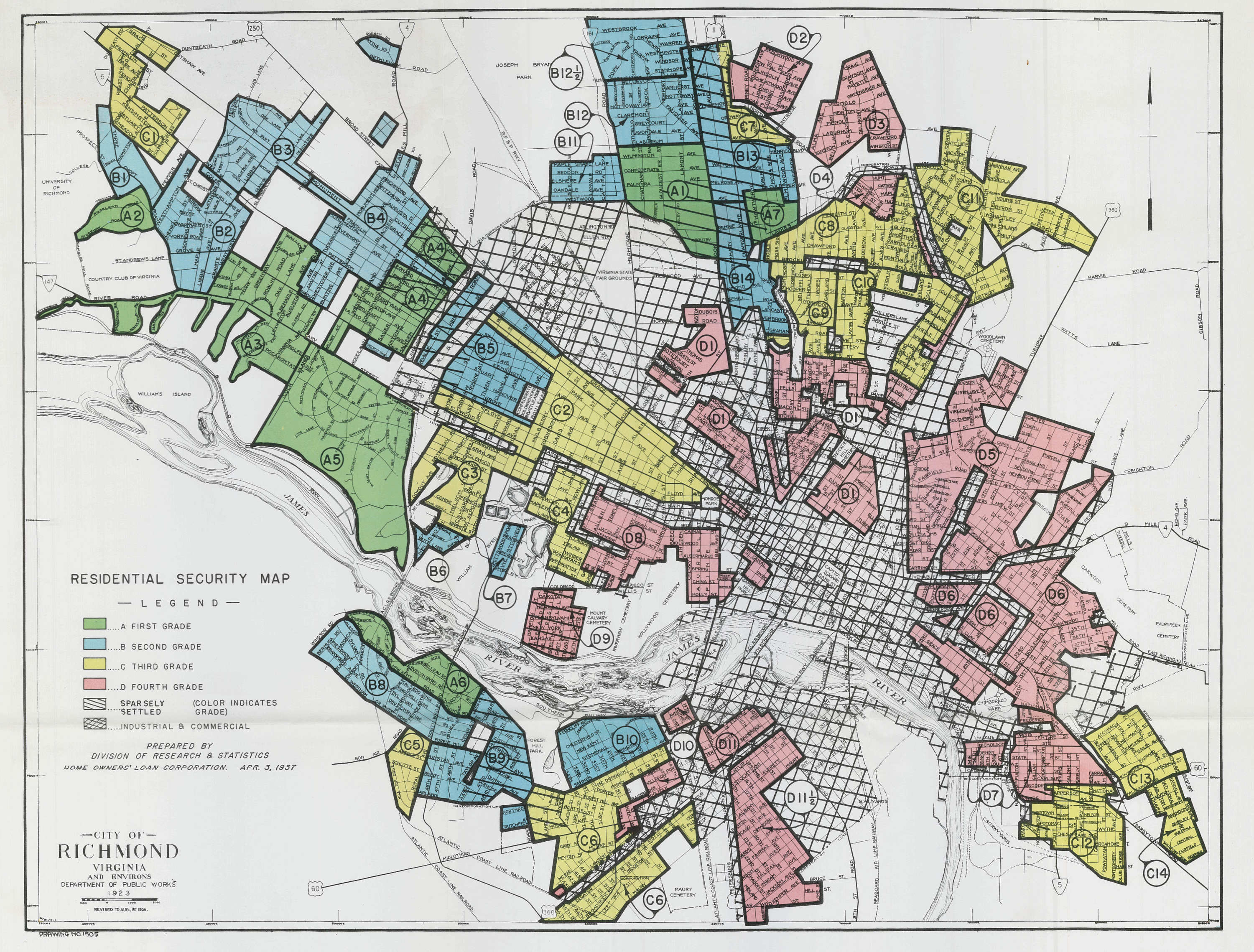
Water access and historical redlining

Charles W. Sterling III recently published "Connections Between Present-Day Water Access and Historical Redlining" in Environmental Justice. The abstract:
Although challenges in water and sanitation access are often assumed to be issues of low- and middle-income nations, more than 400,000 homes in the United States still lack access to complete indoor plumbing. Previous research has demonstrated that the remaining plumbing challenges are more prevalent in communities with high Black and Brown populations. This study hypothesizes that the 1930s practice of redlining by the Home Owners' Loan Corporation (HOLC), which systematically denied loans to minority populations, is linked to present-day inadequate plumbing access (i.e., defined as incomplete plumbing above the national average). Digitized HOLC maps for 202 urban areas across the country and U.S. Census data from the 2016 to 2020 American Community Survey were combined to interpolate the modern-day plumbing access for historical neighborhoods (n = 8871 communities). Analysis via binomial logistic regression demonstrated that nationally, redlined communities (HOLC Grade “D”) are significantly more likely to have a rate of incomplete plumbing above the national average compared with greenlined communities (HOLC Grade “A”) (0.1352; confidence interval = ±0.036). This finding was also observed for three of the nation's four census subregions (Northeast, Midwest, and West). Slight differences by region in relationships between the proportion of specific racial/ethnic populations on rates of incomplete plumbing demonstrate the need for targeted place-based interdisciplinary examinations of exclusionary practices. The demonstration of the present-day impacts of redlining after nearly 90 years emphasizes the need to intentionally mitigate past injustices to ensure modern-day equity.

Friday, August 18, 2023

Water rights and forest regulations in the Charter of the Escartons (1343)

The Grand Charter of the Escartons
I was fortunate to be able to spend some time this summer along the Guisane River, in the area formerly known as the Dauphiné, today in southeastern France. The river is notable for its old canals, still in use, and the surrounding mountain slopes are covered in forest. It turns out this landscape has an interesting legal history.

In 1343, Humbert II, the last Dauphin of Viennois (before that title passed to the kings of France and was used for the heir apparents to the royal throne), confirmed the rights of the people of the Briançon region in the "Grand Charter of the Escartons", effectively creating a sort of autonomous republic free of feudal obligations that survived, with its rights confirmed by the Kings of France, until the French Revolution. Two articles caught my eye (my translation from the French translation by Fernand Carlhian-Ribois):

Art. XVII  : The people of Briançon now have the right to build canals to water their land, take water from torrents and rivers without having to pay the right of use either to the Dauphin Humbert or to his heirs and successors.

Art. XVIII  : It is forbidden for the officers, Dauphins and Nobles to cut timber or firewood in the forests of the Communities of Briançonnais, Queyras, Vallouise, Césane, Oulx, Pinet, Chevalette, Fontenils, or other places in the Baillage, because the cuts are the cause of floods, landslides and avalanches. This prohibition is perpetual. 

Article 18, with its early recognition of the connection between deforestation, erosion, and flooding, is interesting for its popular environmentalism, blaming the environmental degradation of the mountain region (a theme that became prominent again in the nineteenth century; see. e.g., George Perkins Marsh's Man and Nature) on the feudal rights of the nobility, and abolishing those rights forever. 

And I wonder what the effect of Article 17 was on riparian conflicts. Said Guisane River is full of canals (see photo below) leading off to mills on the riverbanks and then returning the water downstream. While family members were enjoying rafting the stream, I was imagining the conflicts between riparian owners and public users that must have resulted from the many dams and diversions. Local legal records must be full of such riparian conflicts, and I would think that Article 17's right to take water free of charge must have complicated the issue.

Tuesday, July 25, 2023

CFP: Environmental History, Legal History, and Environmental Law – Two Transdisciplinary Conversations


Susan Bartie (ANU), Ben Pontin (Cardiff), and I are organizing a double session on environment, law, and history for the 4th World Congress of Environmental History, to be held (in hybrid format) in Oulu, Finland, 19-23 August 2024. This double session will showcase environmental-legal-historical research that demonstrates the opportunities as well as the challenges inherent in this meeting of disciplines, and discuss strategies, theories, and research methods that might help in overcoming these challenges. The sessions' abstract is below.

If you're interested in joining (in person or remotely, you need not decide now), please submit a proposal through this link by 18 September 2023. Please indicate in your submission whether you wish to propose a traditional research paper (the first session) or make a presentation as part of the roundtable (second session).

Abstract:

The triangle ‘environment–history–law’ suggests a wealth of opportunities for productive transdisciplinary scholarship: Historical analysis of environmental law, environmental histories of legal change, legal histories of the environment, etc. Yet such transdisciplinary projects have to date been tentative and largely tangential to the thriving fields of environmental history, legal history, and environmental law. Legal history, while having moved beyond its previously narrow focus on legal doctrine to embrace wider contexts of society, economy, and culture, has to date remained largely indifferent to environmental issues or to the environment as a category of analysis. The field of environmental law, so salient in pressing issues such as climate change and biodiversity conservation, tends to see itself as brand new, overlooking centuries of environmental laws. And while environmental histories frequently reference legal issues and institutions, from common property to rights of nature, they are often insensitive to the legal context in which these institutions operate.

The first session will showcase new environmental-legal-historical research that demonstrates both the opportunities and challenges inherent in this meeting of disciplines. The following, roundtable session will bring together scholars working across the boundaries of environment, history, and law, in order to discuss the challenges facing this intersection of disciplines, from institutional obstacles to the difficulty in meshing historical and normative analysis. With the participation of the audience, it will seek to identify strategies, theories, and methods that might help in overcoming these challenges. Panelists will be drawn from a variety of disciplines, regions, and methodological approaches. 

Sunday, July 23, 2023

The reasonableness standard, Israel's current crisis, and Edward Coke

As protests continue to erupt in Israel over the government's proposal to oust the power of courts to review decisions of the government and its ministers for reasonableness, I thought it worth taking a look at the historical origins of this doctrine in an area of particular interest to this blog - water law.

Israeli administrative law's reasonableness standard was inherited from the British, who ruled Palestine from 1917 to 1948 and imported much English law and legal culture to the middle eastern jurisdiction. In the 1928 Supreme Court case of AG v Altshuler ([1920-1933] PLR 273), for instance, the court held that a municipal bylaw of Tel Aviv was invalid due to unreasonableness, relying on the English precedent of Kruse v Johnson ([1898] 2 QB 91).

Sir Edward Coke
As many will know, the reasonableness standard was apparently introduced to English law by the 1598 decision of the Court of Common Pleas in Rooke's Case (5 Co Rep 99b, 77 Eng Rep 209). At issue was the power given to the Commissioners of Sewers by statute (the 1531 Statute of Sewers) to assess lands adjoining water courses in order to fund the building of works to protect adjacent lands from flooding. The Commissioners assessed a certain Carter, who had seven acres of land flood-prone adjoining the Thames, with the costs of repairing the banks of the river along a long segment of the river, leaving a further 800 acres, possessed by others and similarly threatened by the waters, free of charge. In their defence, the Commissioners pointed to the language of the statute (s 3), which gave them the power to make repairs 'as Case shall require, after your Wisdoms and Discretions'. Edward Coke's report explained what he saw as the rationale behund the court's rejection of this claim:

Notwithstanding the words of the commission give authority to the commissioners to do according to their discretions, yet their proceedings ought to be limited and bound with the rule of reason and law [emphasis added - DS]. For discretion is a science or understanding to discern between falsity and truth, between wrong and right, between shadows and substance, between equity and colourable glosses and pretences, and not to do according to their wills and private affections ; for as one saith, talis discretio discretionem confundit [such discretion confuses discretion].

So administrative discretion, explained Coke, must be subject to 'the rule of reason and law'.

One might have legitimate criticisms of the way the reasonableness standard is currently applied in Israeli law, but it is clear that the current government's main motivation in its proposed legislation is simply the desire to be free of the rule of reason and law - which explains why there are hundreds of thousands of us out on the street protesting...

Friday, June 30, 2023

The right to abate a public nuisance

William B. Meyer's "“No Quixotry in Redress of Grievances”: How Community Abatement of Public Nuisances Disappeared from American Law" was recently published in Law and History Review. The abstract:
Before 1859, the right of any member of the public to abate a public nuisance existed unchallenged in American law as a judicially recognized form of popular justice. In that year, the decision in Brown v. Perkins, authored by Massachusetts Chief Justice Lemuel Shaw, restricted the right to those who had suffered particular injury. The decision grew out of a suit for damages by the owner of an illegal saloon, which had been sacked by a local mob. Reversing what Shaw himself had said in his charge to the jury in the same suit in the preceding year, it had little grounding in earlier American case law. Shaw's prestige and the apparent demands of public policy, however, helped win courts over to the new doctrine in relatively short order. The change was most enthusiastically promoted by judges and scholars of conservative leanings disturbed by the threat of popular excess and most resisted by those of more radical inclinations. It paralleled American law's broader shift in the same period toward centralized regulation and the constitutionalization of rights and powers.
Lemuel Shaw, 1856

Wednesday, June 28, 2023

The postwar ocean frontier and its legacy for law of the sea

Just out in Environment and History: "Wild Blue: The Post-World War Two Ocean Frontier and its Legacy for Law of the Sea" by Helen Rozwadowski. The abstract:

The post-1945 ocean came to be viewed through the cultural prism of 'frontier', denoting both a bonanza of resources and also lawlessness that impeded secure investment in their exploitation. After Arvid Pardo inserted the cultural representation of ocean frontier into law of the sea discussions with his 1967 proposal of the ocean as the Common Heritage of (Hu)Mankind, the prospect of using hitherto unexploited ocean resources to equalise an unequal world was widely, if not universally, embraced. While many commentators deny the power of the ocean frontier representation, this paper argues that, even as environmental concerns about pollution and declining resources aligned with worries about global overpopulation, the ocean continued, during the protracted negotiations of the third United Nations Conference on the Law of the Sea beginning in 1973, to be viewed as full of resources. The historical context of decolonisation and Garrett Hardin's 1968 Tragedy of the Commons argument reframed the ocean into a site for competition over resources.

Arvid Pardo monument at the University of Malta (Dans)

Saturday, June 3, 2023

Jhering and environmental legal history

The German-language legal history journal Zeitschrift für Neuere Rechtsgeschichte last year published Sascha Ohlenforst's article, "Vom Sinn und Nutzen der Umweltrechtsgeschichte. Methodische Überlegungen auf Grundlage der Interessen- und Wertungsjurisprudenz" [On the sense and use of environmental legal history. Methodological considerations based on the jurisprudence of interests and values.]. The abstract:

How to write a history of environmental law that can be integrated into environmental and  legal history? What insights can be gained from dealing with past environmental law? The article discusses and problematizes essential questions of modern legal history and, on the basis of the jurisprudence of interests and values – especially with reference to Rudolf von Jhering –, promotes a possible new orientation of the history of environmental law. Such a method considers above all the different interests of historical actors and reference groups as a major factor of dynamization in environmental law. Examining these interests as social factors not only contributes to a deeper understanding of the particular human-environmental relations in the past, but also provides a detailed insight into the development of law. By consulting a case study on mining law, both the dynamizing factors as well as the continuities and disruptions between past and present law are illustrated.

Thursday, May 18, 2023

Tani on Calabresi and the "Economic Style"

Karen Tani just completed a fascinating four-part series at Legal History Blog on Guido Calabresi's particular form of law and economics scholarship and its influence on legal thinking. Though Tani doesn't directly deal with environmental issues (nor did Calabresi give them much attention), the series raises important questions that have relevance to understanding the history of environmental regulation and environmental law scholarship in recent decades. In particular the series focuses on the question of to what extent economic thinking in Calabresi's writings claimed exclusivity or made room for other ways of thinking about legal problems. 

Calabresi himself often insisted (as in the subtitle "One View of the Cathedral") that economics was just one factor to be considered in legal analysis, and his classic works (such as The Cost of Accidents and the Cathedral article) also at least paid lip service to this idea, but I have always thought that the depth of Calabresi's economic analysis, juxtaposed with the cursory treatment he usually gave to distributive considerations, broadcast the message that efficiency was the key factor to be considered.

This way of thinking has obviously had great effects on environmental law, starting from the way environmental issues are typically presented to law students - as negative externalities that need to be internalized or collective-action problems that need the aid of law to overcome, rather than, say, as issues of distributive justice or problems of environmental ethics.