Thursday, May 18, 2023

Tani on Calabresi and the "Economic Style"

Karen Tani just completed a fascinating four-part series at Legal History Blog on Guido Calabresi's particular form of law and economics scholarship and its influence on legal thinking. Though Tani doesn't directly deal with environmental issues (nor did Calabresi give them much attention), the series raises important questions that have relevance to understanding the history of environmental regulation and environmental law scholarship in recent decades. In particular the series focuses on the question of to what extent economic thinking in Calabresi's writings claimed exclusivity or made room for other ways of thinking about legal problems. 

Calabresi himself often insisted (as in the subtitle "One View of the Cathedral") that economics was just one factor to be considered in legal analysis, and his classic works (such as The Cost of Accidents and the Cathedral article) also at least paid lip service to this idea, but I have always thought that the depth of Calabresi's economic analysis, juxtaposed with the cursory treatment he usually gave to distributive considerations, broadcast the message that efficiency was the key factor to be considered.

This way of thinking has obviously had great effects on environmental law, starting from the way environmental issues are typically presented to law students - as negative externalities that need to be internalized or collective-action problems that need the aid of law to overcome, rather than, say, as issues of distributive justice or problems of environmental ethics.

Friday, May 5, 2023

Rome and the sea of law

ASOR (Ancient Near East Today) just put up a post by my editorial colleague, Emilia Mataix Ferrándiz: "A Sea of Law: The Romans and Their Maritime World". Mataix Ferrándiz begins:

The sea was key for Rome’s success; it served as the setting of several battles that granted them hegemony over the Mediterranean as well as the main highway for both ideas and commerce. However, human bodies are not naturally suited to the sea; entering or crossing it means challenging one’s own capacities in the face of the power of water. The latter is echoed in literary sources, which often focus on the sea’s enormity and wilderness, thus evoking — and sometimes even exaggerating — its aura of mystery and uncertainty and the effect it has in ancient societies.

Roman legal sources, on the other hand, tend to focus more on the practical challenges and effects of interacting with the sea, presenting a different vantage point from which to study how Romans regarded and dealt with the challenges presented by the sea. So what can we say about how Roman jurists perceived the sea? Although jurists coincide in their understanding of the sea as a dangerous realm not governed by their civil law, the solutions which they provided for similar problems vary from jurist to jurist and from one period to another.

Roman mosaic from Veii (Italy), 3rd-4th century AD, Badisches Landesmuseum Karlsruhe (Carole Raddato)

In the Roman world, spaces were governed by different legal fields. While the land was managed by ius civile (the law of Roman citizens), the sea was a space of ius gentium, or the law of all peoples. It was the jurist Marcian (second–third century CE), who wrote that the sea was the common property to all according to natural law. From his writings the main point to note is that the sea is not subject to an individual’s dominion and, therefore, is also not subject to Roman governance. Despite Roman imperialistic aims and propaganda, it is unlikely that the ideology of rule over land and sea extended to any practical attempts to regulate the use of the sea. 

Mataix Ferrándiz goes on to argue that

Monday, April 17, 2023

Environmental laws circa 1970

The Journal of Global History recently published Lena Joos's "‘Only One Earth’: Environmental Perceptions and Policies before the Stockholm Conference, 1968–1972". The article is based on a comparative study of sixty-three preparatory country reports for the UN Conference on the Human Environment 1968–1972 (UNCHE). One of the article's sections, "Environmental policy measures around 1970 in global comparison", has a lot of information on environmental laws in these countries at the time, including a table with dozens of laws from various countries on a variety of environmental issues. Joos writes that legal measures were the most widespread reported approach to solving environmental problems:

In 1972, forty-nine countries (78%) had legal regulations on the environment in place. Three different forms of legal measures can be distinguished at the national level. Firstly, environmentally significant changes to the legal framework, for example, laws, which defined the responsible actors and empowered them with the requisite powers. Other measures of this type were laws that regulate, for example, the granting of licenses and the privatisation or nationalisation of environmentally significant goods. For example, authorities issued licenses for hunting animals (Botswana, Israel), forest areas (Brazil, DRC), and industrial sites (Denmark, Israel, Norway). Privatisation was not mentioned in any report; nationalisation of forests occurred in Nepal (1956) and Iran (1963); nationalisation of the land was introduced in Senegal (1964). Overall, however, measures concerning ownership were rarely reported, even in socialist countries. The second form, legal requirements, can further be divided into precepts and prohibitions. For instance, countries set emission standards for industries (Canada, Japan), motor vehicles (Denmark, Ireland, the USA), or required filters for the production process (Brazil, FRG, Norway, Portugal, Sweden, Ukraine, Yugoslavia). Prohibitions aimed at preventing actions harmful to the environment were widespread and mentioned in 71% of the reports. The most famous example was the prohibition of the pesticide DDT, which was banned by nineteen of the sixty-three countries between 1969 and 1971. Closely linked to the requirements and prohibitions was the third form of legal measures: the sanctioning of environmentally damaging behaviour, e.g. fines for polluting activities.

Not all countries surveyed implemented legal environmental standards. And the mere existence of environmental legislation says little about the level of detail and the design of the laws. Thus, while many countries had environmental laws, in most, these were fragmentary. Around 1972, according to the reports, only Japan, Sweden, the GDR, and Switzerland had comprehensive environmental laws. In all other cases, the laws covered only one specific sector of the environment such as the protection of wildlife, air preservation, soil conservation, nature and landscape protection, water and sea protection, town planning, forest conservation, noise, radiation protection, waste management, and pesticides. In terms of the implementation date, individual environmental laws were in some cases implemented before 1950. However, most of the laws mentioned in the country reports originated in the fifteen years before the UNCHE. The large-scale establishment of environmental legislation was thus a fairly recent development around 1970 and can be connected to some extent to the preparatory process of the UNCHE.

This is an interesting and important argument, though I'd like to see more evidence before being convinced that a law enacted in 1960 should be credited to the preparatory process of the UNCHE. 

12 June 1972 - Meeting of the Second Committee of the United Nations Conference on the Human Environment, Stockholm, Sweden. At the presiding table during the meeting of the Second Committee (left to right): Mr.Luis Perez Arteta, Programme Director of the Second Committee; Joseph Odero-Jowi (Kenya), Chairman of the Second Committee, and M. Plehn-Mejia, Committee Secretary. (Photo Credit: UN Photo/Yutaka Nagat)
Joos goes on:

Tuesday, April 4, 2023

Not so fast: Nature versus the Common Law concludes

I haven't posted in the last few weeks, leading my friends at the Legal History Blog to reasonably conclude that my series on Nature versus the Common Law was finished. But now I have some time to post what is in fact the final installment in the series.

The posts in this series, based on my article in Clio@Themis, aimed to illustrate a once-common way of thinking about law and legal claims, in which the natural environment was held not only to provide the physical background on which polities and their legal systems existed, but to demand from these legal systems a measure of accommodation. For some judges, it is true, the demands of nature, however worthy or desirable from a social or economic point of view, had no place in court; a judge's role was to resist such claims in the name of the law. For many others, however, environmental realities might be imbued with normative force powerful enough to outweigh considerations of legal precedent and tradition. Moreover, while environmental differences could sometimes break the chains of black-letter law, environmental similarities might at the same time create new legal bonds, as in the Indian and Canadian cases that looked to the law of the independent United States of America, with is great rivers, for legal guidance. All this is to say that in the context of water law in the British Empire, nature could often be "jurisgenerative", to use Robert Cover's term – creating law.

The environmental rhetoric of these courts may, at first glance, seem but a particular instance of the wider phenomenon of colonial and newly independent courts working to stake out the independence of their legal systems from the law of the old country. Yet this would be a mistake: Most of the judges arguing for nature's normative force were themselves British; and in the cases examined here even judges of the independent United States argued not for a general rejection of the English common law, but for the inapplicability of some of its water law rules due to supposed environmental incompatibility.

In conclusion, though, it should be noted that this study has shown that nature also had a "jurispathic" role, impeding the smooth flow, or "transplant", of legal norms around the empire. Legal norms, in particular the common law, spread around the British Empire through a network of orders, legislation, publications, correspondence, educational institutions, career paths, and more. Yet the spread of norms, never smooth, was hampered by a number of factors, some of them natural : distance, forbidding seas, and monsoon winds, to name a few. These factors impeded the transmission of legal ideas and norms in all areas of law. At the same time, this study has highlighted an additional mechanism through which nature sometimes frustrated the spread of norms: perceived environmental similarity and difference.

Nature thus had a dual normative role in this context: creating new norms while at the same time extinguishing others. One need not take a deterministic view of the place of nature in legal history, nor recognize in nature any sort of agency of the intentional kind, to acknowledge that nature had an important role in constituting the connections that both facilitated and obstructed the global flow of water law in the age of empire.

Yet if the first set of law-impeding environmental factors, deriving from physical impediments to legal communication, has historically applied with similar force across all areas of law, the efficacy of the latter mechanism, based on perceived environmental factors, presumably has been correlated with the degree to which the area of law directly dealt with environmental issues. With regard to water law, as we have seen, whether environmental conditions in fact dictated or determined the rejection of common law norms, it is clear that judicial perceptions of nature did play a role in impeding the spread of English norms in this field. I have argued elsewhere that forest law, too, was at least in some contexts heavily influenced by perceptions of environmental foreignness and change. Further study might reveal similar patterns with regard to other related areas of law, from sanitation regulation to wildlife protection.

Happy spring holidays!

Tuesday, March 14, 2023

The history of Sierra Club v Morton

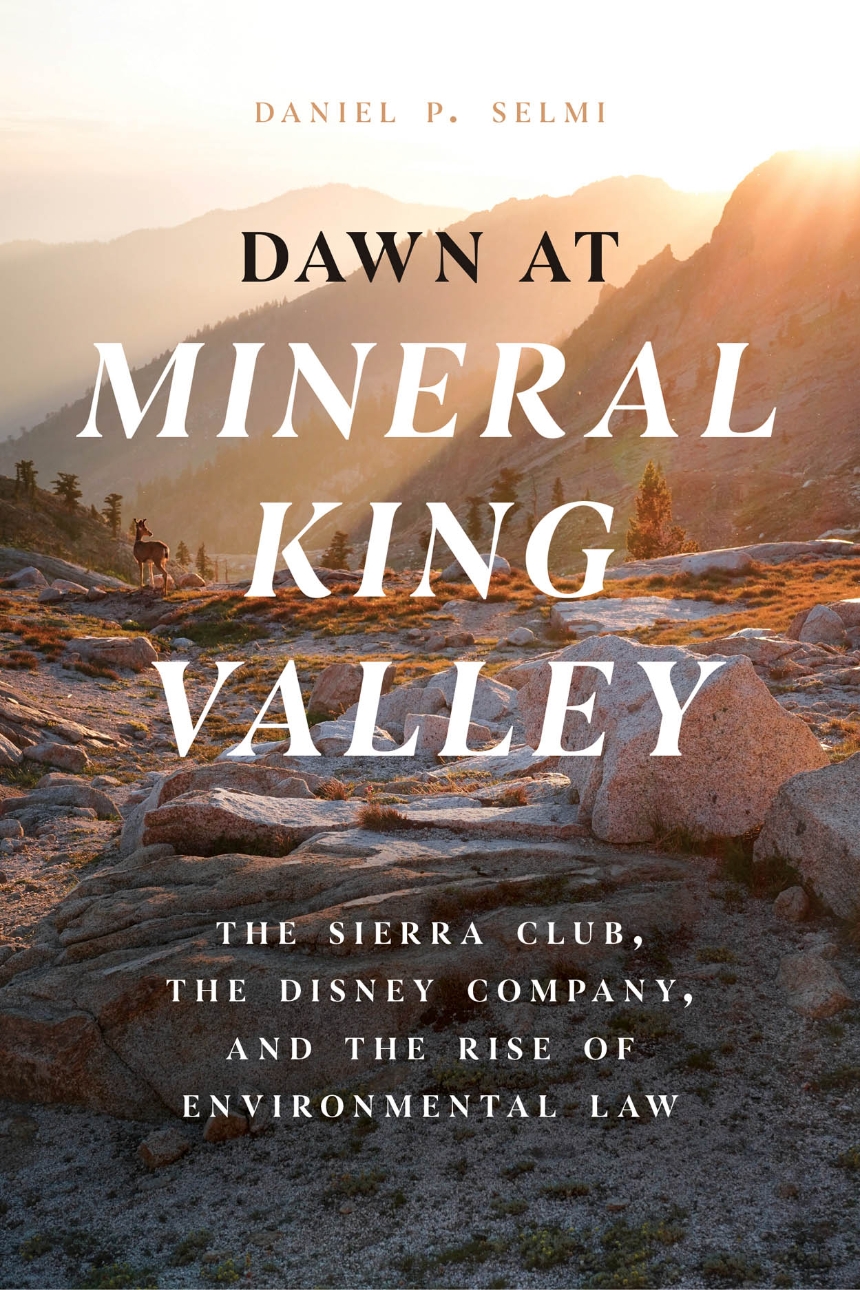
Jotwell recently ran a review by Angela Fernandez of Daniel P. Selmi's Dawn at Mineral King Valley: The Sierra Club, the Disney Company, and the Rise of Environmental Law (U Chicago Press, 2022). Fernandez writes:
Sierra Club v. Morton [known to some as the "Should Trees Have Standing" case - DS] is a seminal 1972 U.S. Supreme Court case on standing, the essential procedural question of who has a legal right to initiate a lawsuit based on a plaintiff’s alleged injury traceable to a defendant’s unlawful conduct. Daniel Selmi’s new book provides a deep dive into the history and context of this famous case, showing that it was about much more than the majority decision’s denial of the Sierra Club’s standing. And it was not, as some have claimed, launched as a test case to establish standing for environmental groups or the entities themselves, the possibility William O. Douglas went into in his famous dissent dear to the hearts of those interested in the Rights of Nature.

*****

Despite the fact that Selmi seeks to de-center standing in his history of the case, or at least destabilize the understanding that standing was what Sierra Club v. Morton was always meant to be about, he presents an excellent and thorough discussion of the issue. Selmi explains that the Sierra Club insisted on its general interest in a case that would impact the environment of concern to its members rather than Club members’ actual use of the area, which the Supreme Court indicated it would have accepted. As Justice White reportedly put it: “Why didn’t the Sierra Club have one goddamn member walk through the park and then there would have been standing to sue.” (P. 204.)

Sunday, March 12, 2023

Nature versus the Common Law VI: Diversion of water

In the last installment in this series we looked at how the English rule on escaping water in Rylands v Fletcher was rejected in British India due to perceived differences in the environments and needs of the two countries. Today we look at a classic issue of water law, complaints by riparian owners of upstream water uses that interfered with their own uses. As with the issue of escaping water, what was considered "natural" could turn, here too, on local natural conditions.

The traditional common law rule of conflicting riparian uses – that an upstream riparian may not divert a stream's water to the (unreasonable) detriment of downstream owners – was explained by the court of King's Bench in 1625 (Shury v Piggot, 81 English Reports 280) in terms of natural law: "a water-course […] doth begin ex jure naturæ, having taken this course naturally, and cannot be averted" and "the nature of this [water-course] is to be current [i.e. to flow]".

In the leading case of Evans v Merriweather in 1842, the Illinois Supreme Court advanced a distinction: An upper riparian might reasonably consume all the water in the stream if his use were a "natural" one, necessary for existence, but not were it to be considered "artificial", for the mere increase of "comfort and prosperity". The court then suggested that the application of this distinction would vary depending on natural conditions:

The supply of man's artificial wants is not essential to his existence; it is not indispensable; he could live if water was not employed in irrigating lands, or in propelling his machinery. In countries differently situated from ours, with a hot and arid climate, water doubtless is absolutely indispensable to the cultivation of the soil, and in them, water for irrigation would be a natural want. Here [in Illinois] it might increase the products of the soil, but it is by no means essential, and can not, therefore, be considered a natural want of man.

What riparian uses were to be recognized as "natural", and therefore permitted, was thus dependent on the climate and environment. Irrigation would be considered an "artificial" use in the American Old Northwest, as it would be in England, but the court had legitimized changing the law if and when the common law spread to arid lands.

This way of thinking was crucial for the development of water law in the arid western states and territories of the United States, in which the traditional common law of riparian rights was rejected in favor of a new system. The new law, known as "prior appropriation", opened up water resources to appropriation by all, not just riparian owners, and allowed them to take as much of the water as they could put to beneficial use, regardless of the effect on later appropriators. An early case from Colorado discussed whether an appropriator could dig a ditch across another's land without permission, an invasion of property that would clearly not be allowed under the traditional common law. Along the way it advanced a general theory of the adaptation of property law to environmental conditions:

Tuesday, March 7, 2023

Conference: Law and nature in the Middle Ages

Courtesy of ESCLH Blog: An upcoming conference (16-17 March) at Université d’Orléans on law and nature in the Middle Ages. Talks include Marie Bassano on the relationship between man and nature among late-medieval jurists and Dante Fedele on the medieval jurists and the sea.

The full program is here.

Sunday, March 5, 2023

Nature versus the common law V: Rylands in India


In previous posts in this series we looked at how courts dealt with the question of whether the common law rules of water law needed to give way to the felt necessities of different environmental conditions in two doctrinal contexts - public rights in non-tidal rivers and shifting watercourses. Next up is an examination of how "the rule in Rylands v Fletcher" fared in India.

The 1868 decision of the House of Lords in Rylands, affirming an 1866 decision of the Court of Exchequer Chamber, is one of the best-known cases in English tort law. The defendant in the case had built a water reservoir on his land to store water for powering a mill, taking all due care, but the water in the reservoir escaped through some old mineshafts and flooded the mines of his neighbor. The court ruled that if a defendant brings something dangerous on to his land and that thing escapes and causes damage to a neighbor, he is liable in tort even if he acted without fault.

Of particular relevance for this study, Lord Chancellor Cairns's ruling turned to a large extent on the issue of whether the use made by the defendant landowner was natural or not. Lord Cairns wrote that if the defendant's land had accumulated water by "natural user" of the land, and then "by the operation of the laws of nature" flowed onto his neighbor's land, there would be no liability. If, however, the defendant used his land for "a non-natural use, for the purpose of introducing into the close that which in its natural condition was not in or upon it", liability would ensue were the water to escape and cause damage, as it did in this case.

Even before the House of Lords had issued its opinion in Rylands's appeal, the Madras Railway Company decided to try and have the rule in the case established by the Court of Exchequer Chamber imported to India. A couple of tanks (reservoirs) located near the rail line in the District of North Arcot had burst several times in 1865 and 1866, and the resulting floods had damaged embankments, bridges, and culverts belonging to the railway company. The company brought suit against the landowner for the damages (Madras Rwy Co v Salvah Makaraju, 5 Madras High Court Reports 139 (1870)), at the same time refusing to allege negligence on the part of the defendant, choosing instead to rely on the new rule of Fletcher v Rylands. It seems that the railway company was hoping from the start to appeal the case up to the Privy Council in London, hoping, as the Madras High Court put it, to take the final decision out of the hands of "Judges conversant with the necessities of the country", instead having "a rule […] imposed elsewhere by Judges not so conversant" (Madras Rwy Co v Zamnida'r of Ka'vatinaggur, 6 Madras High Court Reports 180 (1871)).

Thursday, March 2, 2023

Weak states and the commons

Vincent Geloso and Félix Foucher-Paquin have posted "Weak States and the Commons: Fisheries and Economic Development in the Gaspesian Peninsula circa 1830". The abstract:

The inefficiencies of common property fisheries are well-known to economists. To avoid over-exploitation, they propose multiple forms of government solutions like taxes, quotas and the enforcement of property rights regimes designed to avoid over-harvesting. However, can there be efficient arrangements under statelessness or in the presence of weak states? One such example is the Gaspesian Peninsula (in the Canadian province of Quebec) during the first half of the 19th century. There, a single firm (the Charles Robin Company) came to dominate the market and it was able to effectively to restrict entry. In this paper, we unveil that it was able to do so by reducing the prices of imported goods that it would give to local fishermen in exchange for a part of their catch. This had the effect of deterring fishermen to contract with other merchants as well as deterring other merchants from entering the market. It also had the effect of making the region, contrary to what historians depict, richer than most regions of Canada at the time. We take this as an example of the ability to deal with commons problems in the presence of weak states.

Alexander Henderson, Causapscal River (1872-1875)

Sunday, February 26, 2023

Nature versus the common law IV: Shifting watercourses


In the last posts in this series we looked at court decisions that discussed whether the ownership of rivers should follow the common law or change to reflect local environmental conditions. Another branch of water-related law dealt with the legal consequences of changes in the course of a river or a shoreline over time. The property-law questions thrown up by these changes, under the legal terms "alluvion" and "diluvion", were to whom newly formed dry land belonged – to the former owner of the dry land now submerged, or to the owner of the adjacent riverbed. The English rule, based on Roman law, was that gradual accumulations of land from water belonged to the to the owner of the land to which the new land was added, while gradual losses of land were lost to the landowner and became part of the river (Foster v Wright, 4 CPD 438 (1878)). Sudden changes in the course of a river, on the other hand, were held not to bring about changes in ownership of the bed.

One line of legal thought held that the English common law rules in this area of law applied everywhere. The English Court of Exchequer in 1839 (In re Hull and Selby Rwy, 151 English Reports 139 (Ex 1839)) opined that the common law of alluvion "is not peculiar to this country, but obtains also in others, and is founded on the necessity which exists for some such rule of law, for the permanent protection and adjustment of property." Similarly, seventy-five years later, the Privy Council rejected arguments that the English law did not apply to the Nigerian shoreline due to differences in the local conditions, Lord Shaw stating that the court did not doubt the "general applicability" of the English law of accretion. This, however, was the minority position.