Showing posts with label politics. Show all posts

Wednesday, February 1, 2023

The legal environment and communal irrigation

The latest issue of the International Journal of the Commons has an article by Steven M. Smith, "Dynamics of the Legal Environment and the Development of Communal Irrigation Systems". From the Introduction (citations removed):

Archinia, Acequia System of El Rancho de las Golondrinas

Given the importance of external forces to the success of the commons, calls to integrate political ecology with the commons literature are becoming a common refrain. The combination can be approached from both directions: how do power structures shape institutions and how do institutions shape power structures? I take a historical perspective to explore both questions and their dynamic relationship. Specifically, I consider how external legal changes alter the incentives for how local users organize themselves and how those changes in local organizations alters the political coalitions, affecting subsequent legal changes.

To explore the question, I document and analyze the evolution of the legal environment and the development of communal irrigation systems, known as acequias, in current day New Mexico, US. Acequias have been held up as a case of a long-lived successful communal management regime of a natural resource . In the region of study, some acequias date back to the 16th century when Spain first colonized the area. The acequias have experienced sizeable shifts in their external legal surroundings, most rapidly and significantly during the US territorial period (1851–1912), that can be used to assess the relationship of external legislation and communal irrigation systems.

Monday, January 30, 2023

50 years ago

Daniel Farber goes back to the history of American environmental law again in his recent Legal Planet post, "50 Years Ago: Environmental Law in 1973". Farber writes:

Like today, 1973 was a time of political turmoil. The bitterly divisive Vietnam War was winding to an end, and much of the news that year was dominated by the Watergate scandal that ultimately brought down President Nixon. One subject stood outside the political turmoil: environmental law. In an EPA survey, 85% of the public thought pollution was a big problem.

The passage of the ESA highlights the extent of the national consensus over the environment. It’s a controversial law today, but it passed the Senate unanimously and the House by a 355-4 margin. In signing the bill into law, President Nixon said: “Nothing is more priceless and more worthy of preservation than the rich array of animal life with which our country has been blessed. It is a many-faceted treasure, of value to scholars, scientists, and nature lovers alike, and it forms a vital part of the heritage we all share as Americans.”  He congratulated Congress for “taking this important step toward protecting a heritage which we hold in trust to countless future generations of our fellow citizens."

After summarizing some judicial decisions of the year, Farber continues:

Wednesday, January 25, 2023

Efficiency and equality in US environmental regulation

Kunal Parker recently reviewed Elizabeth Popp Berman, Thinking Like an Economist: How Efficiency Replaced Equality in U.S. Public Policy (Princeton UP, 2022). There's a lot here that's relevant to the history of environmental regulation. First, Parker's summary of Popp Berman's argument, with obvious implications for understanding historically some mainstays of environmental policy, such as cost-benefit-analysis and market tools for regulation:


The book explores the rise to prominence of an economic “style of reasoning” in U.S. policymaking in the post-World War II decades. Between 1950 and 1980, Popp Berman shows, this style pervaded realm after realm of policymaking, from social welfare programs to the regulation of markets to the management of the environment.

The chief institutionalizers of the economic style of reasoning were not neoliberals or libertarians (these would become truly prominent in government only after the election of Ronald Reagan in 1980). Instead, they were Democrat-appointed economists and the bureaucrats they worked with and influenced. Albeit not ideologically opposed either to social programs or to market intervention, these economists and bureaucrats insisted that social goals be met as efficiently as possible and that market solutions were generally preferable to interventionist ones. Wherever possible, they pushed cost-benefit analyses and reviews within administrative agencies, urged the dismantling of early-twentieth-century market controls, and sought to achieve ends by creating markets for entitlements rather than by imposing standards by fiat. In all this, they shared much with those further to their right.

By the time Ronald Reagan was elected president, the economic style introduced during the Kennedy and Johnson years had become thoroughly entrenched. Indeed, it had become the hegemonic approach to solving all manner of public problems, its ubiquity and self-evidence continually reinforcing each other. Reagan Republicans would employ the economic style, but the ground had been laid for them decades earlier by Democrats. Indeed, Popp Berman argues, Democrats proved far less strategic in using the economic style than Reaganites. Democrats privileged it as a method in context after context and allowed it to subsume their substantive ends. By contrast, Reaganites were more selective and often successfully subordinated it to their substantive ends.

Parker, though, queries whether equality was actually the guiding principle in the pre-efficiency era:

Thursday, December 15, 2022

How control of nature shaped the international order

Posted recently to International Law Reporter, a nomination by Gail Lythgoe for the most interesting, important, or influential article or book published in 2022:

Joanne Yao, The Ideal River: How Control of Nature Shaped the International Order (Manchester Univ. Press 2022)

This book explores the geographical imaginaries of three rivers (the Rhine, Danube, and Congo) and how these very imaginaries shaped the constitutions, structure, and life of three early international organizations. It is a marvellous tale of how (and why) experts sought to tame nature and also says much about law’s relationship to the physical geography. I always really recommend and admire it because of how well written and engaging it is.

From the publisher's website:

The ideal river examines nineteenth-century efforts to establish international commissions on three transboundary rivers - the Rhine, the Danube, and the Congo. It charts how the Enlightenment ambition to tame the natural world, and human nature itself, became an international standard for rational and civilized authority and informed our geographical imagination of the international. This relationship of domination over nature shaped three core International Relations concepts central to the emergence of early international order: the territorial sovereign state; imperial hierarchies; and international organizations. The book contributes to environmental politics and international relations by highlighting how the relationship between society and nature is not a peripheral concern, but one at the heart of international politics. 

Friday, May 6, 2022

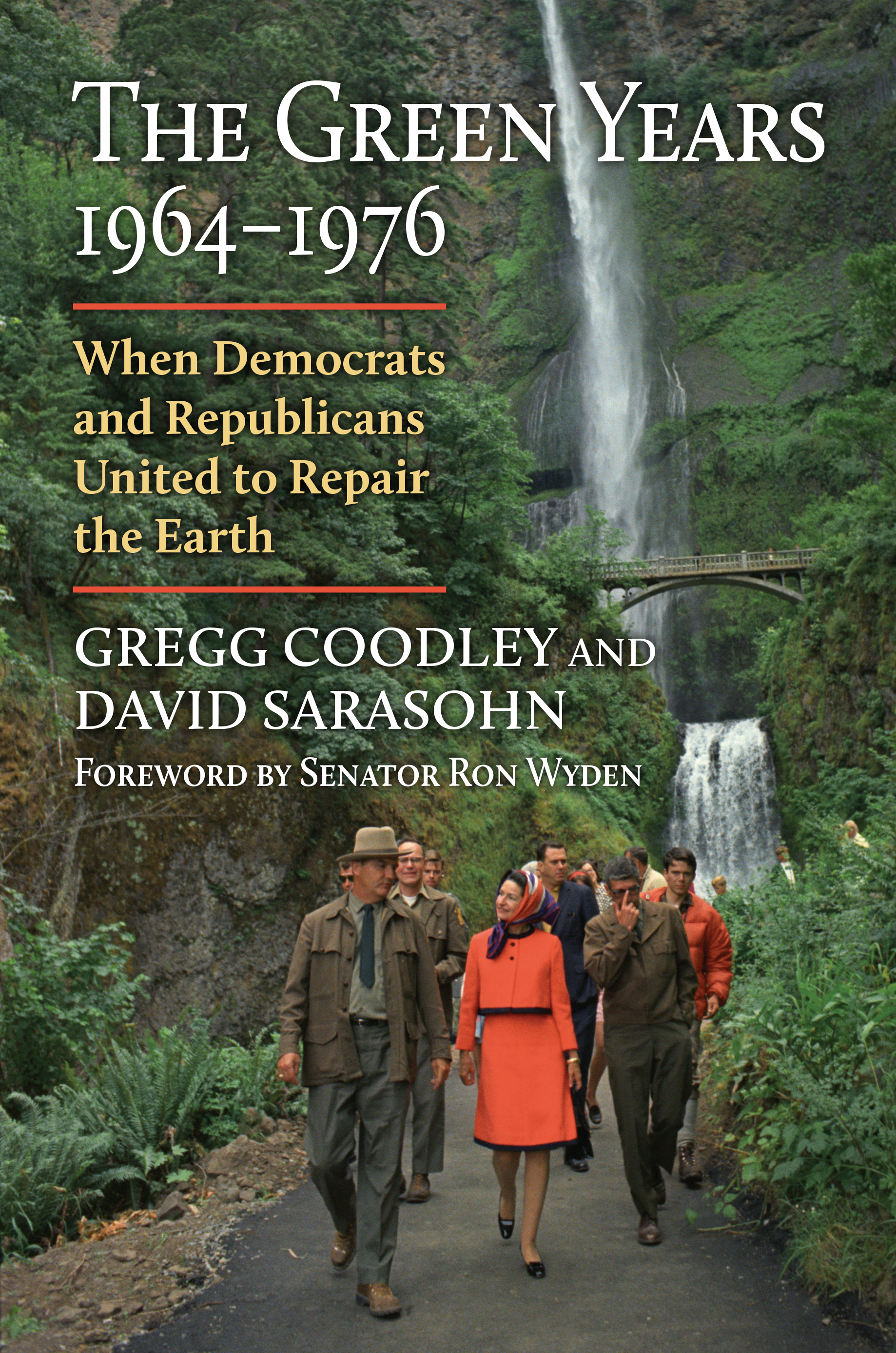
When Democrats and Republicans united to repair the Earth

H-FedHist recently published a review by Bart Elmore (recent recipient of the Dan David Prize) of Gregg Coodley and David Sarasohn's The Green Years, 1964-1976: When Democrats and Republicans United to Repair the Earth (U. Press of Kansas, 2021). Elmore writes:

Building on the work of numerous environmental historians—including Robert Gottlieb, Martin V. Melosi, Carolyn Merchant, Roderick Nash, Adam Rome, and Paul Sutter, among many others—Coodley and Sarasohn offer here an exhaustive play-by-play account of the legislative battles between 1964 and 1976 that led to the passage of some of the most important environmental laws in the United States. The central takeaway of this book is that though Democrats controlled Congress throughout these years, “all environmental laws passed from 1964 to 1976 commanded huge bipartisan support” (p. 257). Coodley and Sarasohn explore how political compromises formed to yield environmental laws, like the Clean Water Act of 1972 or the Toxic Substances Control Act of 1976, but also save room for concluding chapters that discuss the factors that led Republican Party members away from supporting environmental legislation in the 1980s and beyond.

*****

An important point of emphasis in the section on the late 1960s and early 1970s is that though Nixon was never personally passionate about environmental issues—he once “walked on the beach in wingtips,” quip Coodley and Sarasohn— key members of Nixon’s staff, especially Pacific Northwesterner John Ehrlichman and Council of Environmental Quality adviser Russell Train, were major proponents of big legislation designed to preserve and protect America’s wildlands, waters, and natural resources (p. 4). The central message here is that Nixon’s impressive environmental legacy—which included the signing of the National Environmental Policy Act in 1970, creating the EPA the same year, and supporting the Clean Air Act and the Endangered Species Act of 1973—was largely a product of Nixon’s calculating desire to maximize political capital by supporting signature legislation that had widening popular support from constituencies on both sides of the political aisle.

But Coodley and Sarasohn are careful to point out that Nixon’s willingness to push for environmental laws did not last forever. The turning point in the book is the winter of 1971 and 1972 where Nixon began to express serious concern that he would soon face major backlash from pro-industry voters if he continued to support stiff environmental regulations. “I have an uneasy feeling that perhaps we are doing too much,” he wrote his chief of staff, H. R. Haldeman, in February 1971. “Just keep me out of trouble on environmental issues,” he told Ehrlichman around the same time (p. 142). Nevertheless, despite Nixon’s waning interest in environmental issues, Republican members of Congress continued to find common ground with Democratic colleagues even as the toxic political bitterness of the Watergate scandal embroiled the nation. 

The review goes on to discuss the book's treatment of the post-Nixon years, as well. 

Friday, August 2, 2019

The Adirondacks in the seventies

Just out in the Journal of Policy History: Peter Siskind's "'Enlightened System' or 'Regulatory Nightmare'?: New York's Adirondack Mountains and the Conflicted Politics of Environmental Land-Use Reform During the 1970s". The abstract:
This exploration of the politics of land-use reform in New York's vast Adirondack Mountains provides a revealing window onto the ambiguities, evolution, and importance of environmental liberalism during the 1970s. A distinctive set of circumstances, featuring forceful advocacy by Governor Nelson Rockefeller and propitious political timing, led to the creation in the early 1970s of one of the most ambitious state-level environmental reforms in modern American history. But implementation during the mid- and late 1970s proved challenging. Environmental management by a new regional agency that possessed powerful regulatory authority over all public and private lands in the region produced discontents, distrust, and organized opposition among both developers and property-rights advocates on the right and environmental advocates on the left. The result was an uneasy, enduring legacy: the new regulatory institution and key environmental planning ideas of the early 1970s and the later, wide-ranging discontents would coexist in similar forms for decades to come.

Thursday, June 13, 2019

Administrative procedure and environmental regulation

Legal History Blog recently published brief pieces by scholars visiting at Princeton's Davis Center this year, in which they wrote about their research. Some excerpts from Angela Creager's:
Why has environmental law, an area of widespread popular engagement and legal activity, met with such limited success in the last half century? Corporate money? Special interests? Neoliberalism? These usual villains are not innocent, but I am interested here in how companies and their lobbyists used provisions of law, namely the 1948 Administrative Procedures Act (APA), to thwart stronger regulation....
My focus has been the Toxic Substances Control Act (TSCA) of 1976. This was the first US law aimed at providing environmental and health oversight of all commercial chemicals. The act was introduced in 1971 as part of the Nixon administration’s environmental initiatives, and different versions of the bill passed both houses by the fall of 1972, only to die in Senate-House Conference Committee during the 92nd session of Congress. In 1974, amidst the Watergate scandal and Nixon’s resignation, the Senate and House of Representatives again passed different versions of TSCA. Once again, the legislation died in committee. Early on, it appeared that none of the bills would not become law, a simple solution for its opponents.
In July 1975, a scandal reignited political pressure for chemicals regulation. Dozens of workers at chemical factory in Virginia were poisoned through their exposure to Kepone, a neurotoxic pesticide manufactured in the plant. The Ford administration made it clear that some version of TSCA needed to be signed into law to appease political pressure. Representatives for the Manufacturing Chemists Association (MCA), a trade group representing the chemical industry, began hammering out the details of a bill with Congressional staffers. The final statute specified numerous procedural hurdles for EPA in fulfilling its mandate to regulate chemicals. These hurdles were not conceptual slipups, but compromises made to produce a bill acceptable to industry. James T. O’Reilly, an industry lawyer who actually helped write the provisions, has said: “The 1976 Toxic Substances Control Act (TSCA) contains such obscure and inconsistent phrases that its supporters were doomed to frustration.” The legal scholar Kevin Gaynor, who analyzed the law shortly after it was enacted, called it “a regulatory morass.” Even its provisions “ensuring transparency of safety data” became “rigid procedural handcuffs.” This was a statute designed to make industry oversight difficult.
Many of these complexities had to do with how TSCA addressed requirements of the APA. For example, rather than make toxicity testing of commercial chemicals required for either old or new chemicals, the bill stipulated that EPA would have to issue a rule to require testing of any individual substance. Requiring rule-making on a chemical-by-chemical basis meant that the agency could only request testing data on a limited number of commercial chemicals, of the 60,000 on the market and thousands added each year. 
(from Environmental Working Group)

Friday, April 19, 2019

LBJ's Green Great Society and environmental law

Dan Farber recently posted at Legal Planet on the environmental aspects US President Lyndon B. Johnson's "Great Society". From the post:
When he announced the Great Society in a commencement speech at the University of Michigan, Johnson gave the environment a leading place. He began his May 1964 speech with the plight of American cities, where he decried “the decay of the centers and the despoiling of the suburbs.” Then he turned to the environment: “The water we drink, the food we eat, the very air that we breathe, are threatened with pollution. Our parks are overcrowded, our seashores overburdened. Green fields and dense forests are disappearing.” He added, “For once the battle is lost, once our natural splendor is destroyed, it can never be recaptured. And once man can no longer walk with beauty or wonder at nature his spirit will wither and his sustenance be wasted.”
Johnson’s Presidency was accompanied by a surge of environmental laws. Here are some of the laws he signed:
1963 The Clean Air Act
1964 The Pesticide Control Bill
The Water Quality Act
The Wilderness Act
1965 The Water Resource Planning Act
The Water and Sanitation Systems in Rural Areas Bill
The Solid Waste Disposal Bill
The Safe Water Conservation Act
1966 The Air Quality Act
National Historic Preservation Act
Endangered Species Act
1967 The National Water Commission
Wild and Scenic Rivers
Wetlands Preservation Bill
Many of these laws are remembered today only as the preludes to the stronger laws that followed in the 1970s. But these Johnson-era laws provided the foundation for that later legislation, and they set the precedent for vigorous federal protection of the environment.
For a different list of environmental laws signed by LBJ, see here.

Saturday, April 6, 2019

The "government take" and environmental protection

Suncor oilsands mine near Fort McMurray (Todd Korol, Toronto Star)
Though Israel's coming elections revolve around other issues (and non-issues), a major political issue in Israel over the last decade has been how to divide the profits of the country's natural gas finds between the developers and the public (the legal owners of the resource). While environmental groups have argued - and this has also been my natural inclination - that the public's ownership should be expressed with a relatively large "government take" (the percentage of revenue paid over to the state in the form of royalties and taxes), I have also noted that increasing the government's financial interest in the gas decreases its motivation to effectively regulate the environmental aspects of its development.

Hereward Longley's recent article in Environment and History, "Conflicting Interests: Development Politics and the Environmental Regulation of the Alberta Oil Sands Industry, 1970–1980", provides historical support for this argument. The abstract:
This article examines the relationship between development politics and environmental regulation and research during the first commercial development phase of the oil sands industry. As demand for oil grew after the Second World War, and oil supplies from the Middle East became less stable, oil companies began building facilities to produce synthetic oil from the bitumen deposits in north-eastern Alberta. The commercialisation of the oil sands industry coincided with the formalisation of environmental policy at both the provincial and federal levels. When the Progressive Conservative Party, led by Premier Peter Lougheed, formed a government after winning the 1971 election, it strengthened and expanded the scope of environmental regulation into the mid-1970s. The 1973 oil crisis changed the economic viability and importance of the oil sands industry. For Lougheed, the oil sands industry became a cornerstone of the PC government’s goals to diversify the Alberta economy. To save the Syncrude project after Atlantic Richfield withdrew its thirty per cent stake in the consortium in December 1974, the Alberta government bought a ten per cent position along with the federal government and Ontario. This article argues that investing in the oil sands industry created a conflict of interest for the Alberta government, as it became both the regulator and the developer of the resource. Using a range of archival sources and oral history, it shows how Alberta’s environmental policies and research programmes were sidelined by the Lougheed government in the latter half of the 1970s, culminating in the cancellation of the Alberta Oil Sands Environmental Research Program in 1980. The marginalisation of environmental regulation and research has contributed to the environmental impacts of the oil sands industry on ecosystems and Indigenous communities, and limited public awareness of environmental change.

Friday, March 15, 2019

The Million-Dollar Duck

The American Historical Review recently published Miranda Johnson's "The Case of the Million-Dollar Duck: A Hunter, His Treaty, and the Bending of the Settler Contract". The abstract:
In settler states such as Canada, indigenous peoples’ claims for sovereignty in the late twentieth century became matters of intense public and political debate. Provoked by widespread indigenous rights activism of the 1970s, the Canadian state embarked on a large-scale examination of claims for rights and restitution. By focusing on the 1962 case of a duck hunter who insisted on his treaty right to hunt as he pleased in a Canadian borderlands region that was becoming more tightly woven into the fabric of the settler nation, this article argues for the value of recovering the discursive strategies of indigenous peoples in making sovereign claims prior to 1970s activism. I suggest that such claims were effective in bending the “settler contract,” which refers to the founding of settler states in dispossession and the silencing of indigenous actors. My approach brings to the fore a distinctive form of non-elite politics, what I call “treaty talk,” or the vernacular stories, civic rituals, and political disputes concerning the treaty promises that Canadian authorities made to northern indigenous communities earlier in the twentieth century. Although treaty talk did not break the settler contract, it posed a significant challenge to settler law and led one judge to reinvent a Canadian myth of benevolent empire.
Dene men gathered for Treaty Day at Fort Resolution, ca. 1924

Friday, November 23, 2018

Farber's 1981 casebook

Dan Farber recently blogged at Legal Planet on what has changed in environmental law since the first edition of his casebook, published in 1981:
Some changes were less than expected. Given Reagan’s election, it seemed likely that we would see some major statutory modifications if not repeals. But that didn’t happen. In fact, looking at that book, I realize that there have been only a handful of significant statutory changes. CERCLA, the Superfund law, wasn’t passed until just after the election by the lame duck Congress. Congress passed minor statutory revisions in the 1980s and a big amendment to the Clean Air Act in 1990 that mostly strengthened it. It also passed a statute just a couple of years ago helpfully revamping the Toxic Substances Control Act. Even in 1980, it was clear to us that the original version was a botched job.  With those exceptions, the statutes now are pretty much the same as they were back then.
Even though the statutes are the same, there have been a massive number of new regulations and court decisions. In 1981, we were able to cover both the Clean Air Act and the Clean Water Act in just over a hundred pages of fairly large print. In the latest edition with Ann Carlson, covering those statutes takes 170 pages in much smaller print. (The next edition will add one more co-author, William Boyd.) In 1980, we could excerpt just about every Supreme Court environmental case, but now there are too many. And of course, there’s CERCLA now. Despite dropping an important topic (public lands) and having smaller print, the latest edition is over 200 pages longer.
I was also interested to see that the 1981 edition had a chapter on federalism, including restrictions on state environmental regulation. We also included some material on the ability of cities to pursue environmental regulations under state law. Both have remained hot topics and the subject of frequent litigation today.
The 1981 edition was ahead of its time in one way: there was a separate chapter on energy and the environment. The amount of pride that I can take in that is dimmed, however, by the fact that we dropped that chapter very soon thereafter and redistributed the contents to other chapters. People had lost interest in energy issues at that point. 

Tuesday, October 23, 2018

Indigenous peoples, political economists and the tragedy of the commons

Next in our series on "The Tragedy of the Commons at 50" (the last post is here) is Michel Morin's "Indigenous Peoples, Political Economists and the Tragedy of the Commons". The abstract:
In “The Tragedy of the Commons,” Garrett Hardin implicitly moved from bounded commons — a pasture or a tribe’s territory — to the case of boundless commons — the ocean, the atmosphere and planet Earth. He insisted on the need for imposing limits on the use of these resources, blurring the difference between communal property and open access regimes. The success of his paper is due in great measure to his neglect of economic, scientific, legal  and anthropological literature. His main lifelong focus was on limiting population growth. He could have avoided the conceptual confusion he created by turning to well-known political economists such as John Locke and Adam Smith or, for that matter, jurists, such as Blackstone. Instead, he simply envisioned indigenous lands as an unbounded wilderness placed at the disposal of frontiersmen. Though he eventually acknowledged the existence of managed commons, he had little interest in community rules pertaining to resource exploitation. For him, these were simply moral norms which inevitably became ineffective after a community reached a certain level of population. He also took economists to task for failing to include in their analysis the true environmental and social costs of public decisions. Still, the famous example of the indigenous people of Northeastern Quebec illustrates a shortcoming of his analysis: community members did not act in total isolation from each other. On the contrary, communal norms could prevent an overexploitation of resources or allow for the adoption of corrective measures.
Beaver Hunting in Canada,
from Charles Theodore Middleton’s A New and Complete System of Geography…, after Chiedel, 1777-1778
(Library and Archives Canada)

Friday, September 21, 2018

Cold-War commons

Next in the series of posts on "The Tragedy at 50" (the last one is here), we have Monica Eppinger's "Cold-War Commons: Tragedy, Critique, and the Future of the Illiberal Problem Space". The abstract:
Major twentieth-century social theories like socialism and liberalism depended on property as an explanatory principle, prefiguring a geopolitical rivalry grounded in differing property regimes. This article examines the Cold War as an under-analyzed context for the idea of “the tragedy of the commons.” In Soviet practice, collectivization was meant to provide the material basis for cultivating particular forms of sociability and an antidote to the ills of private property. Outsiders came to conceptualize it as tragic in both economic and political dimensions. Understanding the commons as a site of tragedy informed Western “answers” to the “problem” of Soviet collective ownership when the Cold War ended. Privatization became a mechanism for defusing old tragedies, central to a post-Cold War project of advancing “market democracy.” Meanwhile, the notion of an “illiberal commons” stands ready for redeployment in future situations conceived as tragically problematic.

Sunday, September 2, 2018

The Powell memo

The website for the book The Republican Reversal: Conservatives and the Environment from Nixon to Trump by James Morton Turner and Andrew C. Isenberg (Harvard UP, 2018) includes a range of interesting primary sources on the topic. Among them is a pdf of a 1971 memo by Lewis Powell to the US Chamber of Commerce, described on the website:
Soon-to-be Supreme Court justice Lewis Powell wrote this memo for the U.S. Chamber of Commerce in 1971 as conservatives grew concerned about the growing influence of liberals and an expanding regulatory state.  It offered conservatives a roadmap for exerting their political power in the defense of individualism and free enterprise.
It's a pretty amazing document. Here's an excerpt:
As every business executive knows, few elements of American society today have as little influence in government as the American businessman, the corporation, or even the millions of corporate stockholders. If one doubts this, let him undertake the role of "lobbyist" for the business point of view before Congressional Committees. The same situation obtains in the legislative halls of most states and major cities. One does not exaggerate to say that, in terms of political influence with respect to the course of legislation and government action, the American business executive is truly the "forgotten man".
Current examples of the impotency of business, and of the near contempt with which businessmen's views are held, are the stampedes by politicians to support almost any legislation related to "consumerism" or to the "environment".
For more on the memo, see here.

Wednesday, August 1, 2018

Public trust and public access

A while back we noted an H-Environment roundtable on Andrew Kahrl's The Land Was Ours: African American Beaches from Jim Crow to the Sunbelt South. Now Kahrl has turned his attention to the North in Free the Beaches: The Story of Ned Coll and the Battle for America’s Most Exclusive Shoreline (Yale UP, 2018), and Law & History Review has a review by Deborah Dinner. Dinner writes:
On July 4, 1974, a daring, no-holds-barred activist named Ned Coll launched an amphibian assault on an exclusive Beach Club in Madison, Connecticut. Coll’s comrades included more than fifty children from nearby Hartford’s poor, majority African-American housing projects. The children, their mothers, and staff members of Revitalization Corps, an advocacy organization dedicated to racial equality and justice for the poor, were clothed in bathing suits and armed only with laughter, songs, and excitement. Yet the affluent white parents on the beach saw the newcomers’ entry as an ambush and quickly retreated, children in tow, to their private club. The episode constituted one highlight of Coll’s campaign to win public access to the beaches along the shoreline of a state plagued by extreme wealth inequality.
A somewhat obscure common law doctrine—newly and hotly contested in the 1970s—rested at the heart of Coll’s creative protest of the Madison Beach Club. The public trust doctrine...

Sunday, July 29, 2018

The California ascendancy: Explaining world leadership in environmental law and policy

[A guest book review from Geoffrey Wandesforde-Smith:]

In the newest addition to the Studies in American Politics series from Princeton University Press, David Vogel in California Greenin’: How the Golden State Became an Environmental Leader (Princeton UP, 2018) asks how it is that California has had such success in protecting its environment and has become a world leader in making and implementing environmental policy and law.

Vogel sketches boldly on a large canvas:
This book describes what is in many respects a remarkable success story. It demonstrates how a state government has been able to overcome substantial obstacles and enact a wide range of regulations that have made measurable - though admittedly uneven – progress in protecting its environment and improving the quality of life of its residents. Although California has often seemed on the verge of ecological (as well as economic) catastrophe, it has proven remarkably resilient. The state’s ability to remain the most important source of environmental policy innovation in the United States over so many decades and across such a diverse range of policy areas is a significant accomplishment.  It is worth understanding why and how this particular state came to play such an important leadership role in this area, as well as the broader policy implications of such leadership [p. 6]. 
One of those implications, Vogel writes, is that the story of California’s ascendancy holds lessons for the world:
What happens in California…has a global impact.  During the 1980s, the relative stringency of California’s vehicle emissions standards was an important reason why Germany chose to support the adoption of similar standards by the European Economic Community… More recently, according to…a Nobel Prize-winning scientist from Mexico, “the rest of the global economy is looking to California, as one of the world’s largest economies, to take the lead” in addressing the risks of global climate change.  The state has come to play an increasingly active international role [p. 8, citations omitted].
When it comes to explaining how and why California has become such a successful and resilient law and policy leader Vogel focuses on three factors he considers to be interconnected in varying ways at different times in the state’s history, depending on the issues being addressed.  

One is the political mobilization of California’s citizens, most especially in the late 1960s and 1970s.  A second is the support for environmental policy initiatives provided at critical moments by least some important segments of an often divided business community.  And a third is the growth over time of the state’s capacity to design and implement programs of resource management and environmental regulation, in some cases in state agencies recognized as world leaders in the work they do [1].

This is obviously a provocative thesis and it may well keep students of the history of California environmental law and policy busy for some time to come.  But it also and immediately raises the question of why, if the story of California’s ascendancy, which on Vogel’s telling has its roots in the late nineteenth century, is so remarkable and potentially so influential, the story hasn’t been told before now.  

The answer is that the story has been told, at least in part, twice before, although Vogel chooses not to engage seriously with either prior account [2]. 

Wednesday, June 20, 2018

FDR and the environment

The Journal of Land Use and Environmental Law recently published an extended review by Michael Blumm of Douglas Brinkley's Rightful Heritage: Franklin D. Roosevelt and the Land of America (HarperCollins, 2016). The abstract:
Douglas Brinkley, biographer of Theodore Roosevelt and his environmental legacy, has produced a sequel on his distant cousin, Franklin Delano Roosevelt (FDR). In a comprehensive ecobiography, Brinkley shows in some detail how committed an environmentalist FDR was, protecting federal lands, encouraging state conservation efforts, making wildlife protection a national priority, and dedicating the federal government to soil protection and forest replanting. Although FDR’s romance with federal dams undercuts the assertion somewhat, the Brinkley biography successfully shows that FDR has a legitimate claim to being the foremost of environmental American presidents.

Sunday, June 17, 2018

The source of disenfranchisement for rural Americans

Slate's Issac Chotiner recently interviewed Eliza Griswold on her new book, Amity and Prosperity: One Family and the Fracturing of America (Macmillan, 2018). In the interview (and presumably the book) Griswold displays a strong historical sensibility about the legal-environmental roots of some of America's (and hence the world's) current predicament. An excerpt:
Isaac Chotiner: What is it that is “fracturing” America?
Eliza Griswold: These days we are hearing so much about this rural/urban divide. What does that really mean? What is the source of disenfranchisement for rural Americans? Much of it stems from natural resources. Rural Americans have paid for the energy appetites of urban Americans for more than a century.
I think a lot people in urban America would hear that and say, “Well, the people who are voting for candidates who are less interested in environmental protections are coming from rural America, and the people who are voting the opposite way are coming from urban America.” What do you say to that?
The urban American understanding of how regulation plays out on the ground in rural America is woefully inadequate. First of all, we don’t understand how for more than a century in many places in Appalachia, rural Americans have had their land ruined, as well as their health and their communities, in a search for the natural resources that feed urban Americans.
On top of that, if you talk to farmers, if you talk to Appalachian farmers … First of all, none of them simply farm, they have two jobs. Often that second job has to do with resources. They are either coal miners or former steelworkers. But how regulation plays out in their life on a daily basis has to do with farming, and farm regulation has driven many small farms out of business.
So, there’s this huge double standard where, if you talk to a pork farmer in Amity, he’s going to tell you that he has to pay $100 every time the vet comes out to take his shots. And that he has to fence his stream and the cows can’t go into the water. And he can’t drive his tractor across the stream either. Yet for more than a century, extractive industry has been able to come in and do whatever it wants to do. Until finally, here’s oil and gas, here are frackers who are actually paying money for mineral leases. Who are urban Americans to come in and wag a finger and say, “You don’t have the right to make any money off your land.” They don’t even understand how regulation practically works on the ground.

Monday, December 25, 2017

The redwood wars

The latest American Historical Review has a review by Neil Maher of Darren Speece's Defending Giants: The Redwood Wars and the Transformation of American Environmental Politics (U. Washington Press, 2017). Some excerpts:
Speece begins with the conflict’s prehistory, describing the rise in the region during the late nineteenth and early twentieth centuries of a “corporatist” logging industry that was permitted, with encouragement from the California Board of Forestry, to self-regulate cutting practices on privately owned land. Redwood preservation during this period most often involved elite groups, such as San Francisco’s Bohemian Club, purchasing groves from timber companies. The next four chapters, which jump to the late twentieth century and the “Redwood Wars” themselves, follow local activists and their two-pronged strategy—involving lawsuits and direct action campaigns—that all but halted old-growth logging on the North Coast and, in doing so, weakened the corporatist reign over redwoods. The legal stalemate that resulted, Speece concludes, fostered “the Deal” orchestrated by President Bill Clinton, which not only protected the old-growth redwoods of the North Coast’s Headwaters Forest but also laid the groundwork for additional protection of endangered landscapes nationwide.
Defending Giants is about more than environmentalists, however, and in order to give voice to the lumber executives, loggers, and lawyers who also serve as foot soldiers in this conflict, Speece embraces a diverse set of historical methodologies. To understand the grassroots beneath his tall trees, he scours local newspapers, digs into unprocessed archival material from North Coast environmental groups, and, perhaps most importantly, conducts dozens of oral interviews with activists, timber workers, lumber company managers, and forest policy bureaucrats. Speece also skillfully navigates a torrent of legal cases initiated by environmentalists to halt redwood logging, and tracks a wide range of timber policy proposals through the hallways of capitols in both Sacramento and Washington, D.C. Finally, he carefully balances his narrative by analyzing the annual reports of the Pacific Lumber Company, which owned these redwood forests, of its successor, the Maxxam Corporation, and of several other timber businesses from the Pacific Northwest. The result, which successfully blends social, political, legal, and business history, will interest more than environmental historians. 

Friday, November 3, 2017

Postwar America's greatest environmentalist

More on working-class environmentalism and the law (see, most recently, here): Jacobin recently ran a piece by Connor Kilpatrick claiming that "Postwar America’s greatest environmentalist was a labor leader". There's a lot here also about politics, religion, climate skepticism and more. Some excerpts:
Today, the AFL-CIO lobbies Congress to pass the Keystone XL pipeline while noted NASA climate scientist James Hansen, one of the first to link global warming to fossil fuels, is repeatedly arrested for protesting such projects. And while in 2017, the idea that the interests between wonky environmentalists and jobs-focused trade unionists would diverge seems like common sense, it’s only because the bad guys won.
But it wasn’t a preordained victory. For nearly a decade in the 1960s and ’70s, environmentalism seemed to be on the cusp of a popular reckoning against the powers of capital. And it found an ally in the labor movement which, for a few years, looked like it might be able to not only cling to life but find a way back into the heart of American society.
[Tony] Mazzocchi and his union, the Oil, Chemical and Atomic Workers International (OCAW), were the primary muscle behind the 1970 Occupational Safety and Health Act (OSHA), signed into law by Richard Nixon. Looking back on that victory, which mobilized both labor and the burgeoning environmental movement, Mazzocchi said: “We have demonstrated that an unpopular idea can be generated into a powerful political program that’ll reignite the consciousness of the American people.”