Showing posts with label blog. Show all posts

Tuesday, September 5, 2023

Privatizing water and fish in colonial India

Devika Shankar's article on property in water and fish in India is now also a blog post at Past & Present. Shankar explains that her article reflects 
a close analysis of over 10 important and highly cited cases from different parts of British India in which judges deliberated on whether flowing water and fish could be treated as private property. Starting with a significant set of cases relating to the planting of stakes in the sea off the coast of Bombay, the article then primarily looks at cases involving rights over rivers in the fluid landscape of the Bengal delta. The article not only highlights the enduring confusion surrounding the status of water in colonial Indian law, but also looks at the different ways in which judges interpreted roman law and precedents from English common law while reaching their judgments. After reaching a variety of conclusions, by the 1880s high courts had begun to simultaneously make room for unprecedented private rights over flowing waters in colonial India while rendering these rights largely redundant by insisting that fish in these waters could not be counted as property until they were caught. The conflicting pull of these judgments however began to create serious problems in Bengal where fishing rights were considered to be especially valuable. It was in order to overcome this impasse that the Bengal government ultimately passed the Bengal Private Fisheries Protection Act in 1889 granting landholders significant rights over fish in rivers across the province. It would do so by significantly strengthening the kinds of private rights that could be claimed over water, and inaugurating a novel category of “private waters” in tidal waters in Bengal and other parts of India. By tracing the arguments and logics that ultimately paved the way for this act, this article highlights the importance of recognizing colonial India, and especially Bengal as an significant site for experimentation with new forms of private property rights over flowing waters.
Charley Brown, Illustrated Guide to the South Indian Railway (1913)

More on property in water and fish in colonial India here.

Sunday, August 27, 2023

The evolution of US NOx standards for cars

Dan Farber at Legal Planet recently posted on "Cars, Smog, and EPA". An excerpt:
For the first 20 years of federal regulation, Congress set the NOx [nitrogen oxides] standards for new cars itself. That’s quite different from the standards for industrial pollution sources, which Congress has always delegated to EPA. The reason may have been the high political stakes in the car industry or the relatively easier task of setting standards for new products in a single industry using a single energy process.
East River and Manhattan Skyline in Heavy Smog (Chester Higgins, Jr., EPA, 1973)
... The initial standard, set in the 1970 Clean Air Act, was 3.1 grams per mile (gpm) for NOx. Achieving that standard was thought to be nearly impossible when Congress created this mandate, but the mandate forced the car companies to make technological breakthroughs with catalytic converters.

Note that the standard is set in terms of pollution per mile rather than pollution per gallon. That means that any increase in fuel efficiency automatically helps a company meet the pollution standards as well. Theoretically, a car could have no pollution control at all but get such phenomenal mileage that it met the pollution standard. Actual mileage has improved but not enough to obviate the need for pollution controls.

Congress adjusted the standards twice. A 1977 amendment reset the limit to 1 gpm in 1981. The 1990 amendments changed the standard to 0.6 gpm, effective in 1994. These are called Tier 1 standards. Apparently Congress did not relish the task of periodically resetting the standards itself  The 1990 Amendments authorized EPA to set standards for 2004 and beyond.

*****

This has to be considered a successful regulatory program. The Biden proposed standard  [of 2023] allow less than 1% of the pollution levels that Congress mandated in 1970.

Thursday, May 18, 2023

Tani on Calabresi and the "Economic Style"

Karen Tani just completed a fascinating four-part series at Legal History Blog on Guido Calabresi's particular form of law and economics scholarship and its influence on legal thinking. Though Tani doesn't directly deal with environmental issues (nor did Calabresi give them much attention), the series raises important questions that have relevance to understanding the history of environmental regulation and environmental law scholarship in recent decades. In particular the series focuses on the question of to what extent economic thinking in Calabresi's writings claimed exclusivity or made room for other ways of thinking about legal problems. 

Calabresi himself often insisted (as in the subtitle "One View of the Cathedral") that economics was just one factor to be considered in legal analysis, and his classic works (such as The Cost of Accidents and the Cathedral article) also at least paid lip service to this idea, but I have always thought that the depth of Calabresi's economic analysis, juxtaposed with the cursory treatment he usually gave to distributive considerations, broadcast the message that efficiency was the key factor to be considered.

This way of thinking has obviously had great effects on environmental law, starting from the way environmental issues are typically presented to law students - as negative externalities that need to be internalized or collective-action problems that need the aid of law to overcome, rather than, say, as issues of distributive justice or problems of environmental ethics.

Friday, May 5, 2023

Rome and the sea of law

ASOR (Ancient Near East Today) just put up a post by my editorial colleague, Emilia Mataix Ferrándiz: "A Sea of Law: The Romans and Their Maritime World". Mataix Ferrándiz begins:

The sea was key for Rome’s success; it served as the setting of several battles that granted them hegemony over the Mediterranean as well as the main highway for both ideas and commerce. However, human bodies are not naturally suited to the sea; entering or crossing it means challenging one’s own capacities in the face of the power of water. The latter is echoed in literary sources, which often focus on the sea’s enormity and wilderness, thus evoking — and sometimes even exaggerating — its aura of mystery and uncertainty and the effect it has in ancient societies.

Roman legal sources, on the other hand, tend to focus more on the practical challenges and effects of interacting with the sea, presenting a different vantage point from which to study how Romans regarded and dealt with the challenges presented by the sea. So what can we say about how Roman jurists perceived the sea? Although jurists coincide in their understanding of the sea as a dangerous realm not governed by their civil law, the solutions which they provided for similar problems vary from jurist to jurist and from one period to another.

Roman mosaic from Veii (Italy), 3rd-4th century AD, Badisches Landesmuseum Karlsruhe (Carole Raddato)

In the Roman world, spaces were governed by different legal fields. While the land was managed by ius civile (the law of Roman citizens), the sea was a space of ius gentium, or the law of all peoples. It was the jurist Marcian (second–third century CE), who wrote that the sea was the common property to all according to natural law. From his writings the main point to note is that the sea is not subject to an individual’s dominion and, therefore, is also not subject to Roman governance. Despite Roman imperialistic aims and propaganda, it is unlikely that the ideology of rule over land and sea extended to any practical attempts to regulate the use of the sea. 

Mataix Ferrándiz goes on to argue that

Monday, January 30, 2023

50 years ago

Daniel Farber goes back to the history of American environmental law again in his recent Legal Planet post, "50 Years Ago: Environmental Law in 1973". Farber writes:

Like today, 1973 was a time of political turmoil. The bitterly divisive Vietnam War was winding to an end, and much of the news that year was dominated by the Watergate scandal that ultimately brought down President Nixon. One subject stood outside the political turmoil: environmental law. In an EPA survey, 85% of the public thought pollution was a big problem.

The passage of the ESA highlights the extent of the national consensus over the environment. It’s a controversial law today, but it passed the Senate unanimously and the House by a 355-4 margin. In signing the bill into law, President Nixon said: “Nothing is more priceless and more worthy of preservation than the rich array of animal life with which our country has been blessed. It is a many-faceted treasure, of value to scholars, scientists, and nature lovers alike, and it forms a vital part of the heritage we all share as Americans.”  He congratulated Congress for “taking this important step toward protecting a heritage which we hold in trust to countless future generations of our fellow citizens."

After summarizing some judicial decisions of the year, Farber continues:

Thursday, January 12, 2023

"Environmental law" - a response to Farber

I have some objections to a recent post by Dan Farber at Legal Planet, "Learning to Name Environmental Problems"

Farber raises the interesting issue of when various issues seen today as "environmental problems" became thought of as such by the law, both in terms of seeing various issues – air pollution, water pollution, wilderness protection, and so on – as parts of a larger problem, and with regard to use of modern terms like "environment" and "pollution". But I think his answers are problematic.

Farber focuses on US Supreme Court decisions, finding its earliest uses of "air pollution" and "water pollution" and references to wilderness as something worthy of preservation in decisions from the 1960s. He also goes on to state that "The 1960s were also Congress’s first forays into issues like air and water pollution, wilderness protection, and the endangered species.  These developments set the stage for the blossoming of federal environmental law with the passages of NEPA, the Clean Air Act, the Clean Water Act, and other major legislation in the decade that followed."

Even allowing for methodological nationalism and the focus on the unrepresentative Supreme Court, this is all rather strange.

Paul E. Wolfe, Los Angeles County Air Pollution Control District vehicle, Burbank, 1947-1950?

Sunday, December 4, 2022

Nazi legislation against animal cruelty


From Sydney Criminal Lawyers, on Lexology (via Legal History Blog): "The History of Laws Against Cruelty to Animals". A particularly interesting section discusses the Nazis:

There can be no words to sufficiently encapsulate the appalling atrocities perpetrated by one of history’s most evil people, Adolf Hitler, and his fascist Nazi party.

And one must take special care before giving credit for any act to the person at the helm of history’s most disgusting and shameful political, social and cultural regime, whereby millions of innocent men, women and children were tortured and murdered, including the systematic use of humans for medical experimentation, annihilation of ‘undesirable’ groups in society including the disabled and slaughter of large segments of targeted racial and religious groups.

Hitler and his extreme right-wing party exemplified the very worst of humankind, and the regime’s ultimate demise was a Godsend to all moral people.

But the irony must also be acknowledged that while on the way to murdering millions of human beings, the famously vegetarian and dog-loving Hitler took unprecedented steps to protect non-human animals from cruelty. And many of the enacted laws go way further than present day legislation.

In that regard, 24 November 1933 saw the German parliament (the Reichstag) the under the Chancellorship of Hitler and Presidency of Hermann Göring) pass the Reichstierschutzgesetz, or Reich Animal Protection Act, which is listed in the above table.

The law imposed a total ban on the almost-universally accepted, and even encouraged and publicly funded, practices of vivisection (operating or experimenting on live animals) and slaughter of animals without anaesthetic.

In a 1933 speech approved by Hitler, Göring declared an end to the “unbearable torture and suffering in animal experiments” and warned that those who “still think they can continue to treat animals as inanimate property” would be sent to concentration camps.

The regime saw a range of further prohibitions to protect animals including bans on animal trapping, the boiling of crustaceans such as crabs and lobsters, live baiting, neglect and cruel acts to domestic animals, and severe restrictions on hunting.

And so it was – perhaps history’s most evil regime was ironically perhaps the most benevolent in the treatment of non-human animals.

This is just one one section of the long post, which includes a chronology of developments and a discussion of Australian law. 

Monday, November 7, 2022

The US Supreme Court’s earliest pollution cases

Over at Legal Planet, Dan Farber recently posted on "The Supreme Court’s Earliest Pollution Cases". Farber writes:

Well over a century ago, the Supreme Court ruled that it had that power to remedy interstate water pollution. That was in 1901. Six years later, the Court decided its first air pollution case.  Notably, these cases came during the conservative Lochner era when the Court was hardly known for its liberalism.  Quite the contrary. Yet the Court didn’t hesitate to address pollution issues.

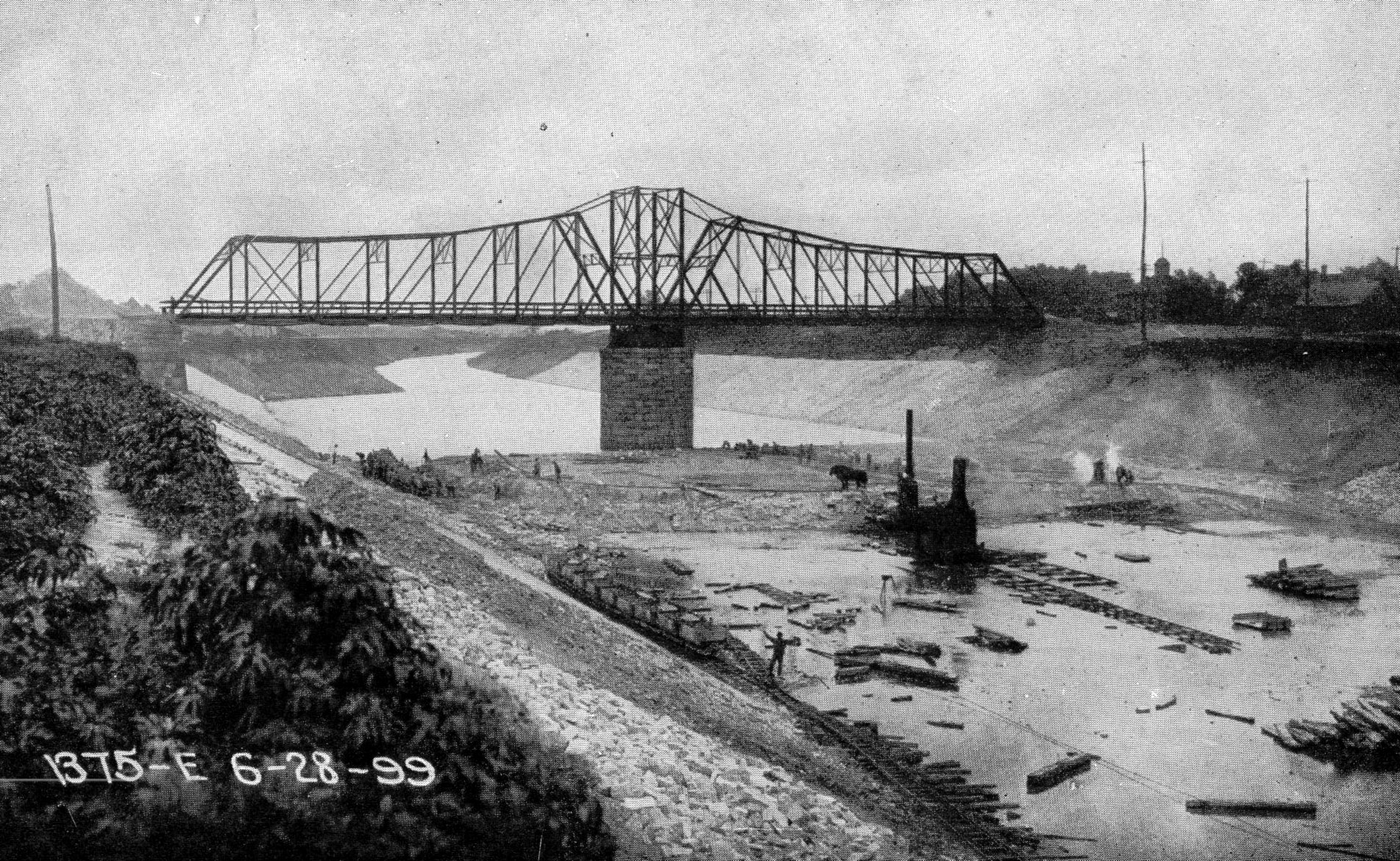
The water pollution case was Missouri v. Illinois.  In a feat of engineering prowess or incredible hubris, depending on how you look at it, Illinois had built a canal to reverse the flow of a river from Lake Michigan to the Mississippi. The canal then became a dumping place for the city’s raw sewage. Missouri claimed that the sewage was befouling the water as far away as St. Louis. The Court had long heard other law suits between states, but this was apparently the first one to involve pollution.

Chicago Drainage Canal being built (from The New Student's Reference Work (1914))

I'm not sure this was really the US Supreme Court's first pollution case - how about the Slaughterhouse Cases? In any case, Farber goes on to also discuss Georgia v. Tennessee Copper Co., an interstate air pollution case. He comments:

These two cases are little known today, but they have cast long shadows.  Very briefly, here were some of their longterm impacts:

  1. International law. This line of precedent got the attention of an international tribunal in the Trail Smelter case, which involving a Canadian smelter polluting across the U.S. border. The tribunal held that a country has a duty to prevent its inhabitants from inflicting serious harm within another country. Thus, Canada had to take responsibility for the pollution. This principle is now famous in international law as the Smelter Trail rule. In turn, that principle of international law was taken up in international concords such as the 1992 Rio Declaration on Environment and Development.

  2. Water pollution. Use of federal common law to pursue water pollution cases enjoyed a big revival in the 1960s and early 1970s. It was ended by the Supreme Court, which held that the then-new Clean Water Act took over the field of interstate water pollution in lieu of court-made rules.

  3. Climate change.  In a groundbreaking climate decision, Massachusetts v. EPA, Justice Stevens invoked this line of cases to emphasize the special interest that states have in access to the Court to protect their interests as sovereigns.  The upshot was to give states standing to sue EPA for failing to take action against carbon emissions. Also, this line of cases was repurposed  early in this century in order to bring lawsuits against major carbon emitters in federal court. The Supreme Court ultimately said that since the Clean Air Act covered climate change, lawsuits based on judge-made federal rules were no longer needed. It left open the possibility of lawsuits based on state law, and state lawsuits against oil companies are now underway.
More on the US Supreme Court and the history of environmental law here.

Tuesday, October 18, 2022

More on the Clean Water Act at 50


Legal Planet's Richard Frank posted today on the US Clean Water Act's 50th birthday. An excerpt:

The CWA as enacted a half-century ago was enormously ambitious and, with the benefit of hindsight, quite naive: in the law’s legislative findings, Congress declared that “it is the national goal that the discharge of pollutants into the navigable waters be eliminated by 1985.”  That obviously did not, and will not, happen.

Nevertheless, and with the possible exception of the Clean Air Act, no law enacted as part of the outpouring of federal environmental legislation in the 1970’s has proven more successful and transformational than the CWA.  The nation’s rivers, streams, lakes and ocean waters are dramatically cleaner and healthier than they were a half-century ago.

That’s primarily due to two key features of the CWA: first, a nationwide permit system designed to mandate aggressive application of pollution control technology to limit pollution from “point sources” such as factories and power plants.  The second feature is a massive infusion of federal funding to state and local governments to upgrade sewage treatment plants across America.

Another key element of the CWA is its incorporation of “environmental federalism” principles.  Subject to federal review and approval (and incentivized by generous federal funding), willing states were allowed to assume responsibility for administering and enforcing the CWA’s federal permit systems.  California was the first state to seek and obtain this delegation of federal CWA authority in 1972, and most–but not all–states have since done so as well.

Yet another important element of the CWA has been its incorporation of the principle of private enforcement.  In virtually all other nations, enforcement of water pollution control and other environmental laws is the sole responsibility of government regulators.  But the CWA authorizes and incentivizes private citizens and organizations to enforce the statute as well.  Today, the private enforcement model is replicated in many of the nation’s environmental laws.  But far more private enforcement actions are brought under the CWA than any other federal environmental statute.  And the number of private CWA enforcement lawsuits far exceeds those brought by federal and state regulators.

More on the history of the Clean Water Act here and here

Sunday, May 15, 2022

Before Yellowstone

Dan Farber recently posted at Legal Planet on "The Arkansas Origin of National Parks". Farber writes:

The origins of the national park system is usually traced back Lincoln’s 1864 signature of the Yosemite Grant Act.  But Congress had actually had the idea of protecting extraordinary places over thirty years earlier, in Arkansas of all places. Hot Springs isn’t high on the list of American places to see, which may be one reason this episode had been forgotten. But it deserves to be remembered as a milestone in federal policy.

*****

On April 20, 1832, Andrew Jackson signed legislation to set the springs and surrounding mountains from development.  The legislation provides that the township surrounding the springs “shall be reserved for the future disposal of the United States, and shall not be liable to be entered, located, or appropriated, for any other purpose whatever.” The law also authorizes the governing to use the revenue from short-term leases of the spring to fund “the opening and improving such lands in said territory, as said legislature may direct, and to no other purpose whatever.”

Unfortunately, Congress didn’t appropriate any money to supervise the area, and the result was helter-skelter private developments. The private owners later sued to establish title to the land they were using, under a law that Congress passed specifically to authorize federal litigation on the issue. The Supreme Court ruled against them in In re Hot Springs cases, 92 U.S. 698 (1875). That ruling cleared the way for active federal management of the land by the Interior Department. The land is now a National Park.

Yellowstone is in some ways a clearer story about preserving nature. Hot Springs began with the different but related goal of ensuring that valuable public resource was used for the benefit of the public.  That may be one reason why the Hot Springs story hasn’t gotten as much attention.  Hot Springs did set an important precedent, however, about keeping land of public value out of the hands of developers. That’s a story worth telling.


Thursday, May 12, 2022

The elimination of leaded gasoline in Japan

In Custodia Legis recently carried an interesting post by Sayuri Umeda on the history of the elimination of leaded gas in Japan. Among other things, it demonstrates that environmental regulation is often driven politically by pressure from businesses that stand to profit from the regulation, a phenomenon we have also seen, for instance, in the history of the Montreal Protocol on ozone-depleting substances. This is an important lesson for those trying to drum up political support for regulation. (It is also a shocking story of greed and regulatory failure in the US and elsewhere.)

Umeda writes (some links removed):

When I saw news headlines online on March 7, 2022, saying that a study found Americans born before 1996 might have a lower IQ from exposure to leaded gasoline, I seriously thought that my own IQ could be lower for the same reason, having grown up in Japan.

I checked when Japan banned leaded gasoline and found that actually, I was safer in Japan. Japan was the first country to ban leaded gasoline.

Tuesday, March 8, 2022

California's 19th-century water law

 Over at Legal Planet, Holly Doremus complains:

California’s water law was developed in the 19th century. It has not been comprehensively reformed since, despite substantial population growth, changing social values, and the appointment 45 years ago of a blue-ribbon commission to recommend changes. Now the “new normal” of the anthropocene promises reduced water availability coincident with increased demand.

It is past time for comprehensive reconsideration of California’s water law system. Fellow Planeteer Rick Frank and I have been working with a diverse group of water law experts to come up with some initial recommendations for change.

The experts' report, titled "Updating California Water Laws to Address Drought and Climate Change",  is here

California water law is indeed antiquated, arcane, and impossibly complex. The odd thing to my mind is how mild the reforms being called for are - things like speeding up stream adjudications, protecting domestic wells, improving monitoring and enforcement, and the like - mostly very nineteenth-century ideas themselves (see my book, The Colorado Doctrine). Nothing questioning the basics of the mixed appropriation and riparian system that California uses, or adopting ideas from the many models of water law in countries around the world. I suspect that the authors think this is all that is politically and constitutionally feasible at this point, but it seems to me that even if all these reforms are adopted, California will remain with a very nineteenth-century water law. 

Perhaps a reminder of how much legal history is never just history.

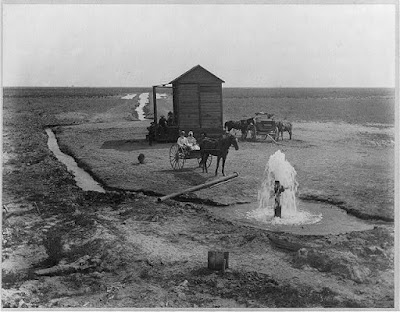
Carleton E. Watkins, Horse-drawn cart beside artesian well, Kern County. c. 1880

Thursday, March 3, 2022

Yellowstone at 150

Anna Price of the Library of Congress's In Custodia Legis recently posted on the 150th anniversary of the creation of Yellowstone National Park, the US's first. Price goes through the legislative history of the statute creating the park, as well as some of the legal issues that arose, including American Indian treaty rights and potential conflicts with settlers claiming preemption and homesteading rights. The latter issue, as the blog points out, also arose in the context of Yosemite Park in the 1872 US Supreme Court Case of Hutchings v Low (a.k.a. The Yosemite Valley Case).

poster designed by Don C. Powell (LOC)

Wednesday, February 16, 2022

Fossil fuels and Jim Crow

Dan Farber recently posted at Legal Planet on "Jim Crow and the Fossil Fuel Industry":

This being Black History Month, I thought it would be worthwhile looking at the fossil fuel industry’s racial history.  Given the historic concentration of the oil and coal industries in the South, it is no surprise to find that these industries have also been deeply entangled with Jim Crow and its legacy of discrimination.

The conclusion:

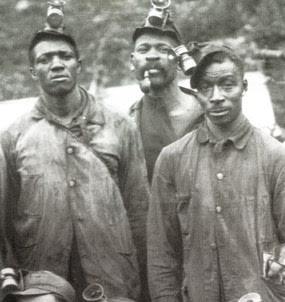
In sum, the racial history of the oil and gas industry seems to have been much worse [than that of the coal industry], associated with more virulent and blatant racism. Blacks were nearly excluded from the industry.  In contrast, blacks found jobs in the coal industry, but only at the bottom of the job ladder. Those bottom rungs were decimated by new technology. In the end, the result in both industries was much the same: a workforce largely empty of Black faces. 

Black miners at New River Gorge (NPS)

Sunday, February 13, 2022

More on water by-laws in Mandate Palestine


I recently posted a piece on H-Empire, based on my article, "Horizontal and vertical influences in colonial legal transplantation: water by-laws in British Palestine" (open access) (see also my recent post on this blog). An excerpt:

Zoltan Kluger, Dizengoff Square Circle in Tel Aviv, 1938 (National Photo Collection)
I ask two questions about the local bylaws enacted in the Mandate period (mainly in the last decade and a half of British rule, which ended in 1948) in the field of water supply and sewage (I'm working on a wider project on this history of water law in Mandate Palestine): Did the initiative for these bylaws, as well as the legal norms and language embodied in them, come from the residents of Palestine and their elected local governments or was it primarily the result pressure applied by the British rulers? And did legal influence cross communal boundaries, between Jewish and Arab local authorities, or did Arab towns tend to copy from other Arab towns, and Jewish from Jewish? The first question I conceptualize as one of "vertical" influence; the second as "horizontal".

Sunday, January 30, 2022

The Antarctic and Outer Space Treaties

Aurora australis, Milky Way, and flags at the South Pole (Martin Wolf, NSF)
Sophia Guido recently posted "How the Antarctic Treaty of 1959 Influenced the Outer Space Treaty of 1967" at In Custodia Legis. An excerpt:

After successfully reaching a consensus on the Antarctic Treaty in 1959, countries were eager to apply these already agreed-upon terms to outer space. The result: many articles in both treaties are very similar to each other. For example, during the Antarctic Treaty discussions, many countries wanted to claim part of the continent as their own based on whose citizens discovered a particular area first, but there were many overlaps of land claimed by multiple nations. So, it was decided that no country could claim sovereignty over any part of Antarctica. By putting this article within the outer space treaty, no country can claim ownership over any celestial body in outer space. As more countries develop the technology to send people or objects into space, this idea is more relevant than ever.

One of the main principles of the Outer Space Treaty is that the exploration and use of outer space and the celestial bodies within it should be carried out for the benefit of all countries, regardless of whether it is for scientific or economic purposes, and only for peaceful purposes. Outer space can be freely explored by all states. However, no country can make any territorial claim to any part of outer space or any celestial body, and every country is responsible for any national space activities carried out by their government or non-government entities and will be liable for any damage caused by their citizens. No country is allowed to place any nuclear weapons or any weapons of mass destruction in any part of outer space.

Wednesday, January 12, 2022

Climate in the American legal academy

A recent post by Dan Farber at Legal Planet discussed the issue of when climate awareness began to enter American law. 

In "The Origins of Climate Awareness in the Legal Academy", Farber writes:

The earliest clear references to climate change that turned up in my search... were in 1978 articles about nuclear energy. The most notable was by an administrative law professor at Harvard, one Stephen Breyer. Now-Justice Breyer argued that it was misleading to consider the environmental impact of nuclear power without also considering the impact of alternatives such as coal. In particular, he said, “reliance upon coal, on the other hand, could aggravate the ‘greenhouse effect,’ whereby excess carbon dioxide (which accompanies coal burning) traps heat inside the earth’s atmosphere, thus possibly melting the icecaps and raising the level of the oceans.” He apparently viewed this as a speculative concern, however, since he immediately added that coal “more realistically” could cause harm to coal miners and other health effects. The other article about nuclear power also observed in passing that “coal combustion may disrupt global weather patterns by increasing the amount of carbon dioxide in the atmosphere, creating a ‘greenhouse effect.’”

***** 

In another article, Herbert Taubenfeld recounted that:

“In 1980, when I spent the summer with the International Division of the EPA, I did an exercise in ‘forward drafting.’ I tried to draft an international treaty limiting the production by all methods of carbon dioxide (to control the global warming trends caused by increasing levels of carbon dioxide) and limiting the production of chlorofluorocarbons (in particular, limit the production of freon, which is the most important element used in refrigeration and air conditioning processes).”

*****

Edith Brown Weiss
A 1981 article by Edith Brown Weiss provided the most thorough (as well as thoughtful) treatment of the climate change issue.... Given the higher level of scientific uncertainty forty years ago, Brown called for consideration of a series of measures, including requiring environmental impact statements to include CO2 emissions, removal of CO2 from smokestacks, and limits on the use of coal. She also called for international consultations and for strategies to deal with deforestation.  Given the uncertainties, however, she said that the issue “should not be pushed into high-level political debates that would cause countries to adopt premature positions based on inconclusive premises and embedded in national political rhetoric.”

I suspect that there were several reasons why legal academics failed to focus more on climate change in this early period. First, the problem was more remote forty years ago than it is today. There was also much more scientific uncertainty about the magnitude of warming and its impacts than there is today. Second, there weren’t any legal developments to talk about, with the first UN treaty 7-10 years in the future. Third, there was so much else going on in environmental law. For instance, Weiss wrote the year after the Superfund law was passed and barely a decade after the Clean Air Act went into effect.

Whatever the reason, legal scholarship seems in retrospect to have been a bit slow to focus on the issue of climate change.  With a few exceptions, legal academia cannot claim much credit for foreseeing how large the issue would loom in the future (now).

Thursday, December 9, 2021

LA's water and history

Richard Frank recently posted at Legal Planet on "The Latest Chapter in Los Angeles’ Century-Long Water War With the Eastern Sierra’s People & Environment". Frank begins:

There LADWP goes again.

Recently the Los Angeles Department of Water and Power announced it was walking away from its longstanding obligation to provide Mono County residents and the environment with a tiny fraction of the water it transports from Mono County to LADWP’s urban customers in Los Angeles.  When efforts by county officials to resolve the dispute informally with LADWP failed, the County sued, arguing that LADWP’s unilateral action violates California’s most iconic environmental law, the California Environmental Quality Act (CEQA).  Earlier this year, a trial court agreed, ruling in the County’s favor.  The court found that LADWP’s decision to turn off the Mono County spigot without prior environmental review violates CEQA.  Now LADWP has chosen to appeal this adverse ruling to the California appellate court—where it is likely to lose again.

If LADWP’s action were an isolated incident, observers might well conclude that this is simply the latest chapter in California’s seemingly interminable water wars.  But it’s not.  To the contrary, LADWP has a sorry, 120-year history of treating the rural people and natural resources of the Eastern Sierra as a population to be exploited and an ecosystem to ravage.  Fortunately, the courts, state officials and environmental advocates have in the past repeatedly intervened to halt or moderate LADWP’s economic and environmental depredations.  Unfortunately, they need to do so again in order to stop LADWP’s announced water cutoff.

There's lots more legal history in this interesting and timely post.

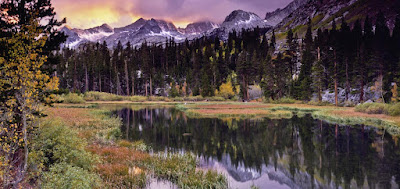
Weir Pond, Eastern Sierras

Thursday, December 31, 2020

Clean Air Act turns 50

Dan Farber recently posted on the subject at Legal Planet. Here's part of what he had to say:

No doubt we could design a more effective and efficient regulatory scheme if we were start over. But the Clean Air Act has nonetheless had a major impact.  Here’s what EPA has to say on the subject  — and remember, this is from the Trump EPA, which is no fan of regulation:

  • Experience with the Clean Air Act since 1970 has shown that protecting public health and building the economy can go hand in hand.

  • Clean Air Act programs have lowered levels of six common pollutants — particles, ozone, lead, carbon monoxide, nitrogen dioxide and sulfur dioxide — as well as numerous toxic pollutants.

  • From 1970 to 2017, aggregate national emissions of the six common pollutants alone dropped an average of 73 percent while gross domestic product grew by 324 percent. This progress reflects efforts by state, local and tribal governments; EPA; private sector companies; environmental groups and others.

  • The emissions reductions have led to dramatic improvements in the quality of the air that we breathe. Between 1990 and 2017, national concentrations of air pollutants improved over 75% for lead, carbon monoxide, and sulfur dioxide; 56% for nitrogen dioxide (annual); and 22% for ozone. Particulate concentrations improved more than a third between 2000, when trends data begins for ultra-fine particles, and 2015.

For more on the history of the Act, see here


Monday, June 1, 2020

The environment in Dan Ernst's legal history exam

Dan Ernst (Georgetown Law) regularly posts a long exam question from his legal history course at Legal History Blog. This year's question was on federal grazing policy in the US. Some excerpts:
One of the Forest Service’s first projects was to subject stockmen used to roaming the mountains at will to the principles of forestry.  To develop and defend the new regulations, Pinchot hired, as chief legal officer of the Forest Service, an able and imaginative lawyer, who was personally indebted to him for, among other things, lending him money in the past.  The chief legal officer, who reported directly to Pinchot rather that the more politically connected Solicitor of USDA, soon worked out an ingenious constitutional justification for criminal enforcement of the grazing regulation, turning in part on the claim that the use of the public domain was not a private right but merely a privilege.  In 1908, Pinchot’s lawyer convinced the Department of Justice to bring a test case against a sheepherder named Pierre Grimaud.  A federal district judge ruled that the prosecution violated the nondelegation doctrine.  On direct appeal to the U.S. Supreme Court, the justices at first deadlocked, 4-4.  Pinchot was unfazed.  “I hold it to be the first duty of the public officer to obey the law,” he explained, “but I hold it to be his second duty, and a close second, to do everything the law will let him do for the public good.”  After Charles Evans Hughes and another justice joined the Court, Grimaud was reargued, and, in 1911, the Court upheld the prosecution.  The Forestry Service immediately brought scores of criminal prosecutions, and, by 1912, USDA could report that overgrazing in the forest reserves had ended.
*****
In 1934, the Colorado Cattleman’s Association sent [Farrington] Carpenter to Washington, DC, to lobby Congress to add beef cattle to the Agricultural Adjustment Act’s list of “basic agricultural commodities” and permit them to enter into marketing agreements controlling cattle prices.  Having succeeded, Carpenter stopped by his Congressman Taylor’s office to say his goodbyes, just as the grazing act was having a hearing.  Realizing that Carpenter would be an effective witness and learning that he did not think the public domain should be turned over to the states, Taylor asked him to testify.  (Carpenter was no fan of national power, but he believed that once the land was devolved to the states, different grazing interests would capture different state legislatures and produce an unworkable patchwork of regulation.)  Before the House committee, Carpenter spoke for small-scale cattle stockmen such as himself, plagued by nomadic sheep herds and pushed off public domain by larger cattle outfits.  Federal control was the small stockman’s only chance to avoid being “completely wiped out of existence,” he testified.
When, a few months later, [Secretary of the Interior] Ickes’s undersecretary offered Carpenter the directorship of the new Grazing Division created within the department to enforce the Taylor Grazing Act, Carpenter warned that sheep herders would object to his appointment because he was known as a champion of cattlemen in his corner of Colorado.  He claimed also to have said that he did not intend to create “a great centralized bureau” like the Forest Service, “run by Eastern people who know little about the public domain.”  After consulting a government official who once represented sheep herders, Ickes decided Carpenter would treat them fairly.  Whether Carpenter’s other warning registered with the Interior Secretary Ickes is not known.