Showing posts with label Ben Pontin. Show all posts

Sunday, January 28, 2018

Historical analysis in environmental law VI: What is at stake

In the last couple of posts in this series I suggested several directions of inquiry for uncovering the history of environmental law. In this final post in the series, I would like to tentatively offer some thoughts on why the historical exploration of environmental law matters.

First of all, history can help us better understand current environmental law. For instance, David Driesen has recently advanced a positive theory of environmental law, attempting to explain its salient features, such as reliance on certain types of standards. Notably missing from his account are historical explanations for these aspects of environmental law, explanations which might be provided by works such as those of Morag-Levine.  Or take the argument of 'free market environmentalists' that private law would do a better job of protecting the environment than modern regulation; this type of argument could be checked against the historical experience of legal systems that have relied on private law for this purpose.

AC Pigou
Second, the history of environmental law is a topic that offers an opportunity to bridge the material and the abstract, or to take up environmental historian Linda Nash's challenge 'to show how what is presumed to be social or cultural is thoroughly intertwined with the natural.' Such an endeavour would be beneficial to both environmental history and legal history, as legal doctrines, institutions, and ideologies—social and cultural artifacts—developed with regard to the natural, may circulate beyond the narrow confines of environmental law to other legal contexts. One thinks, for instance, of Pigouvian taxes, cost-benefit analyses, and feasibility standards, all developed 'intertwined with the natural' but spreading their branches far afield.

Environmentalists often portray themselves as acting in the name of an apolitical public interest.

Sunday, November 30, 2014

Pontin on environmental law-making in Victorian Britain

We recently had the pleasure of hosting Ben Pontin at the Law and Environment Workshop at TAU. Ben presented some of his fascinating, ongoing research on what he terms "the first green industrial revolution", the wave of environmental law-making (both judicial and legislative) that swept Victorian Britain.

Ben's presentation on his book project on the influence on environmental law of Britain's landowning class and its struggle with capitalist industrialists was fascinating. Hopefully we'll hear more about this work, complementing recent work on middle- and working-class environmentalism, soon.

A recent article of Ben's, "Environmental Law-Making Public Opinion in Victorian Britain: The Cross-Currents of Bentham’s and Coleridge’s Ideas", published in the Oxford Journal of Legal Studies, sets out some of the intellectual and cultural background, as explained in the abstract:
James Northcote, Portrait of Samuel Taylor Coleridge (1804)
It is increasingly clear that law and its enforcement in Victorian Britain were quite effective in tackling formative industrial problems concerning pollution and broader threats to nature. What is unclear is the political philosophy, if any, underlying this historic achievement. A prevalent view is that early ‘environmental’ law lacked any philosophical underpinning (being instead a piecemeal reaction to the various problems of industrialization as and when these presented themselves). The article revisits this issue with reference to Dicey’s analysis of 19th century ‘law-making public opinion’. Dicey identified three broad streams of seminal opinion that, he argued, shaped laws as the century unfolded. The early part of the century was dominated by ‘Old Toryism’, including the romantic conservatism associated with Samuel Taylor Coleridge. This then gave ground to ‘Benthamism’ (or ‘individualism’) which in turn ceded dominance to ‘collectivism’ (also influenced by Bentham’s ideas). Whilst Dicey ignored laws relating to the environment, I argue that this is not because these presented a particular difficulty for his thesis. Indeed, all three seams of ‘law-making opinion’ converged around the legal protection of nature to offer a rich and diverse philosophical foundation for environmental law.

Friday, November 14, 2014

Nuisance injunctions

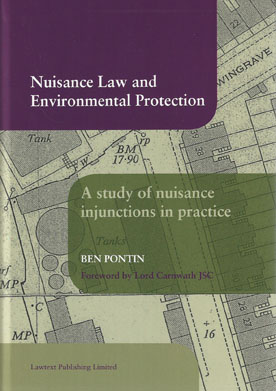
The Journal of Environmental Law has a review by Patrick Bishop of Ben Pontin's Nuisance and Environmental Protection - A Study of Nuisance Injunctions in Practice (Lawtext, 2013) (Ben blogged here about the book and his related work last summer.) Bishop writes:
This book’s aim is succinctly stated from the outset, namely to examine: ‘what nuisance law is with reference to what it does in practice, in circumstances where a claimant is awarded an injunction to restrain ongoing pollution’ (p 1). Pontin posits various nomenclatures to describe his methodology, ‘realist’, ‘law-in-action’ or ‘law-in-context’ (p 3), but in essence the approach adopted is contextual.... The intention is to elucidate the socio-economic and environmental impact of nuisance injunctions by the study of materials extraneous to the law reports; in summary this book intends to broaden and enhance our understanding of nuisance by considering ‘what happened next’.
...the introduction provides a discussion of the main theories relating to the effect of the grant of an injunction. The author identifies four hypotheses gleaned from the literature. First, the idea that the grant of an injunction is likely to result in the closure of the defendant’s polluting exercise (the closure theory). Secondly, it will simulate thinking and investment into new modes of business in a manner which eliminates or at least reduces pollution to acceptable (non-actionable) levels (the clean-up theory). Thirdly, there is the possibility that an injunction might force the defendant to relocate its place of business to an alternative area where the nature of the locality is such that the polluting activity would not constitute an actionable nuisance (relocation theory). Finally, the parties might enter into a post injunction bargain, whereby the claimant is paid to move on or waive their legal rights as suggested by Ronald Coase in his ground-breaking work, ‘The Problem of Social Cost’, (Coase theorem). Thus, while it is Pontin’s intention to produce a text of practical significance, useful to potential litigants as well as lawyers and academics, the discussion of each of the four cases is grounded in theory and the outcome of each case study is judged against the four hypotheses identified. 
*****
Across the cases, the emphasis of the contextual discussion varies considerably; the chapter discussing Attorney General v Birmingham Corporation (1858–1895) focuses on the life and career of the claimant, Sir Charles Adderley. While he has faded into relative obscurity, Adderley is described by Pontin as a figure comparable to Rachel Carson and Gro Harlem Brundtland for his contribution to the enactment of the Public Health Act 1875 (p 59). In contrast, the claimant in Halsey v Esso Petroleum Ltd (1961–1972) is given scant attention and instead the background discussion is concentrated on national economic policy. The focus of each chapter is presumably shaped by the available archival material: it is safe to assume that the life of a former parliamentarian and cabinet minister (Adderley) has been recorded in considerably more depth than that of a Fulham van driver (Halsey). Regardless of the differing emphasis of each chapter, the contextual discussion is fascinating and more importantly, it is always enlightening.
The conclusion to each case study returns to the four hypotheses identified in the introduction. Of these, only the closure theory is discredited; the post-injunction investigation reveals that in none of the four cases was the defendant forced out of business. There is evidence, to a greater or lesser extent, to support the clean-up theory (Birmingham and Halsey), the relocation theory (Tipping v St Helens Smelting Co Ltd (1863-1884) and eventually Halsey) and in Farnworth v Manchester Corporation (1928–1930), the parties entered into a Coasian bargain, albeit that an agreement was reached after 40 years of negotiation! Significantly, in each case the injunction was suspended, thereby providing the defendant with the necessary time to find an alternative to outright closure. As Pontin notes: ‘The costs to industry were bearable, and indeed in each case the defendant had a choice as to compliance. Thus, the law afforded them a measure of flexibility’ (p 167). 

Monday, July 14, 2014

Revisionist English nuisance law history: Part 2

[by Ben Pontin]

As explained in Part One, interpretations of English nuisance law’s contribution to environmental protection during the industrial revolution are changing. That is to say, increasing attention is being given to those instances where victims of industrial nuisance obtained remedies from the courts. Previously, emphasis had been placed on the doctrinal (notably in Joel Brenner’s account) and institutional limitations (in John McLaren’s) of victims of industrial nuisance obtaining a remedy. One of the turning points has been the close study of Adderley’s action against Birmingham Corporation in 1858 (the ‘Great Birmingham Sewage Case’), discussed in my book Nuisance Law and Environmental Protection.

In order to make sense of Adderley’s (and nuisance law’s) achievements – and why they do not fit within the traditional account of nuisance law failure – it is necessary to embrace a level of complexity in the social and economic backdrop of nineteenth century nuisance law that is lacking in the earliest leading studies of this subject. Thus, whereas Victorian Britain in Brenner’s account is characterised as dominated by urban and manufacturing interests in the face of which the courts daren’t say ‘no’ (McLaren is more nuanced), Adderley’s case suggests a power structure far more sympathetic to the plaintiff than hitherto contemplated by historians in this field. A power structure, that is, in which the landed aristocracy spun a persuasive enough (at the time) narrative of noble, honourable and authoritative resistance to the materialist excesses of industrialisation.

Sunday, July 13, 2014

Revisionist English nuisance law history: Part 1

[The first in a series of posts by Ben Pontin:]

English nuisance law is a tort to land that has attracted considerable – some would say disproportionate - interest within circles of environmental law history. In Coventry v Lawrence [2014] UKSC 13 (at [176]), Lord Carnwath commented on part of my contribution to the field as follows:
Ben Pontin in his valuable recent book Nuisance Law and Environmental Protection (2013) shows how since the middle of the 19th Century common law nuisance has played an important complementary role to regulatory controls, on the one hand stimulating industry to find better technical solutions to environmental problems, and, on the other, stimulating the legislature to fill gaps in the regulatory system. He sees the present appeal as an important opportunity for the Supreme Court to review the proper role of this part of the law of nuisance in the modern world. (p 184)
Coventry concerned the relationship between nuisance law and regulation, which is a topic that has been central to nuisance law history since the pioneering studies of Joel Brenner and John McLaren in the 1970s and 80s.

Brenner and McLaren argue in different ways to the conclusion that effective legal remedies for revolutionary pollution awaited statutory regulation later in the nineteenth century. Prior reliance on nuisance law, as it had evolved since antiquity, substantially (so the argument goes) failed to remedy industrialisation’s legendary ‘monster nuisances’. The explanation for nuisance law’s weakness provided by Brenner lies with courts moving away from ‘pre-industrial’ strict liability to favour the ‘wealth generating polluter’ in their disputes with neighbours seeking to protect their property and its amenity (Brenner, ‘Nuisance Law and the Industrial Revolution’ (1974) Journal of Legal Studies 403). McLaren’s explanation differs in its focus on litigation costs and similar ‘institutional’ limits of nuisance law in the face of the vast scale of industrial pollution (McLaren, ‘Nuisance Law and the Industrial Revolution – Some Lessons from Social History’ (1983) Oxford Journal of Legal Studies 155).

The Chancery Court claim in
AG v Birmingham
By contrast, my book offers a revised portrayal of nuisance law, as a success. It does so with reference to a small selection of in-depth case studies of specific instances of industrial nuisance litigation, beginning with Attorney General v Birmingham Corporation (1858) 4 K & J 528. Contextual records relating to the litigation underpinning this case reveal some intriguing events, and ultimately a remarkable practical achievement. Over the course of forty years of litigation, affecting hundreds of thousands of people, involving tens of millions of pounds of investment (on today’s currency calculation), the enjoined municipal defendant invented and adopted a sewage purification technology that satisfied the plaintiff (Sir Charles Bowyer Adderley) and led to the injunction’s lifting. The case inspired others to litigate sewage pollution, and thus it is understandable that Lord Robert Carnwath (again) in a recent article refers to the ‘Great Birmingham Sewage Case’ (in ‘Judges and the Common Laws of the Environment – at Home and Abroad’ (2014) Journal of Environmental Law doi: 10.1093/jel/equ009).

‘Great’ litigation in this and other fields of industrial pollution cannot be divorced from its complex social and economic backdrop, characterised by a territorial elite under threat from capitalism reinventing itself as a the nation’s guardian of ‘Nature’s treasures’. How gothic revivalism shaped nuisance law’s achievements is the subject of a blog to follow.

Friday, July 4, 2014

Welcome, Ben Pontin

We're happy to announce that the blog will be hosting a series of posts by Ben Pontin, of the University of the West of England, Bristol. Ben is the author of Nuisance Law and Environmental Protection: An Analysis of the Enforcement of Injunctions (Lawtext 2013), as well as numerous articles on environmental law in Victorian Britain, including:
Environmental law textbooks tend to start off by explaining modern environmental legislation as a response to the failure of nuisance law to effectively control pollution. Ben will be posting here on his revisionist view of nuisance law's historical achievements.

Wednesday, June 12, 2013

A realist analysis of nuisance law's historical achievements

Just out in the Journal of Law and Society is Ben Pontin's "The Common Law Clean Up of the ‘Workshop of the World’: More Realism About Nuisance Law's Historic Environmental Achievements". Joining the author's previous work on environmental law in nineteenth-century Britain (e.g. here and here), the new article uses a legal realist lens to examine the achievements and limits of Victorian-era nuisance law in bringing about environmental improvements.