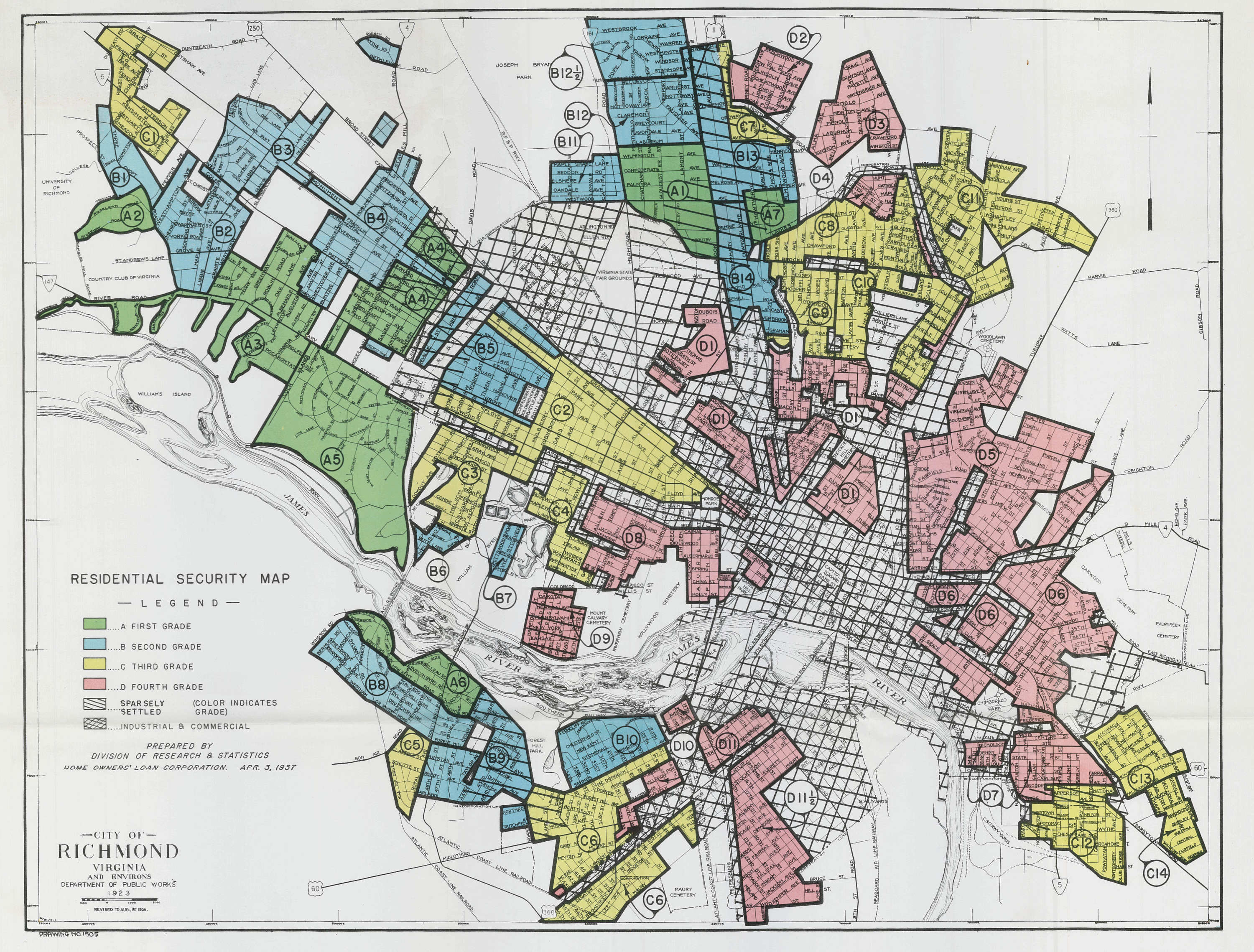
Although challenges in water and sanitation access are often assumed to be issues of low- and middle-income nations, more than 400,000 homes in the United States still lack access to complete indoor plumbing. Previous research has demonstrated that the remaining plumbing challenges are more prevalent in communities with high Black and Brown populations. This study hypothesizes that the 1930s practice of redlining by the Home Owners' Loan Corporation (HOLC), which systematically denied loans to minority populations, is linked to present-day inadequate plumbing access (i.e., defined as incomplete plumbing above the national average). Digitized HOLC maps for 202 urban areas across the country and U.S. Census data from the 2016 to 2020 American Community Survey were combined to interpolate the modern-day plumbing access for historical neighborhoods (n = 8871 communities). Analysis via binomial logistic regression demonstrated that nationally, redlined communities (HOLC Grade “D”) are significantly more likely to have a rate of incomplete plumbing above the national average compared with greenlined communities (HOLC Grade “A”) (0.1352; confidence interval = ±0.036). This finding was also observed for three of the nation's four census subregions (Northeast, Midwest, and West). Slight differences by region in relationships between the proportion of specific racial/ethnic populations on rates of incomplete plumbing demonstrate the need for targeted place-based interdisciplinary examinations of exclusionary practices. The demonstration of the present-day impacts of redlining after nearly 90 years emphasizes the need to intentionally mitigate past injustices to ensure modern-day equity.
Showing posts with label finance. Show all posts
Showing posts with label finance. Show all posts
Friday, August 25, 2023
Water access and historical redlining
Charles W. Sterling III recently published "Connections Between Present-Day Water Access and Historical Redlining" in Environmental Justice. The abstract:


Friday, February 23, 2018
Royal forests in Poland and Lithuania
 |
| Title page of Jan Kochanowski’s Satyr albo dziki mąż (1564), a political satire in verse that criticized forest exploitation. (National Digital Library Polona, from the article) |
October's Environmental History published, alongside an article on early Chinese forest law, Mateusz Falkowski's "Fear and Abundance: Reshaping of Royal Forests in Sixteenth-Century Poland and Lithuania". The abstract:
This article analyzes new restrictive forest legislation announced by king Sigismund Augustus (d. 1572) in Poland and Lithuania. In the sixteenth century, eastern Europe remained the most densely forested region on the continent; Poland and Lithuania, however, were blessed not only with resources but also with an unusual combination of plains, forests, rivers, and seaports that facilitated the development of large-scale forest industries. Drawing on a combination of royal documents, domain surveys, correspondence, customs registers, and contemporary literature, I argue that the significant resources available to the king allowed him to think of the forest economy and long-distance trade in its products as the backbone of state finances. I recognize changes in the forest regime as part of the greater state reforms redefining the relationship of the king’s subjects to his domain, as well as a strategic move designed to increase treasury income to finance the military during the Livonian War (1558–83). I also argue that changes in the forest regime were established because of the abundance of resources, unlike in many contemporary European states that introduced prohibitive laws as a result of wood shortage fears.For other recent takes on forest law see here, here and here, or click on the "forest" label.
Sunday, September 20, 2015
Yale's Dutch water bond
 |
| Courtesy Yale University |
The story of the 1648 bond held by the Yale rare books library, on which the university will be paid interest, has been making the rounds. The always erudite Rechtsgeschiedenis Blog (Legal history with a Dutch view) explains:
This week news came out about the upcoming payment of interest to Yale University on a perpetual bond issued in 1648 by a Dutch water authority, the Hoogheemraadschap van de Lekdijk Bovendams. Next week its legal successor, the Hoogheemraadschap Stichtse Rijnlanden, will pay the sum of €136,20 ($154), the interest over twelve years. Yale’s Beinecke Library bought the bond in 2003 as a cultural artefact.
*****
The website of the Regionaal Historisch Centrum Rjnstreek en Lopikerwaard, the regional archive at Woerden, offers a concise history of this institution. In 1285 a dam had been placed in the Hollandse IJssel to prevent the water of this river to stream into the Lek near the village of Vreeswijk, now a part of Nieuwegein. After floodings in this region of the diocese Utrecht due to neglect of this dam bishop Jan van Diest published in 1323 an ordinance for its maintenance. The schouwbrief of 1323 was followed by more instructions, in particular by ordinances published on behalf of Charles V in 1537. “Bovendams” means “ahead of the dam”, in this case up to Amerongen, to the east, 33 kilometers. From the dam westwards another water authority came into existence dealing with the Lekdijk Benedendams up to the town of Schoonhoven.
*****
The bilingual website Beursgeschiedenis/Exchange History has a short article showing the 1648 bond is not the oldest surviving one from this hoogheemraadschap, but one from 1624, since 1938 in the possession of the New York Stock Exchange, thus one of the oldest surviving shares worldwide. The 2,5 percent interest yields even today 15 euros. The bonds of 1648 were issued specifically to build a krib, a pier in the Lek near the hamlet of Honswijk, now situated within the municipality Houten. Maintaining such piers and fighting against piers and other structures at the other side of the river kept the hoogheemraadschap busy for centuries.... Like other Dutch water authorities the hoogheemraadschap was an independent authority which could proceed in court against for instance the counts of Culemborg or the States of Guelders. The website for the history of stock exchange does call to attention the fact that even the counts of Holland and the bishops of Utrecht, in medieval times often deadly enemies, both invested money in the maintenance plans of water authorities.
*****
Some elements in this week’s story need elaboration. You can shake your head in disbelief about a rich university welcoming a payment of just over one hundred dollars, but you might also marvel at the fact of the longevity of institutions vital for the protection of areas threatened by the powers of mighty rivers or seas. Issuing perpetual bonds or rents was not an invention of the Dutch Republic. Medieval rents issued by cities are documented for regions such as Tuscany and Flanders since the thirteenth century. Water authorities could levy taxes to get money, but these taxes were meant to cover the costs of normal maintenance.
Subscribe to:
Posts (Atom)