Showing posts with label website. Show all posts

Thursday, April 21, 2022

Environmentalism Then and Now

I just came across a site by the American Bar Association's Division for Public Education with teaching materials on the history of environmental law

It's an eclectic group of resources. For instance the PowerPoint presentation entitled "Environmentalism Then and Now: Is Going Green New? You Be the Judge..." includes slides on a 1681 regulation by William Penn requiring Pennsylvanians to conserve one tree for every five cut down, and a 1739 petition by Benjamin Franklin to the Pennsylvania Assembly to stop waste dumping in Philadelphia harbor.

There's also a unit on the Exxon Valdez spill and ensuing litigation, including Supreme Court briefs.

Exxon Vladez - skimming operation (NOAA)

Tuesday, February 1, 2022

National security and climate change

The National Security Archive project recently posted "National Security and Climate Change: Behind the U.S. Pursuit of Military Exemptions to the Kyoto Protocol", a collection of internal papers and accompanying detailed commentary. Burkely Hermann writes:

Journalists and commentators have argued lobbying by the United States meant that the Kyoto Protocol gave militaries a large exemption from emissions targets and standards. However, the documents tell a different story, of exemptions which were not as wide as the Pentagon or critics of the agreement would have liked. These provisions exempted emissions from international operations authorized by the United Nations or those described as in accordance with the UN Charter, and bunker fuels from being added to national emissions totals.

*****

On December 11, 1997, the same day the Kyoto Protocol was adopted, the United Nations Framework Convention on Climate Change (UNFCCC) Conference of the Parties released a decision which enshrined the exemptions within the treaty itself. The decision stated that emissions “based upon fuel sold to ships or aircraft engaged in international transport,” i.e., bunker fuels, should not be part of national totals. It was further decided that emissions from multilateral operations following the United Nations Charter would not be included in national emissions totals but would be “reported separately”. 

There's lots more detail, including 27 archival documents and scores of links to other sources. The project's website also has many other documents and essays on other aspects of climate change treaty negotiations.

Confidential State Dept. cable, October 26, 1997

Tuesday, July 14, 2020

Historic Spanish conservation laws

The US Library of Congress's online Herencia collection, containing royal decrees, papal bulls, legal opinions, judgments, and royal orders from Spain from the 15th through the 19th centuries, has recently been running a crowdsourcing project to review transcriptions of the historic documents.

Two collections that might interest readers of this blog are the collections of laws and statutes on agriculture, conservation, hunting, and fishing, and that on disease and public health law.
Royal Order of December 12, 1748 concerning the conservation of forests and plantations (LOC)

Monday, April 20, 2020

Sources on the legal history of epidemics

I've been busy with other things for a while and haven't had a chance to post, but I've just put up the first draft of a list of sources on the legal history of epidemics.

Please pass it on to anyone who might be interested, and please email me with any sources or suggestions!

Wishing everyone good health,

David
Title page of Girolamo Previdelli, De Peste et ejus privilegiis (Bologna, 1528)
(courtesy of Bayerische StaatsBibliothek)

Thursday, July 25, 2019

Streams of life and strife

Table IX of the Lex Irnitana – Museo Arqueológico de Sevilla
(image: Red Digital de Colecciones de Museos de España, http://ceres.mcu.es)
Last week Otto Vervaart's always learned Rechtsgeschiedenis Blog featured a post on water law: "Streams of life and strife: Water as a legal matter in Roman law". Some highlights:
The project Roman Water Law at the Freie Universität and the Humboldt Universität in Berlin helps to look at regulations concerning water and its uses according to an interesting scheme. Legal attention to water has a very long history.
*****
The core of the virtual collection is a combination of legal sources found in the Corpus Iuris Civilis, three individual leges (laws) and the Codex Theosodianus with texts from Roman authors who touched the subject of water. The results are 572 entries with a Latin text and English translation to which one of ten newly defined categories have been assigned.
The harvest for Roman laws in the technical sense, leges approved by the senate of the Republic, may seem meagre with just three laws. However, one of them, the Lex Flavia Irnitana from AD 91, was only found in 1981. The fragments of six out of originally ten bronze tables are now held at the Museo Arqueológico in Seville {Hispania Epigraphica, no. 5058). This law, dated around 91 BC, is the most complete surviving example of a Lex Flavia, a municipal law. Chapter 82 of the Lex Irnitana deals with drainage and creating and changing roads, paths, canals and sewers, for which only the duumviri, a pair of magistrates elected for one year, are authorized if there is a municipal decret for their actions.
*****
The core of the project are the classifications added to each entry. There are ten main types of classes, starting with definitions (44), followed by
Right to use water
Constructions to use water – Process of construction and maintenance
Legal protection of water use
Urban praedial servitudes of water
Regulation of damages and prevention of damage caused by water
Consequences of changes caused by water
Water as a route of transport
Water as a border
Buildings at banks, coasts and beaches 

Friday, January 18, 2019

Trends in environmental treaty-making

Legal Planet recently mentioned the University of Oregon's International Environmental Agreements Database Project. The project has a ton of information on environmental treaties, including lists of treaties by date, subject, and lineage; a library of historical documents on marine mammal protection; and more.

The graph below (click here for a larger version), taken from the main page of the website, charts the number of of environmental treaties, protocols, and amendments by decade (up to 1950) and then by five-year period. The quantitative data highlight some features that beg for some interpretation and context: A small surge in activity in the 1890s (not surpassed until the 1940s), a huge jump in the 1950s (more than three times the activity than the preceding decade), and a continuing drop since the mid-1990s peak (presumably associated with the 1992 Rio Earth Summit).
Thoughts anyone?

Sunday, September 2, 2018

The Powell memo

The website for the book The Republican Reversal: Conservatives and the Environment from Nixon to Trump by James Morton Turner and Andrew C. Isenberg (Harvard UP, 2018) includes a range of interesting primary sources on the topic. Among them is a pdf of a 1971 memo by Lewis Powell to the US Chamber of Commerce, described on the website:
Soon-to-be Supreme Court justice Lewis Powell wrote this memo for the U.S. Chamber of Commerce in 1971 as conservatives grew concerned about the growing influence of liberals and an expanding regulatory state.  It offered conservatives a roadmap for exerting their political power in the defense of individualism and free enterprise.
It's a pretty amazing document. Here's an excerpt:
As every business executive knows, few elements of American society today have as little influence in government as the American businessman, the corporation, or even the millions of corporate stockholders. If one doubts this, let him undertake the role of "lobbyist" for the business point of view before Congressional Committees. The same situation obtains in the legislative halls of most states and major cities. One does not exaggerate to say that, in terms of political influence with respect to the course of legislation and government action, the American business executive is truly the "forgotten man".
Current examples of the impotency of business, and of the near contempt with which businessmen's views are held, are the stampedes by politicians to support almost any legislation related to "consumerism" or to the "environment".
For more on the memo, see here.

Monday, October 9, 2017

Environmental timelines

A while back Environmental History carried a review by Daniel Simberloff of Ian Rotherham's Eco-history: An Introduction to Biodiversity and Conservation (White Horse Press, 2014). Simberloff notes:
The high point of Eco-history is a remarkable 42-page “Timeline,” detailing in linear fashion 224 key points in the history of British nature conservation from AD 1000 to 2000: laws especially, but also extinctions, introductions, establishment of nature reserves and environmental organizations. Rotherham concisely lists the impacts of each event, with further explication for about half of them. This section alone could be published as a short book that almost any environmental historian would value.
I don't think they're related, but there's also a very elaborate website called "Environmental history timeline", itself packed with little known nuggets of environmental-legal history, such as the fact that in 1970 US President Richard Nixon "issued an executive order... requiring industries to obtain a federal permit before dumping wastes into U.S. waterways or face criminal charges. This was the beginning of the US National Pollution Discharge Elimination System (NPDES) permitting process." Or that in 1779
Johann Peter Frank (1745-1821), writes A Complete System of Medical Policy in Germany advocating governmental responsibility for clean water, sewage systems, garbage disposal, food inspection and other health measures under an authoritative “medical police.” This idea was well received and influenced policy in Germany, Italy and other nearby nations. The authoritarian approach did not sit well with the French, British or Americans, where direct government controls developed only in areas of specific problems such as communicable disease and sanitation.
There's a lot more in this timeline, worth perusing and bookmarking.

Thursday, April 20, 2017

Yet more forest law

The always vigilant Rechtsgeschiedenis Blog recently posted on the Oxford Libguide on English legal history, noting that it surprisingly has a prominent section on Forest Law. The guide explains the subject:
Generally used to designate the legal regime following the Norman conquest (or at least from temp Henry I 1100): "... the subjection of ... vast tracts of forest land to an alien and oppressive "forest law" protecting the royal hunt" ...[ Baker, Introduction to English Legal History (4th edn 2002), 12[
It raised considerable problems of rights of ownership: for example, it was possible to be the legal owner of land within the designated area of a forest, and yet not be able to "harvest" its produce, either by hunting wild game or felling timber.
Already such a source of grievance to be the subject of clauses in the first attempt to limit the royal power of King John, by 1217 had become the subject of a separate Charter (of the Forest). The arrival of this shorter charter was what lead to the Magna Carta being so called.
The forest law was maintained by specific officers (such as wardens, verderers, and foresters) and with two principal courts hearing charges of breach of the laws, the courts of attachment and the forest eyres.

Among the online resources noted by the guide are John Manwood's [apparently his real name] 1598 Treatise and Discourse on the Lawes of the Forest [the 1717 edition is here], Jane Winters's essay on Forest Law, and the above image of the 1225 Forest Charter granted by Henry III, one of three surviving originals.

For more on British forest law, see here.

Sunday, November 20, 2016

Bhopal Digital Archive

Mitra Sharafi recently posted on the digital archive created by her and others at the University of Wisconsin on the 1984 Bhopal disaster in which lethal gas leaked from the local Union Carbide plant and killed 15,000 to 25,000 people. The archive is centered on documents collected by legal scholar Marc Galanter, who was involved in civil litigation against the company. The archive explains the basic legal chronology:
Bhopal is frequently referred to as the world’s worst industrial disaster. The leak followed a period of reduced maintenance and neglect of safety systems at the plant.
The arrival in Bhopal of American lawyers led to the filing of hundreds of lawsuits against the American parent company, Union Carbide Corporation (UCC), in the United States. The Indian Parliament passed the Bhopal Act, designating the Government of India (GOI) as the exclusive representative of the victims. The GOI brought filed suit in US federal court on April 8, 1985. The many American cases were consolidated for pre-trial proceedings in the federal district court for the Southern District of New York. The case was assigned (by lot) to Judge John F. Keenan, at the time a relatively junior judge. Union Carbide moved to dismiss on grounds of forum non conveniens—i.e., that the case could more appropriately be tried in India.
The Court allowed discovery on matters limited to the question of where the case should proceed. The parties submitted briefs and supporting material and presented oral arguments. Judge Keenan granted the defendant’s motion to dismiss subject to some conditions, which Union Carbide accepted after modification by the Court of Appeals.
The case was re-filed in India in the District Court in Bhopal on Sep. 5, 1986. On Dec. 17, 1987, that court ordered preliminary compensation of Rs. 350 crores (then equal to about 25 million dollars). Union Carbide appealed to the High Court of Madhya Pradesh, which affirmed the order for preliminary relief, with modifications, reducing the amount of Rs. 250 crores. UCC then appealed to the Supreme Court of India. In February 1987, while the appeal was pending in the Supreme Court, UCC and the GOI reached a settlement, under which UCC paid the Government of India $480 million in dollars.
The GOI set up tribunals to determine the compensation to be paid to claimants. The tribunal process extended over more than 15 years. Because the value of the Indian rupee fell from roughly 13 to the dollar in 1987 to 45 to the dollar in 2004, the GOI ended up having a considerable residue (over $300 million) after paying the victims. In 2004 the Supreme Court ordered the remaining funds to be paid out pro rata to all those who had been compensated.
Many in India remain convinced that the culprits were let off too easily in light of the comparatively low damages payment and the absence of UCC’s chairman, Warren Anderson, from the trial that convicted his Indian subordinates.

Friday, October 28, 2016

Environmental history in oral arguments

Brian Tomasovic recently posted the abstract for his article "Soundscape History and Environmental Law in the Supreme Court", published last year in Environmental Law. The abstract:
Today’s technology unleashes new, digitized information resources with immense scale and speed. This Article examines one such resource — the archive of audio recorded proceedings of the United States Supreme Court — appraising, for the first time, its value to those who study and practice environmental law. From hundreds of hours of audio across six decades, a history of environmental litigation sounds forth, imparting rich lessons on advocacy, judicial reasoning, and the role of the Court in environmental law’s development. The Article organizes itself in three major parts, furnishing insights on: oral advocacy in the environmental docket; the voices from the bench; and the audience for prospective engagement with any selection or subset of recordings. Serving partly as a listener’s guide, the Article defines the reach of environmental litigation in the audio archive and demonstrates its unique value as a tool for learning and the professional betterment of environmental law scholars and practitioners.
Tomasovic explains that argument audio hosted on the Supreme Court’s website presently begins with the October 2010 Term, while recordings going back to 1955 are at the Oyez website. The article's Appendix B "compiles the list of available oral argument recordings for more than three hundred Supreme Court cases where environmental protection or natural resource concerns were at stake", and also "labels, using keyword tags, the identity of these settings under the rubric of the environmental burdens, risks, or amenities at issue in each case".

Is this resource important? Tomasovic thinks so; here are some highlights from my perspective (footnotes omitted). I'll start with his treatment of environmental history as reflected in the recordings:

Monday, July 25, 2016

City smoke ordinances

The Library of Congress webpage The Evolution of the Conservation Movement, 1850-1920 has quite a bit of legal material from the period:
The collection consists of 62 books and pamphlets, 140 Federal statutes and Congressional resolutions, 34 additional legislative documents, excerpts from the Congressional Globe and the Congressional Record, 360 Presidential proclamations, 170 prints and photographs, 2 historic manuscripts, and 2 motion pictures.
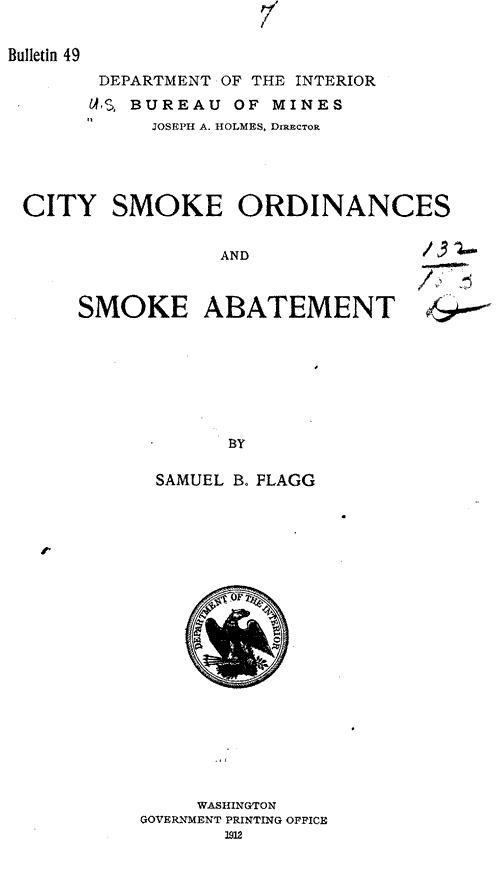
There are some unexpected treasures here, for instance Samuel Flagg's 1912 booklet, City Smoke Ordinances and Smoke Abatement, published by the Bureau of Mines (see title page below). The website explains:
Although concern for the effect of human environmental activity on human welfare did not move to the center of what is now called the environmental movement until the 1960s, the turn-of-the-century conservation movement did include something contemporaries referred to as "human conservation:" an attempt to improve the quality and quantity of human life, particularly in the nation's burgeoning urban centers, through attention to certain kinds of environmental management, particularly technological intervention. Within this framework, engineers, scientists and public policy-makers sought to determine how natural resources, such as mineral fuels, could be used with both maximum efficiency and minimal detriment to the human environment. This brief survey by the U.S. Bureau of Mines provides a concise and systematic overview of contemporary anti-air-pollution efforts as reflected in the smoke-abatement ordinances of cities throughout the country, and prescribes the essential characteristics of ordinances appropriate for municipalities of different sizes. An Appendix reprints actual ordinances from Chicago, Pittsburgh, Des Moines, Milwaukee, Los Angeles, and Boston by way of example. It should be noted that the problems caused by urban smoke are defined (p. 8) in terms of economic waste, damage to buildings, loss of light, dirt, and injury to vegetation, but not as a direct threat to human health.
For more environmental law treatises of the period, see here. For more on smoke regulation, see here and here.

Friday, June 10, 2016

Digital resources on the commons

"General map which shows the status of the mother river Queiles from the Kingdom of Aragon until it enters the terms of Tudela, the dams, main ditches, Bracers highest grade, which includes the villages with their jurisdictions and roads", drawn March 15, 1792 by Fernando Martínez Corcín. Source: Archivo general de Navarra, Cartografia, signature 146.
(from the ICA page on the Albalá de Tudela)
Rechtsgeschiedenis Blog recently covered digital resources on commons institutions, highlighting the website of Institutions for Collective Action, the Digital Resources on the Commons page of the International Association for the Study of the Commons, and Indiana University's Digital Library of the Commons. There's a tremendous amount of historical material, both primary and secondary, available through these sites.

Like Otto at RB, I'm particularly interested in the water institutions. Institutions for Collective Actions's portal has case studies for 5 Dutch and 3 Spanish waterboards, with a tremendous amount of information on the historic legal institutions governing the management of water in these areas. For instance, here's an excerpt from a description of how the waters of the River Queiles around Tudela, in Navarre (in the north of today's Spain) were governed under a series of ordinances going back to 1220 (a hundred years after the city's Muslim rulers were ejected, but obviously showing the continued influence of their rule):
The ownership of the water of the river Queiles was divided into monthly shifts between the communities that were entitled to irrigation. The first description of this system is to be found in the ordinances of Tudela of 1220. Each month was divided into three periods of different lengths: the almoceda, the alhema. and the entremés. The almoceda began at sunrise on the 22nd of each month and ended on the 26th, lasting four days and nights. The alhema began at sunrise on the 26th and was of variable duration, depending on the location and the time of year: on the right bank, it lasted five days in ten of the twelve months of the year and four days in April and May. From 1376 onwards, on the left bank the alhema lasted for eight days and nights, except in April and May, when its duration was reduced to seven days. The remainder, between the end of the alhema and the start of the almoceda was called entremés.

Wednesday, June 8, 2016

ELI interviews of environmental law pioneers

The Environmental Law Institute (where years ago I spent a great summer internship as a law student) recently uploaded interviews with 24 people involved in creating the legal framework for modern environmental law in the US, along with short biographies of the interviewees. Scott Fulton, ELI's President, explains:
Nearly 50 years ago, thousands of Americans rallied in the spring of 1970 to celebrate the first Earth Day, an event that marked the beginning of the modern environmental movement. As we approach the 50-year milestone, the Environmental Law Institute has interviewed and recorded the stories of 24 of the men and women who inspired, created, and implemented U.S. framework laws to protect public health and the environment. We asked them why they chose to work on environmental problems and what caused the rise in public concern and support for new environmental laws in the early days. We learned how sweeping new laws like the Clean Air Act and the Clean Water Act came to be created and carried out by able leaders from both political parties, what innovations in those laws made environmental law work well, and where they fell short of expectations.

[Sorry I've been lax in blogging lately. As always, I'm happy for others to pitch in with posts!]

Friday, February 26, 2016

Spirit over the waters

Chicago Sanitary & Ship Canal, original Lockport Lock (American Canal Society)
I recently came across Paul Janicke's website Spirit Over the Waters, which contains libraries of cases having to do with the Lake Michigan water diversion controversies (1900-present) and related patent infringement controversies on wastewater treatment (1914-1947). The site explains the first set of cases:
Twenty percent of the world’s fresh water in the world is in the Great Lakes. That water has drawn significant interstate controversies for over 100 years. States have had recourseto the Supreme Court seven times, testing what a state can or cannot do with the water of Lake Michigan. The most important of the cases, the one between Illinois and the other lake-bordering states, was filed in 1922 and is still open today. The central issue has been the withdrawal by Illinois of significant quantities of Lake Michigan water to use as flush water for Chicago’s human and industrial wastes, sending them westward into the Mississippi .Other issues evolved as well. 
The Supreme Court has been the main decider.
In most instances of controversy the Supreme Court appointed a special master to gather the evidence and recommend resolution. The Court’s decision in each instance is readily available, but none of the underlying masters’ reports and related briefing are in the Court’s records today. For this library all the special masters’ reports, and much of the states’ briefing, has been recovered, along with significant evidentiary and background materials. It is hoped that scholars and members of the public will find this long story pertinent to contemporary discussions regarding water supply in an era of major droughts in many parts of the country.
And the second:

Thursday, October 1, 2015

Imperial free trade and the environment on flim

The relationship between trade and the environment is a fraught one; most recently it has been prominent in debates over the proposed Trans-Pacific Partnership.

"Empire Trade", a 1934 British propaganda film, provides some historical context (you can view it at the excellent Colonial Film website; I got to it through a University of Exeter online course on the British Empire). Here low tariffs within the British Empire are touted in terms of the jobs brought to the home country by exports to the colonies and dominions, and the the raw materials from around the empire that feed British industry.

Visually, prosperity at home is represented by belching smokestacks, white-hot furnaces, and smoking locomotives.

"The size, rather than the position of England, governs our greatest national problem today.
We are not a self-supporting country. We depend for our existence on the exchange of our
manufactured commodities for the food and raw materials that we cannot produce ourselves,
and for these we must rely largely upon our Empire and our merchant navy."
And the video tour around the empire is a celebration of exploitation of nature and colonial labor. (Please read the captions, but trigger warning: some of the text is distasteful.)

Rubber plantation in Malaya. "The amount of rubber produced here alone
is nearly twice as much as the rest of the world's output, and so
forms a tremendously important addition to our Empire resources."
Coconut plantation in Malaya. "This chap doesn't have to wait for the fair
and the coconut shies to come to town; he can have 'em for breakfast every morning."
Floating logs in Canada. "The watermen, who see to it that these logs float downstream without
jamming, have an exciting time." A few frames later, some of them fall in the water.
South Africa. "Her most important industries are diamond and gold mining,
both developed by British engineers, equipped with British machinery."
It seems that circa 1934 environmental degradation and exploitation of less developed countries were clearly seen to result from free trade. One might be charitable and say that they were seen as the price that needed to be paid for economic prosperity, but watching this film, one gets the sense that its makers weren't troubled at all by these costs.

Monday, July 20, 2015

Magna Carta and the environment

King John hunting, from Statutes of England (14th century)

Much has been written recently on Magna Carta, now celebrating its 800th anniversary. Jill Lepore's piece at the New Yorker is good; the best is still Tony Hancock's 1959 take.

I was fortunate to attend the recent British Legal History Conference at the University of Reading, as part of which we made an excursion to the meadow at Runnymede where King John signed Magna Carta. The first environmental element in this story is a monument that was never erected at Runnymede, planned to honor William III. Apparently the reason it was not built was that the soft ground of the meadow would not have been able to support it.

William Thomas, Design for a column with a statue of William III
intended to be erected at Runnymede (British Library)

Given the design, we should be thankful for that environmental constraint, but, as usual, the environment didn't get in the way of good ole American ingenuity. Runnymede is now a silly place, with a lot of memorials set up by Americans; the central one, erected by the American Bar Association, looks like a World War II memorial:


American donors also got some very classy plaques:


And the main British contribution to the site just might be a joke:


But enough about Runnymede. Magna Carta itself (here's an accessible English translation) has very little on liberty or what we would think of today as major constitutional issues, and a lot of esoteric clauses ranging from the colorful to the weird to the upsetting. And quite a bit on environmental-legal issues. Take clause 33: "All fish-weirs shall be removed from the Thames, the Medway, and throughout the whole of England, except on the sea coast." As Nicholas Vincent explains at the British Library's website, what's at issue here is the free navigation, or the public trust as we might call it today.

Thursday, April 9, 2015

More on Joseph Sax

At the recent ASEH conference in Washington, DC I attended an interesting panel commemorating Joseph Sax and examining his influence in several fields. The organizers of the panel have created a website with the panel presentations, as well as other resources on this important figure in the history of environmental law.

Also on the same topic, I recently came across Mark Van Putten's "Making Ideas Matter: Remembering Joe Sax", recently published in the Michigan Journal of Environmental and Administrative Law. The abstract:
Joe Sax made his ideas matter. He had consequential ideas that shaped an entire field—in his case, environmental law—both in theory and in practice. His scholarship was first rate and has enduring significance in academia, as evidenced by the fact that two of his law review articles are among the 100 most frequently cited articles of all time. Others are more competent to review the importance of his scholarship; my experience in environmental advocacy is more pertinent to evaluating his impact on environmental policymaking. Here, his ideas have had a greater impact than any other legal academic. As the New York Times observed in the opening sentence of its obituary for Professor Sax, he “helped shape environmental law in the United States and fueled the environmental movement.” As environmental law historian Richard Lazarus put it, Sax “provided much of the strategic blueprint followed by the environmental public interest groups,” which is still followed more than fifty years after he began his career at the University of Colorado Law School in 1962. How did a self-effacing, erudite, bookish professor come to have such an impact?
If you know of other remembrances or other resources having to do with  Prof. Sax, please send them my way, or offer to write something on him for this blog!

Friday, April 4, 2014

Animals and legal history

Otto Vervaart of the very learned Rechtsgeschiedenis Blog (Legal history with a Dutch view) recently posted "The dog, the cat and the mouse: animals and legal history", on the occasion of a conference on the animal in legal history concluding today in Heidelberg. An excerpt:

File:Grimm.jpg
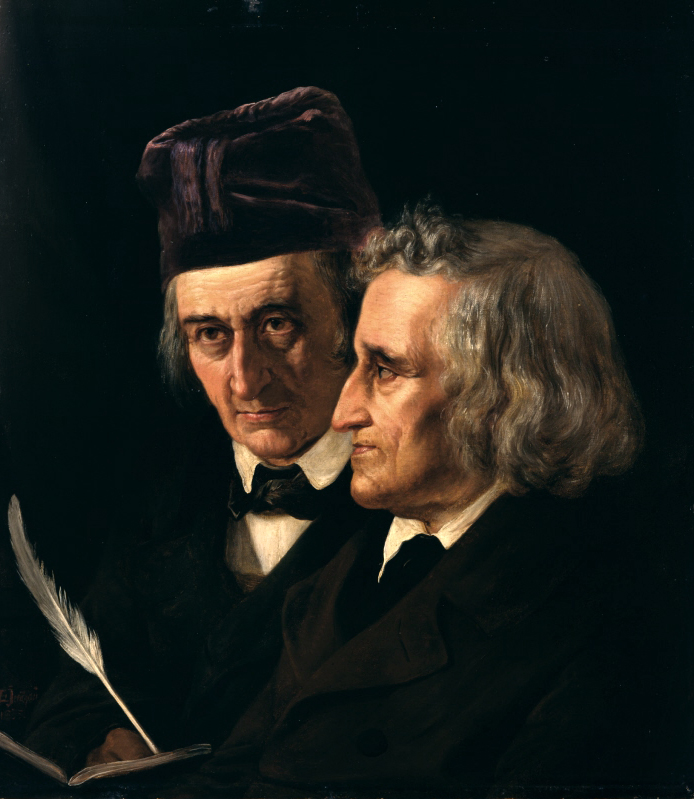
Elisabeth Jerichau-Baumann, Die Brüder Grimm (1855)
(Jacob on right)
Animals are no aliens in legal history. Especially in German legal history animals come into view already early. I invite you to look for example at images from medieval bestiaries in Bestiaire du Moyen Âge, a virtual exhibition of the Bibliothèque nationale de France (interface French, English and Spanish), They are portrayed in various ways in the famous illuminated manuscripts of Eike von Repgow’s Sachsenspiegel. In April Dietlinde Munzel-Everling will discuss the animals in the Sachsenspiegel. Jacob Grimm, one of the pioneers of German academic legal history did not only study and publish versions of the medieval animal epic about the fox Renard in his Reinhart Fuchs (Berlin 1834). In an earlier post here I looked in more depth at the various versions of this much liked medieval story. His explanation of German words in his Deutsche Grammatik (first edition Göttingen 1819) often included historical explanations. The word vogelfrei, meaning literally and originally “free as a bird”, was in the context of exiled people and victims of execution who were denied a funeral narrowed to “delivered to the birds”.

Sunday, January 5, 2014

The hidden histories of environmental law

Thanks to the Legal History Blog and Slate's "The Vault", I came across "The Roaring Twenties", a digital history site self-described as "an interactive exploration of the historical soundscape of New York City". The site has historical newsreel footage of all kinds of loud noises from early twentieth-century New York, along with published materials and hundreds of original documents from the municipal archives relating to noise complaints (see the explanation of sources under "Info"), all organized by date, by type of noise, and accessible by location on a historical map of the city. In addition to the material on noise, other environmental issues pop up as well, such as in a 1930 video of a staged confrontation between two boys over a banana peel thrown on the sidewalk in Manhattan's Lower East Side (check it out for its great accents and slang). (And if you want to understand why New Yorkers for years turned their back on their waterfront, watch some movies of tugboats and other watercraft at work.)
New York City Smog, Nov. 1966

The website is a good illustration of the masses of historical materials on environmental regulation that have yet to be explored and of some of the blinders that have limited research into pre-1970 environmental law. These types of limitations have been recognized for decades by legal historians as methodological obstacles that need to be overcome, yet they continue to plague study of environmental-legal history:

First, there is the issue of terminology. The environmental issues exposed by "The Roaring Twenties" site were not necessarily cataloged under "environment" or "pollution", but rather under issues such as nuisance, sanitation, public health, smoke, noxious vapors, and cleanliness. This kind of terminological disconnect can cause legal developments with deep historical roots to appear as if they sprouted from nowhere.

Second, there is the issue of scale. As in the case of the New York City materials documented by the website, much environmental regulation took place (and still does) at the level of sub-national governments, making it invisible to historians focused on developments at the national level.

Third, there are the interrelated issues of what counts as law, what sources are legal sources, and what legal sources are studied. The city documents reproduced on the website consist largely of complaints to city officials and their responses. The documents indicate that in some cases the complaints resulted in legal action in the courts (typically lower courts whose decisions are difficult to access and often overlooked by legal scholars), but in many (perhaps most) cases they resulted in action by administrative officials such as a letter to the creator of the nuisance, a visit by inspectors, and the like. These kinds of enforcement activities are often ignored by students of the law, yet they are arguably legal actions par excellence, whether as actions taken under color of law, or as law in action creating a normative reality that governed behavior and expectations.

For instance, the website has this to say about a 1933 complaint by Mr. D. Friedman of Atlantic Avenue in Brooklyn about noise from a nearby factory: