Showing posts with label water. Show all posts

Thursday, September 14, 2023

Water law in common law cultures - Getzler's synthesis

The latest issue of Western Legal History is dedicated to the topic of "Water", and I plan to post on a number of the pieces in this issue. 

I'll start with Joshua Getzler's masterful survey of water law in Britain and many of the territories it ruled at various points in history, "Ownership and Control of Fresh Water in Common Law Cultures". Getzler manages not only to integrate major developments in many legal systems - including those of the US, Canada, Australia, New Zealand, India, and Mandate Palestine - and across nearly a millennium (beginning with Bracton), into a succinct and coherent whole, but he does so while elegantly connecting classical doctrine with current concerns, such as environmental protection and indigenous water rights. 

One aspect of the article that I particularly liked was its unpacking of the intertwined and often contradictory lines of thought in the common law, which Getzler deftly connects to Romanist and feudal ideas of property.

I highly recommend this article to anyone looking for a broad yet succinct survey of the history of water law.

(For more on water law in the British Empire, see my posts here.)

Tuesday, September 5, 2023

Privatizing water and fish in colonial India

Devika Shankar's article on property in water and fish in India is now also a blog post at Past & Present. Shankar explains that her article reflects 
a close analysis of over 10 important and highly cited cases from different parts of British India in which judges deliberated on whether flowing water and fish could be treated as private property. Starting with a significant set of cases relating to the planting of stakes in the sea off the coast of Bombay, the article then primarily looks at cases involving rights over rivers in the fluid landscape of the Bengal delta. The article not only highlights the enduring confusion surrounding the status of water in colonial Indian law, but also looks at the different ways in which judges interpreted roman law and precedents from English common law while reaching their judgments. After reaching a variety of conclusions, by the 1880s high courts had begun to simultaneously make room for unprecedented private rights over flowing waters in colonial India while rendering these rights largely redundant by insisting that fish in these waters could not be counted as property until they were caught. The conflicting pull of these judgments however began to create serious problems in Bengal where fishing rights were considered to be especially valuable. It was in order to overcome this impasse that the Bengal government ultimately passed the Bengal Private Fisheries Protection Act in 1889 granting landholders significant rights over fish in rivers across the province. It would do so by significantly strengthening the kinds of private rights that could be claimed over water, and inaugurating a novel category of “private waters” in tidal waters in Bengal and other parts of India. By tracing the arguments and logics that ultimately paved the way for this act, this article highlights the importance of recognizing colonial India, and especially Bengal as an significant site for experimentation with new forms of private property rights over flowing waters.
Charley Brown, Illustrated Guide to the South Indian Railway (1913)

More on property in water and fish in colonial India here.

Friday, August 25, 2023

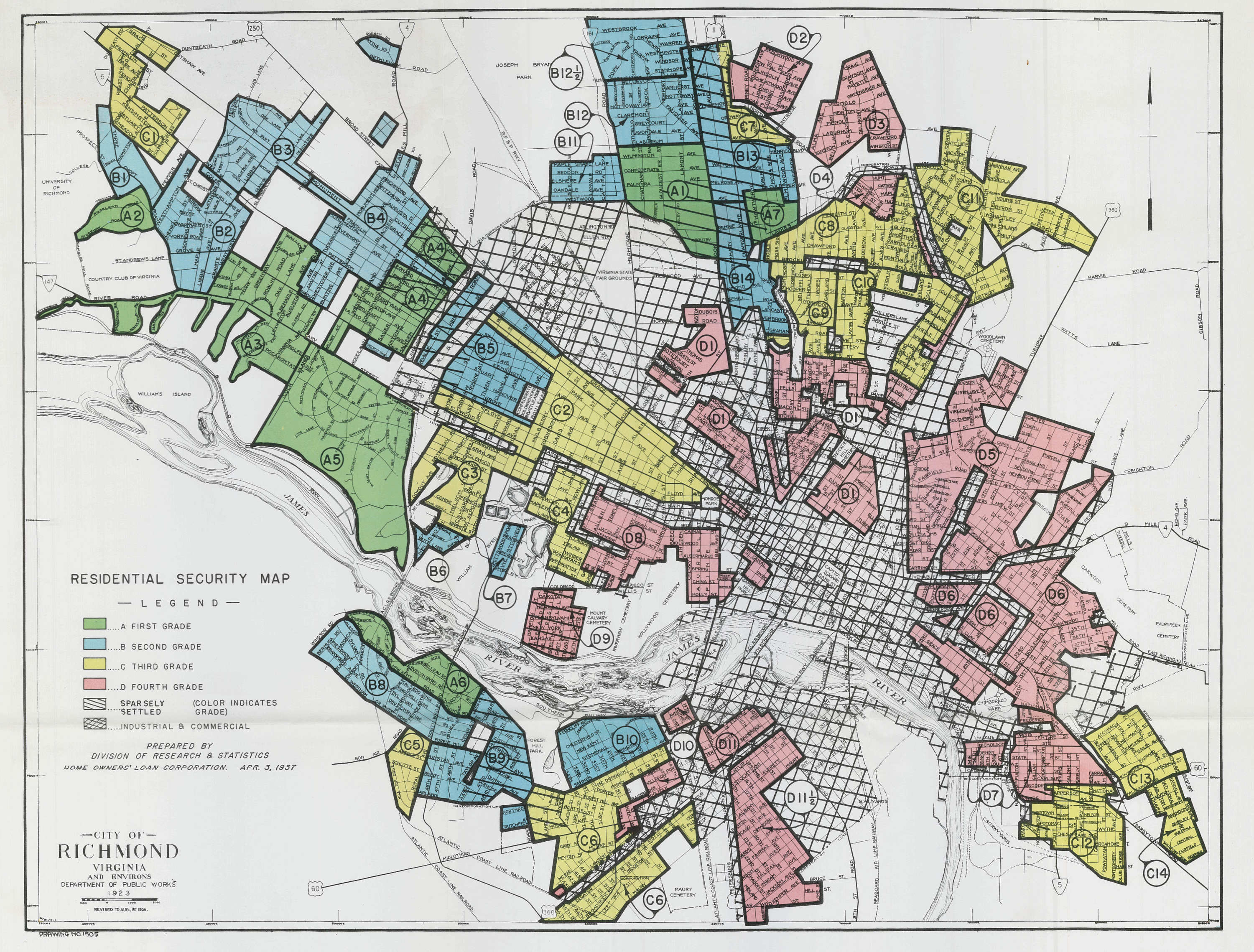
Water access and historical redlining

Charles W. Sterling III recently published "Connections Between Present-Day Water Access and Historical Redlining" in Environmental Justice. The abstract:
Although challenges in water and sanitation access are often assumed to be issues of low- and middle-income nations, more than 400,000 homes in the United States still lack access to complete indoor plumbing. Previous research has demonstrated that the remaining plumbing challenges are more prevalent in communities with high Black and Brown populations. This study hypothesizes that the 1930s practice of redlining by the Home Owners' Loan Corporation (HOLC), which systematically denied loans to minority populations, is linked to present-day inadequate plumbing access (i.e., defined as incomplete plumbing above the national average). Digitized HOLC maps for 202 urban areas across the country and U.S. Census data from the 2016 to 2020 American Community Survey were combined to interpolate the modern-day plumbing access for historical neighborhoods (n = 8871 communities). Analysis via binomial logistic regression demonstrated that nationally, redlined communities (HOLC Grade “D”) are significantly more likely to have a rate of incomplete plumbing above the national average compared with greenlined communities (HOLC Grade “A”) (0.1352; confidence interval = ±0.036). This finding was also observed for three of the nation's four census subregions (Northeast, Midwest, and West). Slight differences by region in relationships between the proportion of specific racial/ethnic populations on rates of incomplete plumbing demonstrate the need for targeted place-based interdisciplinary examinations of exclusionary practices. The demonstration of the present-day impacts of redlining after nearly 90 years emphasizes the need to intentionally mitigate past injustices to ensure modern-day equity.

Friday, August 18, 2023

Water rights and forest regulations in the Charter of the Escartons (1343)

The Grand Charter of the Escartons
I was fortunate to be able to spend some time this summer along the Guisane River, in the area formerly known as the Dauphiné, today in southeastern France. The river is notable for its old canals, still in use, and the surrounding mountain slopes are covered in forest. It turns out this landscape has an interesting legal history.

In 1343, Humbert II, the last Dauphin of Viennois (before that title passed to the kings of France and was used for the heir apparents to the royal throne), confirmed the rights of the people of the Briançon region in the "Grand Charter of the Escartons", effectively creating a sort of autonomous republic free of feudal obligations that survived, with its rights confirmed by the Kings of France, until the French Revolution. Two articles caught my eye (my translation from the French translation by Fernand Carlhian-Ribois):

Art. XVII  : The people of Briançon now have the right to build canals to water their land, take water from torrents and rivers without having to pay the right of use either to the Dauphin Humbert or to his heirs and successors.

Art. XVIII  : It is forbidden for the officers, Dauphins and Nobles to cut timber or firewood in the forests of the Communities of Briançonnais, Queyras, Vallouise, Césane, Oulx, Pinet, Chevalette, Fontenils, or other places in the Baillage, because the cuts are the cause of floods, landslides and avalanches. This prohibition is perpetual. 

Article 18, with its early recognition of the connection between deforestation, erosion, and flooding, is interesting for its popular environmentalism, blaming the environmental degradation of the mountain region (a theme that became prominent again in the nineteenth century; see. e.g., George Perkins Marsh's Man and Nature) on the feudal rights of the nobility, and abolishing those rights forever. 

And I wonder what the effect of Article 17 was on riparian conflicts. Said Guisane River is full of canals (see photo below) leading off to mills on the riverbanks and then returning the water downstream. While family members were enjoying rafting the stream, I was imagining the conflicts between riparian owners and public users that must have resulted from the many dams and diversions. Local legal records must be full of such riparian conflicts, and I would think that Article 17's right to take water free of charge must have complicated the issue.

Sunday, July 23, 2023

The reasonableness standard, Israel's current crisis, and Edward Coke

As protests continue to erupt in Israel over the government's proposal to oust the power of courts to review decisions of the government and its ministers for reasonableness, I thought it worth taking a look at the historical origins of this doctrine in an area of particular interest to this blog - water law.

Israeli administrative law's reasonableness standard was inherited from the British, who ruled Palestine from 1917 to 1948 and imported much English law and legal culture to the middle eastern jurisdiction. In the 1928 Supreme Court case of AG v Altshuler ([1920-1933] PLR 273), for instance, the court held that a municipal bylaw of Tel Aviv was invalid due to unreasonableness, relying on the English precedent of Kruse v Johnson ([1898] 2 QB 91).

Sir Edward Coke
As many will know, the reasonableness standard was apparently introduced to English law by the 1598 decision of the Court of Common Pleas in Rooke's Case (5 Co Rep 99b, 77 Eng Rep 209). At issue was the power given to the Commissioners of Sewers by statute (the 1531 Statute of Sewers) to assess lands adjoining water courses in order to fund the building of works to protect adjacent lands from flooding. The Commissioners assessed a certain Carter, who had seven acres of land flood-prone adjoining the Thames, with the costs of repairing the banks of the river along a long segment of the river, leaving a further 800 acres, possessed by others and similarly threatened by the waters, free of charge. In their defence, the Commissioners pointed to the language of the statute (s 3), which gave them the power to make repairs 'as Case shall require, after your Wisdoms and Discretions'. Edward Coke's report explained what he saw as the rationale behund the court's rejection of this claim:

Notwithstanding the words of the commission give authority to the commissioners to do according to their discretions, yet their proceedings ought to be limited and bound with the rule of reason and law [emphasis added - DS]. For discretion is a science or understanding to discern between falsity and truth, between wrong and right, between shadows and substance, between equity and colourable glosses and pretences, and not to do according to their wills and private affections ; for as one saith, talis discretio discretionem confundit [such discretion confuses discretion].

So administrative discretion, explained Coke, must be subject to 'the rule of reason and law'.

One might have legitimate criticisms of the way the reasonableness standard is currently applied in Israeli law, but it is clear that the current government's main motivation in its proposed legislation is simply the desire to be free of the rule of reason and law - which explains why there are hundreds of thousands of us out on the street protesting...

Tuesday, April 4, 2023

Not so fast: Nature versus the Common Law concludes

I haven't posted in the last few weeks, leading my friends at the Legal History Blog to reasonably conclude that my series on Nature versus the Common Law was finished. But now I have some time to post what is in fact the final installment in the series.

The posts in this series, based on my article in Clio@Themis, aimed to illustrate a once-common way of thinking about law and legal claims, in which the natural environment was held not only to provide the physical background on which polities and their legal systems existed, but to demand from these legal systems a measure of accommodation. For some judges, it is true, the demands of nature, however worthy or desirable from a social or economic point of view, had no place in court; a judge's role was to resist such claims in the name of the law. For many others, however, environmental realities might be imbued with normative force powerful enough to outweigh considerations of legal precedent and tradition. Moreover, while environmental differences could sometimes break the chains of black-letter law, environmental similarities might at the same time create new legal bonds, as in the Indian and Canadian cases that looked to the law of the independent United States of America, with is great rivers, for legal guidance. All this is to say that in the context of water law in the British Empire, nature could often be "jurisgenerative", to use Robert Cover's term – creating law.

The environmental rhetoric of these courts may, at first glance, seem but a particular instance of the wider phenomenon of colonial and newly independent courts working to stake out the independence of their legal systems from the law of the old country. Yet this would be a mistake: Most of the judges arguing for nature's normative force were themselves British; and in the cases examined here even judges of the independent United States argued not for a general rejection of the English common law, but for the inapplicability of some of its water law rules due to supposed environmental incompatibility.

In conclusion, though, it should be noted that this study has shown that nature also had a "jurispathic" role, impeding the smooth flow, or "transplant", of legal norms around the empire. Legal norms, in particular the common law, spread around the British Empire through a network of orders, legislation, publications, correspondence, educational institutions, career paths, and more. Yet the spread of norms, never smooth, was hampered by a number of factors, some of them natural : distance, forbidding seas, and monsoon winds, to name a few. These factors impeded the transmission of legal ideas and norms in all areas of law. At the same time, this study has highlighted an additional mechanism through which nature sometimes frustrated the spread of norms: perceived environmental similarity and difference.

Nature thus had a dual normative role in this context: creating new norms while at the same time extinguishing others. One need not take a deterministic view of the place of nature in legal history, nor recognize in nature any sort of agency of the intentional kind, to acknowledge that nature had an important role in constituting the connections that both facilitated and obstructed the global flow of water law in the age of empire.

Yet if the first set of law-impeding environmental factors, deriving from physical impediments to legal communication, has historically applied with similar force across all areas of law, the efficacy of the latter mechanism, based on perceived environmental factors, presumably has been correlated with the degree to which the area of law directly dealt with environmental issues. With regard to water law, as we have seen, whether environmental conditions in fact dictated or determined the rejection of common law norms, it is clear that judicial perceptions of nature did play a role in impeding the spread of English norms in this field. I have argued elsewhere that forest law, too, was at least in some contexts heavily influenced by perceptions of environmental foreignness and change. Further study might reveal similar patterns with regard to other related areas of law, from sanitation regulation to wildlife protection.

Happy spring holidays!

Sunday, March 12, 2023

Nature versus the Common Law VI: Diversion of water

In the last installment in this series we looked at how the English rule on escaping water in Rylands v Fletcher was rejected in British India due to perceived differences in the environments and needs of the two countries. Today we look at a classic issue of water law, complaints by riparian owners of upstream water uses that interfered with their own uses. As with the issue of escaping water, what was considered "natural" could turn, here too, on local natural conditions.

The traditional common law rule of conflicting riparian uses – that an upstream riparian may not divert a stream's water to the (unreasonable) detriment of downstream owners – was explained by the court of King's Bench in 1625 (Shury v Piggot, 81 English Reports 280) in terms of natural law: "a water-course […] doth begin ex jure naturæ, having taken this course naturally, and cannot be averted" and "the nature of this [water-course] is to be current [i.e. to flow]".

In the leading case of Evans v Merriweather in 1842, the Illinois Supreme Court advanced a distinction: An upper riparian might reasonably consume all the water in the stream if his use were a "natural" one, necessary for existence, but not were it to be considered "artificial", for the mere increase of "comfort and prosperity". The court then suggested that the application of this distinction would vary depending on natural conditions:

The supply of man's artificial wants is not essential to his existence; it is not indispensable; he could live if water was not employed in irrigating lands, or in propelling his machinery. In countries differently situated from ours, with a hot and arid climate, water doubtless is absolutely indispensable to the cultivation of the soil, and in them, water for irrigation would be a natural want. Here [in Illinois] it might increase the products of the soil, but it is by no means essential, and can not, therefore, be considered a natural want of man.

What riparian uses were to be recognized as "natural", and therefore permitted, was thus dependent on the climate and environment. Irrigation would be considered an "artificial" use in the American Old Northwest, as it would be in England, but the court had legitimized changing the law if and when the common law spread to arid lands.

This way of thinking was crucial for the development of water law in the arid western states and territories of the United States, in which the traditional common law of riparian rights was rejected in favor of a new system. The new law, known as "prior appropriation", opened up water resources to appropriation by all, not just riparian owners, and allowed them to take as much of the water as they could put to beneficial use, regardless of the effect on later appropriators. An early case from Colorado discussed whether an appropriator could dig a ditch across another's land without permission, an invasion of property that would clearly not be allowed under the traditional common law. Along the way it advanced a general theory of the adaptation of property law to environmental conditions:

Sunday, March 5, 2023

Nature versus the common law V: Rylands in India


In previous posts in this series we looked at how courts dealt with the question of whether the common law rules of water law needed to give way to the felt necessities of different environmental conditions in two doctrinal contexts - public rights in non-tidal rivers and shifting watercourses. Next up is an examination of how "the rule in Rylands v Fletcher" fared in India.

The 1868 decision of the House of Lords in Rylands, affirming an 1866 decision of the Court of Exchequer Chamber, is one of the best-known cases in English tort law. The defendant in the case had built a water reservoir on his land to store water for powering a mill, taking all due care, but the water in the reservoir escaped through some old mineshafts and flooded the mines of his neighbor. The court ruled that if a defendant brings something dangerous on to his land and that thing escapes and causes damage to a neighbor, he is liable in tort even if he acted without fault.

Of particular relevance for this study, Lord Chancellor Cairns's ruling turned to a large extent on the issue of whether the use made by the defendant landowner was natural or not. Lord Cairns wrote that if the defendant's land had accumulated water by "natural user" of the land, and then "by the operation of the laws of nature" flowed onto his neighbor's land, there would be no liability. If, however, the defendant used his land for "a non-natural use, for the purpose of introducing into the close that which in its natural condition was not in or upon it", liability would ensue were the water to escape and cause damage, as it did in this case.

Even before the House of Lords had issued its opinion in Rylands's appeal, the Madras Railway Company decided to try and have the rule in the case established by the Court of Exchequer Chamber imported to India. A couple of tanks (reservoirs) located near the rail line in the District of North Arcot had burst several times in 1865 and 1866, and the resulting floods had damaged embankments, bridges, and culverts belonging to the railway company. The company brought suit against the landowner for the damages (Madras Rwy Co v Salvah Makaraju, 5 Madras High Court Reports 139 (1870)), at the same time refusing to allege negligence on the part of the defendant, choosing instead to rely on the new rule of Fletcher v Rylands. It seems that the railway company was hoping from the start to appeal the case up to the Privy Council in London, hoping, as the Madras High Court put it, to take the final decision out of the hands of "Judges conversant with the necessities of the country", instead having "a rule […] imposed elsewhere by Judges not so conversant" (Madras Rwy Co v Zamnida'r of Ka'vatinaggur, 6 Madras High Court Reports 180 (1871)).

Sunday, February 26, 2023

Nature versus the common law IV: Shifting watercourses


In the last posts in this series we looked at court decisions that discussed whether the ownership of rivers should follow the common law or change to reflect local environmental conditions. Another branch of water-related law dealt with the legal consequences of changes in the course of a river or a shoreline over time. The property-law questions thrown up by these changes, under the legal terms "alluvion" and "diluvion", were to whom newly formed dry land belonged – to the former owner of the dry land now submerged, or to the owner of the adjacent riverbed. The English rule, based on Roman law, was that gradual accumulations of land from water belonged to the to the owner of the land to which the new land was added, while gradual losses of land were lost to the landowner and became part of the river (Foster v Wright, 4 CPD 438 (1878)). Sudden changes in the course of a river, on the other hand, were held not to bring about changes in ownership of the bed.

One line of legal thought held that the English common law rules in this area of law applied everywhere. The English Court of Exchequer in 1839 (In re Hull and Selby Rwy, 151 English Reports 139 (Ex 1839)) opined that the common law of alluvion "is not peculiar to this country, but obtains also in others, and is founded on the necessity which exists for some such rule of law, for the permanent protection and adjustment of property." Similarly, seventy-five years later, the Privy Council rejected arguments that the English law did not apply to the Nigerian shoreline due to differences in the local conditions, Lord Shaw stating that the court did not doubt the "general applicability" of the English law of accretion. This, however, was the minority position.

Tuesday, February 21, 2023

Customary groundwater management in Japan

Recently published in Water History, Takahiro Endo's "The Kabu-ido system and factors affecting local groundwater extraction control: case study of a customary groundwater management in Japan". The abstract:

In the early 1800s, a water conflict occurred in a community named the Fukuzuka Ring Levee on the Noubi Plain, Japan. Upper villages required artesian wells for irrigation and domestic uses, but lower villages did not welcome them because drainage from the wells caused impoundment damage to their paddy fields. The Kabu-ido system was a set of rules, including regulation of the number of wells per village, introduced to de-escalate the conflict. Under the system, groundwater uses were controlled not by external authority, but by the community residents themselves. This paper has two purposes. First, it reconstructs the daily operations of the Kabu-ido system, principally by referring to surviving local diaries, to describe hitherto unknown details regarding the management of groundwater by local people 200 years ago. The diaries show that well managers, selected from residents, regulated the use of wells using various tools, including permission and surprise inspection. Second, this paper evaluates to what extent self-imposed numerical regulation was successful by checking the number of wells listed in village expenditure notes. The documents indicate that regulation did not always work. The factors underlying this are considered using the analytical framework from the commons studies. Analysis shows that, while institutional arrangements of the Kabu-ido system, such as well management with keys, rules of joint responsibility, and the prohibition of indoor wells, work positively in enforcing numerical regulation by lowering the costs of monitoring for unauthorized wells, the natural characteristics of groundwater and climate conditions such as sudden drought work negatively.

Noubi Plain

Saturday, February 18, 2023

Nature versus the common law III: Canadian and Indian rivers

Bhanutpt, Krishna River

In the previous post in this series, we looked at how nineteenth-century American courts debated whether the common law rules of riparian rights applied to the grand American rivers, seemingly so different from those of England. But the question of whether the common law applied to environments unlike England's soon arose in territories around the British Empire as well. Robert Travers has argued that while judges in England had used ideas of natural law to modify the common law, in India natural law arguments were used in some contexts to support the replacement of local law by English norms. Here, however, we see the reverse, with nature invoked to reject English rules of water law in favor of new norms, felt to be more appropriate to the local environment.

In an 1842 case (Esson v M’Master, 3 NBR 501 (1842)) the New Brunswick Supreme Court noted the "great difference in the character of the small rivers of England and those of this Province", but thought that this consideration "may be thought more fit for the Legislature than the Court ". Yet the same court in 1849 (Rowe v Titus, 6 NBR 326 (1849)) adopted the ruling of an American court, following the argument of counsel that:

The principles of the law of England, in respect to rivers, cannot be applied to this country : there the rivers are not subject to such sudden freshets, nor are they used for the same purposes as in this country ; the cases therefore on this subject in the United States, where the rivers are used for the same purposes as in this country, will be very important.

The idea that Canadian courts should follow American courts rather than English ones when dealing with rivers was not limited to New Brunswick. In an 1852 case (R v Meyers, 3 UCCP 305 (1852)), Chief Justice James Macaulay of the Upper Canada (Ontario) Court of Common Pleas, after examining the English precedents which normally would be thought binding in the British colony, demonstrated the legal power of geography over the common law by contrasting English precedents with decisions from "this side of the Atlantic", lumping together American and Canadian cases without distinguishing between them. Macaulay's judgment was also significant in ruling that the test for navigability of a river was its "natural capacity", not its use in practice, once again demonstrating the normative power of nature. The influence of American jurisprudence was evident as well in an 1882 opinion of Justice Samuel Strong of the Supreme Court of Canada :

I do not hesitate to say that the rule which appears to have been adopted as a principle of the common law as administered in England, that no rivers are to be considered in law as public and navigable above the ebb and flow of the tide, is not applicable to the great rivers of this continent, as has been determined by the Supreme Court of the United States and by the courts of most of the States […]

Sunday, February 12, 2023

More on nature versus the common law: American judges on American rivers


As I mentioned in a post last week, the first topic covered in my article "Nature Versus the Common Law: Nature as a Norm in the Water Law of the British World" is the question of whether the water, bed, or other resources of a non-tidal river belonged to the riparian landowners or to the state or public. 

While the civil law (for example Article 538 of the Code Napoleon) distinguished between private and public rivers based on tests of navigability and floatability, the English common law adopted a slightly different distinction : Tidal rivers were held to be the property of the Crown, while rivers and lakes above the reach of the tide were the property of the adjoining landowners, with each riparian owner owning the river from the edge of his dry land up to the median of the water body ("usque filum aquæ" or "ad medium filum"). Non-tidal but navigable bodies of water typically were subject to a public right or servitude of navigation, while the water, the submerged land, and other resources (such as fish) belonged to the riparian owners.

These rules were relatively uncontroversial in England, but in British colonies and the new United States they were often felt to be inappropriate to the environmental reality of other continents, in which rivers might be kilometers wide in some portions and navigable for thousands of kilometers above the reach of the tides, while freshwater lakes might bear a closer resemblance to seas than to the small lakes of England. In this context, a rule under which all non-tidal waters were private seemed problematic to many.

The first reported case in which the tension between the received law of England and the local environment arose was the 1807 Pennsylvania case of Carson v Blazer, in which a landowner along the Susquehanna River, near Harrisburg, demanded compensation from some fishermen who had fished shad from the river alongside his land4. As the Susquehanna at this point was navigable but not a tidal river, the common law rule seemed to be clear – the river, and the right to fish, belonged to the riparian owners. But Chief Justice William Tilghman, presiding over the trial, thought otherwise, distinguishing between the geographies of England and Pennsylvania :

Thursday, February 9, 2023

Natural transplants

A few months ago the NYU Law Review published an article by Vanessa Casado Pérez and Yael R. Lifshitz, "Natural Transplants". The abstract:
Policymakers are constantly faced with the complex task of managing novel challenges. At times, these challenges result from new technologies: Consider fights over allocating air rights for drones or decisions about how to share scarce vaccines in a pandemic. Other times the resources are old, but the challenges are new, such as how to fairly allocate water in times of unprecedented drought or previously undesirable rare earth minerals that are in demand for modern manufacturing and energy production. Often, instead of carefully tailoring a regime to the new resource, decisionmakers simply rely on mechanisms they are familiar with. When jurisdictions borrow from each other, scholars call this a “legal transplant”—as when one state copies another state’s innovations or when the federal government learns from the “laboratories of democracy.” This Article unveils a new dimension of legal transplants: transplants across subject areas. By transplants across subject areas, this article refers to instances when a jurisdiction looks for doctrines in other legal areas, often within its own legal system, when regulating a new resource or addressing a new challenge.
This Article makes three key contributions. First, it identifies a new type of transplant—between subject matters within a jurisdiction. Second, it analyzes the reasons for internal, cross-subject legal transplants and the criteria for selecting which subject areas to copy from. Third, the Article brings the legal transplants literature to bear, specifically, on natural resource law. It explores two cases, groundwater and wind energy, where policymakers and courts have borrowed from other resource schemes, often ignoring the scientific and social differences between these natural resources. Other areas of law, such as the incorporation of contract doctrines in landlord-tenant relations, are also described to show the explanatory power of the natural transplant framework. This conceptual framework is then applied to new mineral developments in space and the deep sea. Cross-subject transplants may be more prevalent than previously appreciated, and understanding them will pave the way to analyze the regulation of new developments in natural resources, infrastructure, and beyond.
Linnaea Mallette, Wind turbines in the ocean

Sunday, February 5, 2023

Nature versus the common law

A little while back I published "Nature Versus the Common Law: Nature as a Norm in the Water Law of the British World" in the French journal Clio@Themis. The article explores some of the areas of water law in which courts around the common law world departed from the established rules of the common law in order to make the legal rules more appropriate, as they saw it, to the local environment. As the article shows, they did so consciously, explicitly granting nature normative force. It also looks at other courts and judges, ones that resisted this kind of normative claim, arguing that the law in new environments had to conform to the old common-law rules, regardless of what nature seemed to demand. 

The question of whether environmental factors required or justified a departure from the inherited rules of the common law arose in courts around British Empire and United States in connection with a variety of legal issues, four of which are examined in the article: a) the question of whether the water, bed, or other resources of a non-tidal river belonged to the riparian landowners or to the state or public ; b) conflicts over property rights following shifts in the course of a river ; c) the issue of the degree of liability of reservoir owners for damage caused to others by escaping waters ; and d) conflicts over whether water might be diverted from a river for irrigation, to the detriment of downstream landowners.

Discovery of the Hudson River, Albert Bierstadt, 1874

I'll be posting some selections from the article later.

Friday, February 3, 2023

Decolonising the Nile water agreements


The latest issue of the Journal of the History of International Law / Revue d'histoire du droit international has an article by Fekade Abebe, "Exclusion vs Cooperation in the Utilisation of Transboundary Watercourses: The Case for Decolonising the Nile Water Agreements". The abstract:

The relationship between Egypt and Ethiopia was marked with tension for centuries due to the utilisation of the Nile river. Recently, it took a turn for the worst after Ethiopia announced it is building the Grand Ethiopian Renaissance Dam (GERD) on the Nile river. This article argues that one important explanation for the deep-seated disagreements between Egypt and Ethiopia is the history of the legal instruments frequently invoked which were set up to safeguard the colonial interest of Britain over Egypt and the entire upper Nile region. Britain’s use of these legal instruments to advance its colonial domination of the region, with disregard to the interests of native communities, had left a legacy of exclusive utilisation over the river which haunts the current legal discourse. The article argues that the Nile basin countries need to acknowledge this colonial legacy in the legal discourse and need to move towards cooperation.

Wednesday, February 1, 2023

The legal environment and communal irrigation

The latest issue of the International Journal of the Commons has an article by Steven M. Smith, "Dynamics of the Legal Environment and the Development of Communal Irrigation Systems". From the Introduction (citations removed):

Archinia, Acequia System of El Rancho de las Golondrinas

Given the importance of external forces to the success of the commons, calls to integrate political ecology with the commons literature are becoming a common refrain. The combination can be approached from both directions: how do power structures shape institutions and how do institutions shape power structures? I take a historical perspective to explore both questions and their dynamic relationship. Specifically, I consider how external legal changes alter the incentives for how local users organize themselves and how those changes in local organizations alters the political coalitions, affecting subsequent legal changes.

To explore the question, I document and analyze the evolution of the legal environment and the development of communal irrigation systems, known as acequias, in current day New Mexico, US. Acequias have been held up as a case of a long-lived successful communal management regime of a natural resource . In the region of study, some acequias date back to the 16th century when Spain first colonized the area. The acequias have experienced sizeable shifts in their external legal surroundings, most rapidly and significantly during the US territorial period (1851–1912), that can be used to assess the relationship of external legislation and communal irrigation systems.

Thursday, January 12, 2023

"Environmental law" - a response to Farber

I have some objections to a recent post by Dan Farber at Legal Planet, "Learning to Name Environmental Problems"

Farber raises the interesting issue of when various issues seen today as "environmental problems" became thought of as such by the law, both in terms of seeing various issues – air pollution, water pollution, wilderness protection, and so on – as parts of a larger problem, and with regard to use of modern terms like "environment" and "pollution". But I think his answers are problematic.

Farber focuses on US Supreme Court decisions, finding its earliest uses of "air pollution" and "water pollution" and references to wilderness as something worthy of preservation in decisions from the 1960s. He also goes on to state that "The 1960s were also Congress’s first forays into issues like air and water pollution, wilderness protection, and the endangered species.  These developments set the stage for the blossoming of federal environmental law with the passages of NEPA, the Clean Air Act, the Clean Water Act, and other major legislation in the decade that followed."

Even allowing for methodological nationalism and the focus on the unrepresentative Supreme Court, this is all rather strange.

Paul E. Wolfe, Los Angeles County Air Pollution Control District vehicle, Burbank, 1947-1950?

Thursday, December 15, 2022

How control of nature shaped the international order

Posted recently to International Law Reporter, a nomination by Gail Lythgoe for the most interesting, important, or influential article or book published in 2022:

Joanne Yao, The Ideal River: How Control of Nature Shaped the International Order (Manchester Univ. Press 2022)

This book explores the geographical imaginaries of three rivers (the Rhine, Danube, and Congo) and how these very imaginaries shaped the constitutions, structure, and life of three early international organizations. It is a marvellous tale of how (and why) experts sought to tame nature and also says much about law’s relationship to the physical geography. I always really recommend and admire it because of how well written and engaging it is.

From the publisher's website:

The ideal river examines nineteenth-century efforts to establish international commissions on three transboundary rivers - the Rhine, the Danube, and the Congo. It charts how the Enlightenment ambition to tame the natural world, and human nature itself, became an international standard for rational and civilized authority and informed our geographical imagination of the international. This relationship of domination over nature shaped three core International Relations concepts central to the emergence of early international order: the territorial sovereign state; imperial hierarchies; and international organizations. The book contributes to environmental politics and international relations by highlighting how the relationship between society and nature is not a peripheral concern, but one at the heart of international politics. 

Monday, November 7, 2022

The US Supreme Court’s earliest pollution cases

Over at Legal Planet, Dan Farber recently posted on "The Supreme Court’s Earliest Pollution Cases". Farber writes:

Well over a century ago, the Supreme Court ruled that it had that power to remedy interstate water pollution. That was in 1901. Six years later, the Court decided its first air pollution case.  Notably, these cases came during the conservative Lochner era when the Court was hardly known for its liberalism.  Quite the contrary. Yet the Court didn’t hesitate to address pollution issues.

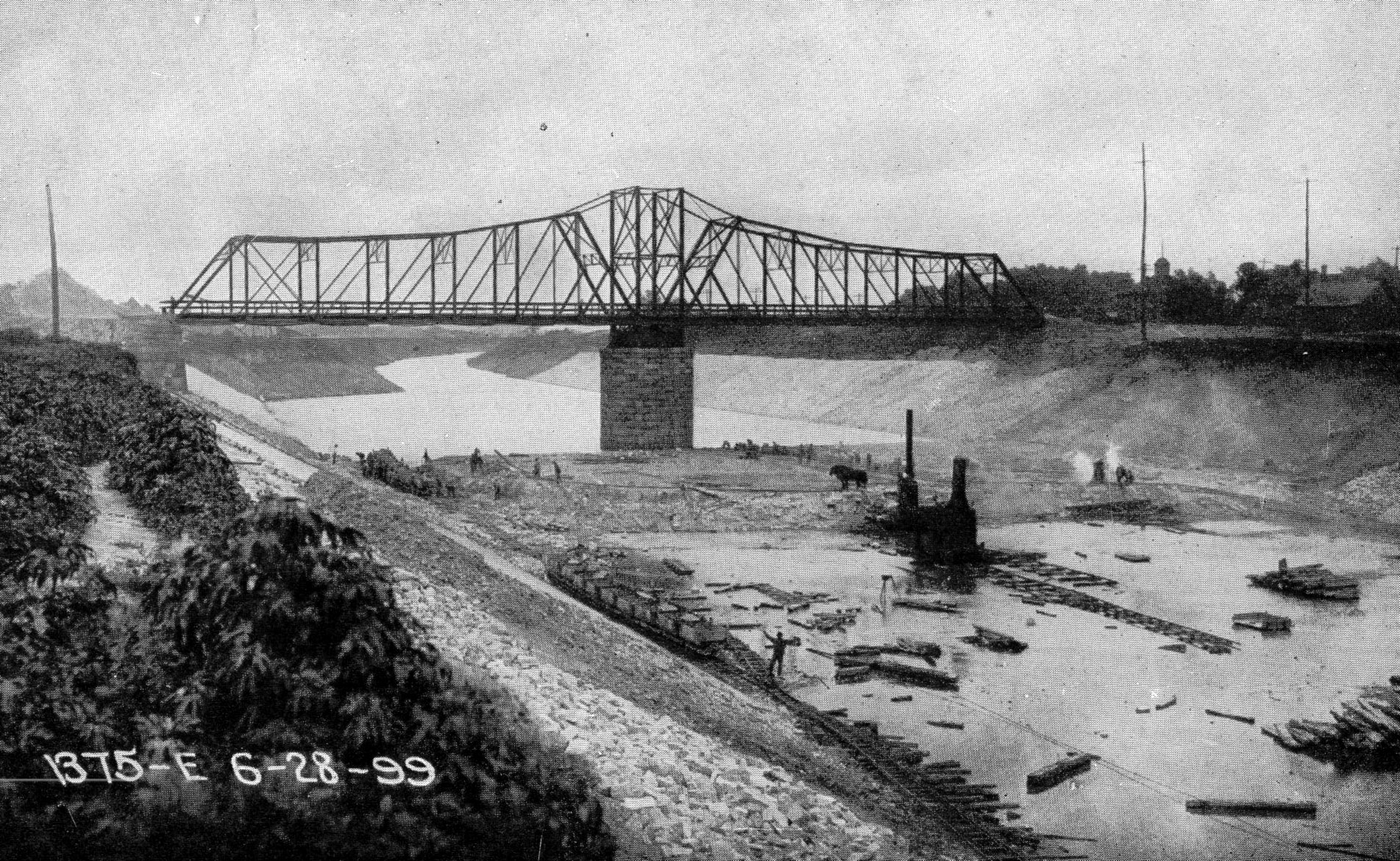
The water pollution case was Missouri v. Illinois.  In a feat of engineering prowess or incredible hubris, depending on how you look at it, Illinois had built a canal to reverse the flow of a river from Lake Michigan to the Mississippi. The canal then became a dumping place for the city’s raw sewage. Missouri claimed that the sewage was befouling the water as far away as St. Louis. The Court had long heard other law suits between states, but this was apparently the first one to involve pollution.

Chicago Drainage Canal being built (from The New Student's Reference Work (1914))

I'm not sure this was really the US Supreme Court's first pollution case - how about the Slaughterhouse Cases? In any case, Farber goes on to also discuss Georgia v. Tennessee Copper Co., an interstate air pollution case. He comments:

These two cases are little known today, but they have cast long shadows.  Very briefly, here were some of their longterm impacts:

  1. International law. This line of precedent got the attention of an international tribunal in the Trail Smelter case, which involving a Canadian smelter polluting across the U.S. border. The tribunal held that a country has a duty to prevent its inhabitants from inflicting serious harm within another country. Thus, Canada had to take responsibility for the pollution. This principle is now famous in international law as the Smelter Trail rule. In turn, that principle of international law was taken up in international concords such as the 1992 Rio Declaration on Environment and Development.

  2. Water pollution. Use of federal common law to pursue water pollution cases enjoyed a big revival in the 1960s and early 1970s. It was ended by the Supreme Court, which held that the then-new Clean Water Act took over the field of interstate water pollution in lieu of court-made rules.

  3. Climate change.  In a groundbreaking climate decision, Massachusetts v. EPA, Justice Stevens invoked this line of cases to emphasize the special interest that states have in access to the Court to protect their interests as sovereigns.  The upshot was to give states standing to sue EPA for failing to take action against carbon emissions. Also, this line of cases was repurposed  early in this century in order to bring lawsuits against major carbon emitters in federal court. The Supreme Court ultimately said that since the Clean Air Act covered climate change, lawsuits based on judge-made federal rules were no longer needed. It left open the possibility of lawsuits based on state law, and state lawsuits against oil companies are now underway.
More on the US Supreme Court and the history of environmental law here.

Tuesday, October 25, 2022

A prize for my article

I'm happy to report that my article,  "Horizontal and vertical influences in colonial legal transplantation: water by-laws in British Palestine", recently was awarded the best article prize by the Israel Association for Law and History. (See related posts here.) I'd like to reproduce (in translation) one point made by the  prize committee in its statement, as I think it could be useful for others' research:

Beyond the excellence of the article itself, the committee believes that Schorr's article can serve as a model for future studies of legal transplantation. The article considers not only the process of transplantation as a product of the sovereign or lawyer's will, but also the material objects through which transplantation takes place - letters, memos, newspapers, and statute books - and it shows the importance of prosaic, everyday factors for this process, such as bureaucratic practices or even the location of law libraries.

In short, material factors matter - a point that environmental history knows full well, but is often shortchanged by legal histories.

Jerusalem Water Works. Ras el Ain. Engine room (Matson, 1930s?)