Showing posts with label distributive justice. Show all posts

Thursday, August 31, 2023

Cottages as public nuisances

More on public nuisance: Maureen Brady recently posted "Cottages as Public Nuisances: The Long History of Land Use Regulation of the Poor", forthcoming in Depaul Law Review. The abstract:

In the Fourth Book of his Commentaries on the Law of England, in a chapter entitled “Offenses Against the Public Health, and the Public Police or Oeconomy,” William Blackstone sited his discussion of “common nuisances.” Although many things on this list of what we now call public nuisances are familiar—blockages of public roads, disorderly saloons, trades emitting offensive smells or sounds—one stands out. Blackstone described as a typical nuisance the erection of “cottages,” going on to discuss and even criticize the situation of these dwellings alongside uses like fireworks and the keeping of hogs in close quarters.

Blackstone, Washington DC

The aim of this Essay is to examine Blackstone’s discussion of cottages in context, endeavoring to use it toward two ends. The first is to better understand the concept of public nuisance and its limits. As others have chronicled, there has been a renaissance in interest in the tort in recent years, spurred on by multimillion dollar litigation invoking it in contexts ranging from the opioid epidemic to climate change. Here, I engage in a close reading of Blackstone’s passage and its citations, examining why cottages were regulated as public nuisances in the first instance and how that history connects to broader developments in English (and later American) law and society. As it turns out, cottages bore a closer relationship in many ways to public nuisance “classics,” like road blockages and certain public health risks, than it might at first appear.

Thursday, May 18, 2023

Tani on Calabresi and the "Economic Style"

Karen Tani just completed a fascinating four-part series at Legal History Blog on Guido Calabresi's particular form of law and economics scholarship and its influence on legal thinking. Though Tani doesn't directly deal with environmental issues (nor did Calabresi give them much attention), the series raises important questions that have relevance to understanding the history of environmental regulation and environmental law scholarship in recent decades. In particular the series focuses on the question of to what extent economic thinking in Calabresi's writings claimed exclusivity or made room for other ways of thinking about legal problems. 

Calabresi himself often insisted (as in the subtitle "One View of the Cathedral") that economics was just one factor to be considered in legal analysis, and his classic works (such as The Cost of Accidents and the Cathedral article) also at least paid lip service to this idea, but I have always thought that the depth of Calabresi's economic analysis, juxtaposed with the cursory treatment he usually gave to distributive considerations, broadcast the message that efficiency was the key factor to be considered.

This way of thinking has obviously had great effects on environmental law, starting from the way environmental issues are typically presented to law students - as negative externalities that need to be internalized or collective-action problems that need the aid of law to overcome, rather than, say, as issues of distributive justice or problems of environmental ethics.

Friday, August 31, 2018

Goodbye Abbey, hello intersectional environmentalism

Sarah Krakoff recently posted a critical take on Edward Abbey on Environmental Law Prof Blog. Some highlights:
Abbey’s love-letters to Utah’s red-rock country spawned generations of canyoneering backpackers, and still serve as the heart of aesthetic and political defenses of desert wilderness. Ever since, Abbey has been attacked and defended. Was he racist, misogynist, and anti-immigration? He was. His views of Black and Brown people were deplorable, and his descriptions of women were retrograde. And yet, his defenders inevitably retort, we need his irascible, cranky, and irrepressible voice today more than ever.  
But do we? I have come to (re)bury Edward Abbey, not to praise him. (Abbey died in 1989 at the age of 62; he was buried illegally on public lands.) Or more accurately, to make a pitch for putting Abbey in his place and moving on. That place should be in the context of what it means to protect those same dramatic and soul-stirring landscapes without perpetuating an alienating version of what it means to be “truly wild,” or “truly radical,” or “truly environmentalist.” The problem with re-lionizing Abbey in 2018 is not just that he was sexist, racist, and xenophobic. But also that those views were sewn into his brand of so-called radicalism. They constituted the lenses through which he saw the landscape he aimed to protect.
What Abbey saw were beautiful empty places where white men (quite specifically) could be free and wild. Their version of wilderness preservation, even supplemented by the occasional nod to the evils of growth-dependent and extraction-based economies, was oblivious to the structures that enabled their seemingly unmediated encounters with the desert. Those structures included brutal and unscrupulous campaigns to dispossess Native people of most of southeast Utah. They included the failure of post-Civil War efforts to democratize homesteading by including eligible African Americans eager to flee the South. And they included, time and again, the cultural acceptability of exploiting women, both by treating them as fungible sex toys and by relying on them to mind the homestead and raise the young’uns. Abbey’s version of radical environmentalism assumes away all of the inequalities baked into his ability to be a free man in canyon country. Abbey also managed to alienate lots of white men while he was at it. He scorned ordinary work as part of his critique of corporate and industrial interests and romanticized manual labor even while he railed against ranchers and farmers in his midst.

Friday, May 25, 2018

Irrigation systems: Moors v British

Erum Sattar recently posted "From the Moors to the New World: Lessons from Dynamic Water Sharing for a Colonial-Era System in the Indus". The abstract:
This project is a close study of the legal and political aspects of management of water resources in semi-arid environments. The British in India laid the foundations of the modern irrigation system in what is now India and Pakistan. In semi-arid environments, the bulk of agriculture relies on irrigation, as it did in Spain under the Moors. We can observe a stark divide in the use of laws and institutions to manage natural resources in different societies, at different times and places. Some societies have managed in a way that achieved prosperity and long-term sustainability. Others have mismanaged so as to create ecological devastation and social stagnation. The Moors of Spain created a vibrant civilization in the Middle Ages that lasted nearly eight hundred years. One of the reasons for the dynamism of their civilization was their judicious management of water resources on which foundation they created a thriving agricultural economy that produced the economic surplus for their vibrant urban culture. Of particular interest for my project is what I regard as the essence of Moorish water management: its management of scarcity by borrowing principles from the great cradles of civilization, Mesopotamia and the Nile, which built abundance in harsh environments, along with principles of use, reuse and justice as conceived of in the Quran. These sets of principles, I shall argue, yielded a society that wasted no drop of its precious waters and adopted and innovated to create new technologies, infrastructure, norms and institutions. The British in India meanwhile laid the foundations of water-sharing in a way that to this day reifies rural hierarchy and leads to social and economic stagnation while devastating the environment. In this project of comparison, I draw relevant lessons from Moorish water systems for today's management of water resources across countries.
Irrigation channel in Spain

Friday, January 26, 2018

Law in the Anthropocene? Maybe not

Eric Biber recently posted a series at Legal Planet based on his recent Georgetown Law Journal article, "Law in the Anthropocene Epoch" (abstract below). The Anthropocene, for those who have somehow missed this buzzword, is (according to its proponents--it has yet to be officially adopted) a new epoch, in which the signs of human changes to the planet are visible in the geologic record. The article and blog posts contain a useful catalog of ways in which current legal doctrines and institutions do a poor job of dealing with environmental challenges, and essentially argue for the desirability of major changes in liberal conceptions of individual rights and private property. That sounds right, but I'd like to quibble over three historical elements of the argument.

First, Biber's confidence in the direction of future political and legal change ("Humans will inevitably respond to the Anthropocene", "These responses will ineluctably lead to greater government involvement", etc.) seems to me problematic, reflecting an environmental-determinist and functionalist view of legal development that I find unconvincing. Many of the challenges identified by Biber have been with us for some time, and the law has apparently not adapted to them. It is not clear that it must or will do so in the future. I think a more tentative or even a normative tone would have made for a more convincing argument.

Second, Biber's use of "the Anthropocene" is idiosyncratic. Many proponents of the idea of an Anthropocene epoch seem to have settled on a start date in the mid-twentieth century, though others (including the originators of the idea) argue for an 1800 start, and others would push it back even further. In any case, if there is an Anthropocene, we are already in it, the challenges identified by Biber are already upon us (with many of them hundreds of years old), and so if, as he argues, the law will change in response to them, it should have already done so. If the Industrial Revolution took place during the Anthropocene, it is hard to make sense of his argument that "These changes will parallel similar revolutionary legal changes associated with industrialization and the development of a national economy in the United States in the nineteenth and twentieth centuries."

Friday, September 1, 2017

Social justice and the historical development of water rights

Jill Robbie blogged this week at the University of Glasgow School of Law's blog, exploring connections between her work on the history of Scottish water law (see her Private Water Rights, 2015) and my own on the history of the appropriation doctrine in the western US. Jill writes:
In The Colorado Doctrine, David investigates the historical development of the prior appropriation doctrine of water rights, commonly associated with the western states of America. The traditional view of the evolution of this doctrine is that the riparian rights doctrine of the eastern states, which entitles all landowners along a river to reasonable use of the water, was unsuited to the arid climate of the west. Therefore, a “first in time, first in right” system of water rights was created under which rights are obtained through use and earlier users are preferred to those coming later. The water rights are severable from landownership and transferable. For some law and economics scholars, the evolution of the prior appropriation doctrine is explained due to the high value of water in the dry climate and the necessity of a private property regime to ensure maximum utilisation of this valuable natural resource. As a result, the history of prior appropriation is often used as evidence of the superiority of private property over a common property regime for scarce resources.
David challenges this traditional view by digging deep into archival material from the mid to late 19th century in Colorado. Using this material, he shows that the ideology prevalent in 19th century western America was stanchly set against speculation and corporate ownership. The development of prior appropriation, where water rights are restricted by actual use and made transferable was, David argues, motivated by principles of distributive justice rather than economic efficiency and wealth maximisation. Due to this finding, David argues that property regimes are often more nuanced and complicated than a strict distinction between private property and commons. He shows that the prior appropriation theory in Colorado grew from a system of public property and provided private rights to water which were transferrable in order to try and ensure as wide a distribution of rights among actual users as possible.
The findings contained in The Colorado Doctrine have interesting parallels in Scotland. The water rights regime in Scotland developed between the mid 17th and mid 18th centuries. Advocate, judge and jurist, Lord Kames was at the centre of this development and established the theory that as water is among the res communes, or communal things, it is outwith ownership and open to all humankind. Everyone has a right to appropriate a portion of water. If a landowner diverted a river, this would be depriving those downstream of their public right to appropriate the water and landowners were therefore prohibited from diverting the rivers running through their lands. This obligation on landowners was then developed by the courts into a correlative right held by landowners against any interference with the flow of a river. Landowners are allowed to take water for primary purposes, such as drinking, washing and cooking, but no other interference with the material flow is allowed. David’s argument regarding the inaccuracy of a strict divide between common and private property regimes is therefore demonstrated by the Scottish regime which derives from a system of commons but with the result that no one is entitled to use water for secondary purposes, such as agricultural or industrial purposes, unless they obtain agreement from the landowners along a river or they are in the position of having a river wholly contained within their own land.

Wednesday, May 11, 2016

More Polanyi, and international environmental law

Karl Polanyi seems to be making a comeback on the pages of the Journal of Environmental Law. Alongside Ben Pontin's review essay discussed here yesterday is Jeffrey McGee and Jens Steffek's "The Copenhagen Turn in Global Climate Governance and the Contentious History of Differentiation in International Law". They write:
Since its inception in 1992, the United Nations (UN) climate regime has made a key ontological distinction between ‘developed’ and ‘developing’ countries....
***** 
However, the outcome of the UNFCCC COP 15 meeting, the ‘Copenhagen Accord’, radically changed the nature of the promises made by countries about reducing greenhouse gas emissions. Instead of requiring developed countries to adopt more ambitious and legally binding emission reduction targets, the Copenhagen Accord invited all countries to simply make non-binding pledges for the period 2013–20. Binding targets and timetables for emission reduction, for developed or (the more advanced) developing countries, had fallen off the negotiating table. The Copenhagen Accord thus provided a radically different architecture for the future of global climate governance than that established under the Kyoto Protocol. This was reaffirmed at the 2012 UNFCCC COP17 meeting in Durban when the formulation of a future global climate change regime ‘applicable to all Parties’ became diplomatic shorthand for a ‘political expectation that the climate regime must contain greater symmetry in the commitments’ between developed and developing countries. 
***** 
The historical and theoretically grounded analysis of the Copenhagen turn provided here necessarily operates at the intersection between legal doctrinal analysis and the interdisciplinary perspective provided by historical economic sociology. Our methodological claim is that in order to understand the outcome of the Copenhagen COP 15 meeting it is necessary to embed the doctrinal understanding of emission reduction commitments in the UNFCCC within the wider context of the ongoing history of distributive conflicts between developed and developing countries in the post-World War II period. It is only through the lens of these distributive conflicts between developed and developing countries, which are best viewed from the perspective of historical economic sociology, that the pattern of prescriptive formal differentiation of commitments on emission reduction before Copenhagen, and the subsequent breakdown in this pattern at Copenhagen, can be fully understood.
The starting point of our analysis is Karl Polanyi’s 1944 classic in historical economic sociology, The Great Transformation. Polanyi’s key insight was identifying a dialectical ‘double movement’ in the historical evolution of Western societies which centred on an alternation of efforts to disembed markets from society and re-embed markets into society. In other words, Polanyi identified in Western society phases of economic liberalisation and market-making (which disembed markets from society) contrasting with periods of political interventionism (to re-embed markets within society). Drawing on Polanyi’s work, John Ruggie identified a historical post-war compromise between global market-making and political interventionism which he coined ‘embedded liberalism’. This term describes a design for global governance that was based, on the one hand, on an international division of labour and the notion of the comparative advantage that was encouraging the making of global markets and trade liberalisation. On the other hand, embedded liberalism also allowed states sufficient discretion in domestic policymaking to cushion their economies and citizens from the more adverse effects of international liberalisation.
However, the historical compromise of embedded liberalism was unsatisfactory for developing countries. During the 1960–70s developing countries, therefore, called for an alternative design for the institutions of global governance, described by Steffek as ‘redistributive multilateralism’ (RM), in which international market activity was embedded within international society by differentiation of obligations and international transfers of wealth from developed to developing countries. The United Nations Conference on Trade and Development (UNCTAD) was the first global institution to exhibit a RM design. The differentiation of obligations between developed and developing countries in the UN climate regime might also be viewed as an important instance of RM. However, we claim differentiation of obligations in the UN climate regime is in significant conflict with the neoliberal principles that have come to dominate international governance in recent decades and that largely supplanted post-war ‘embedded liberalism’ in the West. We, therefore, contend that focussing on this historical tension between neoliberal and redistributive designs of institutions offers a new and important perspective on the shift in global climate governance that occurred in 2009 at Copenhagen.
The Copenhagen COP 

Monday, February 1, 2016

The Colorado Doctrine in business history


I'm pleased that my book, The Colorado Doctrine: Water Rights, Corporations, and Distributive Justice on the American Frontier (Yale UP, 2012) continues to get reviewed. The latest is one by Todd Holmes in Business History Review. Holmes sums up the book well:
The book begins with an in-depth investigation of the mining laws that emerged in the Colorado territory following the 1859 discovery of gold. Here Schorr sets an impressive tone for the following chapters, as he seamlessly interweaves his legal and historical training in research and analysis. Drawing on ninety-one mining codes from seventy-eight districts, Schorr demonstrates how the principle of equality, modified by the rule of sufficiency, limited mining claims in both size and ownership. And as he shows, this Lockean principle of equal access soon spread from land to water. From Colorado's territorial laws and constitution to the 1882 Coffin decision that etched the young state into legal history, the water monopoly bestowed in common law to riparian lands was consistently undercut and, ultimately, abolished in favor of the broader distribution achieved through the system of prior appropriation (first in time, first in right). In the final two chapters, Schorr charts how the principle of distributive justice continued to influence Colorado's water laws in the decades that followed; in the process, he squarely challenges the varying interpretations of corporate greed and market efficiency often ascribed to the law of appropriation. Contrary to Gilded Age stereotypes of corporations running amok in the West, Colorado courts consistently ruled in favor of small farmers and placed heavy restrictions on the size, access, and contracts of irrigation companies. Such efforts of fair distribution, however, did not make for efficient markets—a fact that Schorr details in his chapter on the beneficial use clause and the diminishing productivity inherent in its restriction on water right transfers.
A couple of the earlier reviews were covered here and here; Google Scholar has links to a lot more.

Monday, January 18, 2016

Oliver Wendell Holmes and water pollution

Yesterday's edition of This Day in Water History notes the anniversary of a historic interstate lawsuit over water pollution, Missouri v Illinois (1906). See my own take after the jump.
January 17, 1900: Fifteen days after Chicago opened the Sanitary and Ship Canal and reversed the course of the Chicago River to discharge sewage into the Mississippi River, Missouri sued Illinois, “…praying for an injunction against the defendants from draining into Mississippi River the sewage and drainage of said sanitary district by way of the Chicago drainage canal and the channels of Desplaines and Illinois river.”
The Bill of Complaint alleged in part:
“That if such plan is carried out it will cause such sewage matter to flow into Mississippi River past the homes and waterworks systems of the inhabitants of the complainant…
That the amount of such undefecated [huh?] sewage matter would be about 1,500 tons daily, and that it will poison the waters of the Mississippi and render them unfit for domestic use, amounting to a direct and continuing nuisance that will endanger the health and lives and irreparably injure the business interests of inhabitants of the complainant…
That the water of the canal had destroyed the value of the water of the Mississippi for drinking and domestic purposes, and had caused much sickness to persons living along the banks of said river in the State of Missouri.”
The opinion in the case was written by Supreme Court Justice, Oliver Wendell Holmes and read in part:
“The data upon which an increase in the deaths from typhoid fever in St. Louis is alleged are disputed. The elimination of other causes is denied. The experts differ as to the time and distance within which a stream would purify itself. No case of an epidemic caused by infection at so remote a source is brought forward and the cases which are produced are controverted. The plaintiff obviously must be cautious upon this point, for if this suit should succeed many others would follow, and it not improbably would find itself a defendant to a bill by one or more of the States lower down upon the Mississippi. The distance which the sewage has to travel (357 miles) is not open to debate, but the time of transit to he inferred from experiments with floats is estimated at varying from eight to eighteen and a half days, with forty-eight hours more from intake to distribution, and when corrected by observations of bacteria is greatly prolonged by the defendants. The experiments of the defendants’ experts lead them to the opinion that a typhoid bacillus could not survive the journey, while those on the other side maintain that it might live and keep its power for twenty-five days or more, and arrive at St. Louis. Upon the question at issue, whether the new discharge from Chicago hurts St. Louis, there is a categorical contradiction between the experts on the two sides.”
Commentary: In effect, Justice Holmes ruled in favor of Chicago. The experts for St. Louis had failed to prove their case.
Reference: Leighton, Marshall O. 1907. “Pollution of Illinois and Mississippi Rivers by Chicago Sewage: A Digest of the Testimony Taken in the Case of the State of Missouri v. the State of Illinois and the Sanitary District of Chicago.” U.S. Geological Survey, Water Supply and Irrigation Paper No. 194, Series L, Quality of Water, 20, Department of the Interior, Washington, D.C.: U.S. Government Printing Office.

Wednesday, October 8, 2014

Carbon debt

Thanks to Environmental History Resources we learned of a new contribution to the fraught topic of responsibility for historic carbon emissions. "Counting carbon: historic emissions from fossil fuels, long-run measures of sustainable development and carbon debt", by Jan Kunnasa, Eoin McLaughlin, Nick Hanley, David Greasley, Les Oxley & Paul Warde, was published in the Scandinavian Economic History Review. The abstract:
This article examines how to account for the welfare effects of carbon dioxide emissions, using the historical experiences of Britain and the USA from the onset of the industrial revolution to the present. While a single country might isolate itself from the detrimental effects of global warming in the short run, in the long all countries are unable to free ride. Thus, we support the use of a single global price for carbon dioxide emissions. The calculated price should decrease as we move back in time to take into account that carbon dioxide is a stock pollutant, and that one unit added to the present large stock is likely to cause more damage than a unit emitted under the lower concentration levels in the past. We incorporate the annual costs of British and US carbon emissions into genuine savings, and calculate the accumulated costs of their carbon dioxide emissions. Enlarging the scope and calculating the cumulative cost of carbon dioxide from the four largest emitters gives new insights into the question of who is responsible for climate change.
Sir James Dyer in his lawyer's cap
(Encyclopædia Britannica)
This is an ambitious effort, combining the skills of economists and historians. But putting on my lawyer's cap, I wonder if the assumption that "the calculated price should decrease as we move back in time to take into account that carbon dioxide is a stock pollutant, and that one unit added to the present large stock is likely to cause more damage than a unit emitted under the lower concentration levels in the past" is a valid one. In varied contexts from mass torts to common property, the law tends to apportion costs according to the proportional contribution to the problem or benefit from the activity, regardless of whose contribution caused more marginal damage due to timing.

That seems right to me from a distributive justice perspective, as well as from one focused on fault: The final unit of pollution, causing the most damage, would not have caused that much damage were it not for the first unit contributing to the stock of pollution. Think of the following example: Poisoner 1 slips half a dose of poison, in this amount completely harmless, into a victim's drink. Then Poisoner 2 slips another half dose. Would we say that only Poisoner 2 is responsible because only his action resulted in any marginal social cost?

Tuesday, June 3, 2014

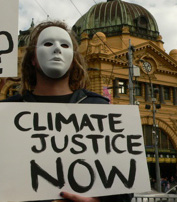
Climate justice

Today's post is on the relevance of history for current environmental law. Dan Farber recently posted "Responsibility for Historic Carbon Emissions: Lessons from Tort and Statutory Compensation Schemes". The abstract:
Existing legal regimes dealing with analogous issues provide useful guideposts in considering the degree to which emitters bear responsibility for past carbon emissions. With regard to liability for environmental damage, the European Union but not the United States recognizes an exemption from liability if the harm was not understood at the time of the conduct. States have also been reluctant to accept strict liability for environmental damage under international law. Similarly, in European law, a defendant is usually not responsible if the state of scientific knowledge at the time did not enable the discovery of a product defect at the time the product was made. In the United States, many state governments recognize a similar limitation on products liability, although some do not. 
climate justiceThe problem of climate change is unique in some ways, and the legal system is not always the best gauge of ethical judgments. Nevertheless, understanding how societies have handled other cases of historical responsibility can illuminate the problem of climate justice. These analogous legal regimes suggest strongly that the right answer is somewhere between full responsibility for all historic carbon emissions and complete exoneration for those emitters.

Wednesday, May 22, 2013

Reg neg, command and control, informational approaches and more

Today was the final day of an impressive conference being hosted at TAU, entitled "New Approaches for a Safer and Healthier Society". While the papers were primarily forward-looking, and focused less on environmental issues than on other public health issues such as smoking, obesity, and patient safety, there was a lot to think about environmentally and historically speaking. I'll focus here on two papers with relevance to the history of environmental regulation.

Peter Schuck presented a paper (coauthored with Steven Kochevar) entitled "Reg Neg Redux: The Career of a Procedural Reform". Reg neg (regulatory negotiation), proposed by Schuck in a 1979 article, is a way for government agencies to make rules relying on communication and negotiation between interested parties rather than on the more formal and adversarial process known as "notice-and-comment rulemaking" required by the US Administrative Procedure Act (APA) of 1946. In addition to sketching history of reg neg since 1979 (its use has apparently been infrequent), the conference paper explored objections that have been raised to the process and explanations for why it has been little used.

Thinking about reg neg and notice-and-comment historically and comparatively though, I wonder which of these methods of rulemaking is really the rule and which the exception: To what extent are American federal rules really formed in the process mandated by APA rather than through informal communications and negotiations carried on before, during, and after the formal notice-and-comment process? When placed in a global, comparative context, might American-style adversarial rulemaking be an exception to the rule? What forms of rulemaking were supposedly extinguished by the APA in 1946, and how might the influences of these traditional methods continue to influence the way secondary legislation is formulated and enacted today? As for so many current environmental law topics, some historical perspective would be useful.

Another paper, offered by Robert Rabin (one of the conference organizers) was "Reducing Tobacco Use: A Reassessment of Strategic Initiatives". Rabin surveyed the various policy tools—taxation, place restrictions, information, and so on—that have been employed over the years to try and limit tobacco use, as well as some of their legal and political limits. He pointed out what a negligible role "command and control" regulation has played in tobacco regulation, and claimed that tort litigation, too, has had little effect on the industry or on tobacco use. His analysis made me wonder how environmental regulation has developed along similar or different lines, and to the extent that it has differed from tobacco control efforts, what explains the divergence.

A comment on Rabin's paper by my teacher Alon Harel, focusing on the distributional effects of informational strategies (a policy tool that has gotten a lot of play in the environmental literature in recent years), supplied a further point of entry for thinking historically about environmental regulation. Harel pointed out that providing information on the harms of smoking seems to have been more successful in lowering smoking rates of the upper classes than of the lower. Might this distributional lens help us make sense of the changing fortunes of "hard" and "soft law" approaches to environmental regulation?

Look for the conference papers in the journal Theoretical Inquiries in Law about a year from now.