Showing posts with label Antarctica. Show all posts

Friday, March 11, 2022

International environmental law panel for ASLH

Reposting from H-Environment:

Dear all,

I am a doctoral candidate at Rutgers University New Brunswick, and I am currently seeking co-panelists for the American Society of Legal History conference to be held in Chicago, Illinois, November 10-12, 2022. The conference welcomes papers dealing with legal history from any time period or geographical area, but is only accepting panel proposals. I am seeking to put together a panel dealing with international environmental law in the 20th century, in the broadest possible sense. My paper specifically will talk about the interplay between international conservation efforts and French national interests in the creation of a "French Antarctic national park" in the subantarctic Kerguelen Islands in 1924.

Here is a link to the ASLH website For more information: https://aslh.confex.com/aslh/2022/cfp.cgi

Panel submissions are due March 18th. I know this is a short turn around but I hope to find interest through this forum. The ASLH is a great organization that offers a helpful forum for discussing a broad range of legal history topics, and is especially supportive of graduate students and early career scholars.

Please feel free to contact me at kms557@history.rutgers.edu if you are interested in joining this panel.

All best,

Katherine Sinclair

Bruno Navez, Remains of vats and boilers at Port-Couvreux, Kerguelen Islands, used for the making of elephant seal oil at the beginning of the XXth century

Sunday, January 30, 2022

The Antarctic and Outer Space Treaties

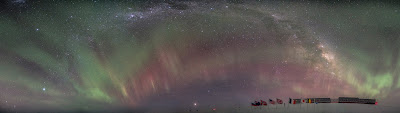
Aurora australis, Milky Way, and flags at the South Pole (Martin Wolf, NSF)
Sophia Guido recently posted "How the Antarctic Treaty of 1959 Influenced the Outer Space Treaty of 1967" at In Custodia Legis. An excerpt:

After successfully reaching a consensus on the Antarctic Treaty in 1959, countries were eager to apply these already agreed-upon terms to outer space. The result: many articles in both treaties are very similar to each other. For example, during the Antarctic Treaty discussions, many countries wanted to claim part of the continent as their own based on whose citizens discovered a particular area first, but there were many overlaps of land claimed by multiple nations. So, it was decided that no country could claim sovereignty over any part of Antarctica. By putting this article within the outer space treaty, no country can claim ownership over any celestial body in outer space. As more countries develop the technology to send people or objects into space, this idea is more relevant than ever.

One of the main principles of the Outer Space Treaty is that the exploration and use of outer space and the celestial bodies within it should be carried out for the benefit of all countries, regardless of whether it is for scientific or economic purposes, and only for peaceful purposes. Outer space can be freely explored by all states. However, no country can make any territorial claim to any part of outer space or any celestial body, and every country is responsible for any national space activities carried out by their government or non-government entities and will be liable for any damage caused by their citizens. No country is allowed to place any nuclear weapons or any weapons of mass destruction in any part of outer space.

Friday, February 12, 2021

EIS in Antarctica

USA's McMurdo Station, Antarctica (USAP)
A recent issue of the Journal of Historical Geography had an article by Alessandro Antonello and Adrian Howkins, "The rise of technocratic environmentalism: the United States, Antarctica, and the globalisation of the environmental impact statement". The abstract:

Environmental impact statements (EISs), and the related environmental impact assessments (EIAs) which precede them, have become central elements of environmental management, governance, and policy worldwide since their introduction in the United States in 1970. Assessing environmental impact has a particular force and centrality within modern Antarctic environmental management and governance too. This article investigates the ways in which the United States used EISs and EIAs in Antarctica between 1970 and 1982 – during their first decade of existence in US law and during a geopolitically and scientifically vibrant decade in Antarctic affairs – as a way of illuminating the broader conceptual and historical aspects of this central, though understudied, environmental governance tool and framework. We historicise and draw attention to the EIS – individually, as a regulatory genre, and as a genre that articulates regional, global and planetary environments – as highly influential and powerful documents demanding attention from environmental historians and historical geographers. We argue that the prominence of EISs in Antarctica arose because they appealed to top-down, process-oriented approaches favoured in Antarctic governance – a technocratic environmentalism – and because of their spatial elements, particularly their tendency to upscaling.

Wednesday, April 23, 2014

The Antarctic Treaty System

McMurdo Station, Antarctica, 1983 (photo: US Navy, NSF)
Ben Saul and Tim Stephens have posted the Introduction to their forthcoming Documents in International Law: Antarctica. The abstract:
Since its establishment in 1959 the Antarctic Treaty System (ATS) has defused the risks of sovereign competition which arose from the early era of exploration in Antarctica, and were later brought to a head in the early years of the Cold War. On the whole it has produced a peaceful, stable, effective and widely accepted regime for cooperation on a range of scientific, environmental, and related issues. Rising powers, such as China (which joined in 1983), have been brought into the system. The ATS has proven sufficiently flexible to accommodate new challenges and risks, even as the number of state parties has expanded, thus making consensus on many issues more difficult to achieve. It has also seen off challenges to its normative and institutional authority in the United Nations General Assembly. There is nonetheless ongoing speculation about the future of the Antarctic regime, including rising concerns about security risks. So far there is no serious evidence that tensions arising from these issues threaten to unravel the half-century consensus on the Antarctic regime. To the contrary, the growing number of states participating in the ATS is testament to its vitality. In the long term, the persisting uncertainty about the final status of sovereign territorial, maritime and continental shelf claims will present the greatest challenge to Antarctic stability. The ATS embodies an uneasy truce and cannot indefinitely defer disputes over sovereign title (and thus sovereign rights to exploit Antarctica’s riches). The time will come when it may be necessary to reconsider sovereign claims and to desire an alternative legal architecture for securing Antarctica’s future. This essay provides an overview of the ATS from its inception to the present, and introduces a collection of key primary legal materials, hard and soft, which sustain the ATS and are reproduced in the book which the essay introduces.