Showing posts with label ecology. Show all posts

Sunday, February 6, 2022

Digital library VIII: Manwood's Treatise of Forest Laws

It's been a while since I updated the "Digital library of historical environmental law", so here's a new addition, connecting environmental law with Magna Carta: John Manwood's Treatise of the Forest Laws (4th edition (1717) here). 

GWU Law's Legal Miscellanea explains that Manwood was a barrister, gamekeeper, and Justice in Eyre of the New Forest under Elizabeth I. His Brefe Collection of the Lawes of the Forest was printed in 1592 for private circulation and the first edition of the Treatise, printed in 1598, was entitled A Treatise and Discovrse of the Lawes of the Forrest. The 4th edition (above) was "corrected and enlarged by William Nelson," a practitioner in the Court of Chancery.

Chris Besant, in his 1991 "From forest to field: A brief history of environmental law" (16 Legal Service Bull. 160 (1991)), explains further:

Forest law operated principally to protect two resources: vert and venison. Vert was the timber of the forest, plus any grasses, ground cover or vegetation necessary to support the venison, including cover or vegetation which provided shade. Venison denoted the wild beasts of the forest (hart and hind, hare, boar and wold), chase (buck, does, fox, matron and the roo), and warren (the hare, pheasant, partridge and the cunnie). All of these beasts were privileged and protected from capture within the forest by the forest law, although outside thereof, they could be taken through capture by anyone.

*****

Magna Carta is a general reaction against the centralisation of government in derogation of the feudal principle. The King in his weakness is forced to concede that he will not 'overreach' his proper bounds as defined by the common and forest laws of the land. Thus the Charter of the Forest is a further delimitation of forest custom in the interests of liberty, and is the beginning of the great destruction of England's natural environment.

Tuesday, February 9, 2021

The ecology of economic thought

I've been participating in a great online series on the historical intersections of economic and environmental thought, organized by Troy Vettese and Julia Nordblad. The organizers write:

One would think that environmental history and economic history would be peas in a pod. After all, central questions in the history of economic thought concern environmental issues such as the early-modern enclosures and the importance of water-power and coal to the industrial revolution. The meanings of ‘the environmental’ and ‘the economic’ have shifted over the centuries, especially as issues were traded between natural philosophy, political economy, and ecology. While much has been written on policy of various kinds, what this workshop is focused on are works that lie at the convergence of environmental, economic, and intellectual history. What  for example are the origins and contexts of Spaceship Earth, catastrophe bonds, geo-engineering, externalities, cap-and-trade, and sustainability? 

Many of the papers are on topics with significant legal aspects, such as the history of economic thought on emissions trading, Pigouvian taxes, and the like. Stephen Gross's paper for tomorrow is particularly laden with connections to the history of environmental law and regulation.

The schedule for the remaining meetings is below. Registration is for each session separately (links below), and the discussions assume pre-reading of the papers, as the authors do not present them but only respond to comments. Papers are available from Troy Vetesse.


Sunday, December 24, 2017

Water rights V: Public rights

(Continuing the series on water rights:)

Whatever property regime applies to water, the public often retains certain rights in the resource. Thus, for instance, in American law, though a river's water may be owned by riparian landowners or appropriators, the federal government retains a "navigation servitude" in the water with which private owners (and states) cannot interfere (Trelease, 1965).

Joseph Sax
Recent decades have seen much discussion of the "public trust doctrine", rules that allow public interests, especially environmental ones, to trump the normal property rules in water. Though the doctrine has its roots in the traditional civil and common law, particularly with regard to tidelands (Selvin, 1980), its modern form was first articulated by Joseph Sax in a highly influential article (1970), in which he argued that the historical doctrine should be developed to encourage courts to subject actions that harm the environment to strict scrutiny. In the field of water rights the doctrine has been applied by American state courts in recent decades to push states to protect environmental values, even when this protection is in tension with private property rights (Craig, 2010). The best-known expression of this trend is the decision of the California Supreme Court in the Mono Lake case, in which the court ruled that longstanding water diversions from the lake by the city of Los Angeles might need to be limited by the state in order to protect ecological values being harmed by the lowering of the lake level. In recent years the doctrine has been adopted in additional countries around the world (Cullet, 2009; Blumm and Guthrie, 2012).

The public trust doctrine continues to receive support from many commentators, but it has also been criticized. On the one hand, it has been argued that the doctrine places undue reliance on an inflexible, property rule as applied by the judiciary, while environmental protection should be sought from progressive legislation (Lazarus, 1986). On the other, the doctrine has been criticizes as historically without basis, undemocratic, and invasive of private property rights (Huffman, 1989, 2007).

Next: A human right to water. The full article is here.

Friday, December 9, 2016

Ecology and procedure in the history of ecosystem management

A while ago we noted a review of James Skillen's book on the US Bureau of Land Management. Now American Historical Review has a review by Leisl Carr Childers of Skillen's latest book, Federal Ecosystem Management: Its Rise, Fall, and Afterlife (University Press of Kansas, 2015). Childers writes:
Divided into two parts and featuring three case studies, Federal Ecosystem Management examines the historical contexts of ecological science and public administration from which ecosystem management emerged in the 1960s and 1970s and analyzes its implementation during the George H. W. Bush and William J. Clinton presidential administrations. According to Skillen, the National Environmental Policy Act (NEPA, 1969) and the Endangered Species Act (ESA, 1973) formed the cornerstones of ecosystem management. These legislative mandates did not systematize ecosystem management; rather, they allowed federal land management agencies to implement two competing versions of the paradigm. Ecosystem management, undergirded by the ESA, focused on achieving substantive goals that married ecosystem protection with resource development and provided a dynamic process through which land managers could respond to the constantly shifting complex of ecological systems by continually adapting their management plans to reach a specific goal. In contrast, ecosystem management relied on NEPA and concentrated on achieving procedural goals by using scientific assessment and open, democratic deliberation. In this version, gathering scientific information and using public input to shape management decisions continued to ensure sustained yield in natural resource development.
Yet without a clear legislative mandate to guide the process, the application of both versions of ecosystem management was as varied as the missions and cultures of the land management agencies that employed them. In case studies on the Greater Yellowstone Ecosystem, where the Forest Service and National Park Service first attempted collaborative projects that utilized the paradigm, and the Northwest Forest Plan and the Interior Columbia Basin Ecosystem Management Project, which emphasized the substantive and procedural versions of the paradigm respectively, Skillen deftly demonstrates the political difficulties surrounding the actual implementation of ecosystem management. In no context was either version of the paradigm truly operational, and the tension between the two variations has perpetrated increasing political polarization. Nevertheless, Skillen leaves readers with the sense that despite its failure, the basic tenants of ecosystem management remain.

Friday, October 28, 2016

Environmental history in oral arguments

Brian Tomasovic recently posted the abstract for his article "Soundscape History and Environmental Law in the Supreme Court", published last year in Environmental Law. The abstract:
Today’s technology unleashes new, digitized information resources with immense scale and speed. This Article examines one such resource — the archive of audio recorded proceedings of the United States Supreme Court — appraising, for the first time, its value to those who study and practice environmental law. From hundreds of hours of audio across six decades, a history of environmental litigation sounds forth, imparting rich lessons on advocacy, judicial reasoning, and the role of the Court in environmental law’s development. The Article organizes itself in three major parts, furnishing insights on: oral advocacy in the environmental docket; the voices from the bench; and the audience for prospective engagement with any selection or subset of recordings. Serving partly as a listener’s guide, the Article defines the reach of environmental litigation in the audio archive and demonstrates its unique value as a tool for learning and the professional betterment of environmental law scholars and practitioners.
Tomasovic explains that argument audio hosted on the Supreme Court’s website presently begins with the October 2010 Term, while recordings going back to 1955 are at the Oyez website. The article's Appendix B "compiles the list of available oral argument recordings for more than three hundred Supreme Court cases where environmental protection or natural resource concerns were at stake", and also "labels, using keyword tags, the identity of these settings under the rubric of the environmental burdens, risks, or amenities at issue in each case".

Is this resource important? Tomasovic thinks so; here are some highlights from my perspective (footnotes omitted). I'll start with his treatment of environmental history as reflected in the recordings:

Sunday, May 1, 2016

CFP: Ecological restoration and the law


The Griffith Law Review has put out a call for papers for what promises to be an interesting special issue on "Ecological Restoration and the Law: Recovering Nature’s Past for the Future". Some highlights from the call:
This special issue provides a timely opportunity to critically investigate one of the gravest temporal, philosophical and methodological deficiencies inherent in how environmental law develops – namely its neglect or structural deficiencies in actively engaging with the recovery of ecosystems. Under the aegis of the philosophy of sustainable development, which provides environmental law’s main temporal and ideological ballast, our environmental regulations and policies have become obsessed with the future and emotionally and ideologically disconnect people from actively engaging with the recovery of ecosystems. The legal priority is commonly to avert, mitigate or adapt to new ecological impacts rather than to restore past damage. While further environmental upheaval must be avoided, sustaining what remains may be illusionary if prevailing conditions are too degraded. A focus on sustainability emotionally and mentally disconnects us from actively restoring nature by presuming that nature has the capacity to passively restore itself. To the extent that legal systems recognise the imperative to actively restore nature, they tend to focus narrowly on environmental restoration rather than ecological restoration (ie, the difference between rehabilitation of small, discrete sites, such as a former mine, and ambitious restoration of entire ecosystems and landscapes).
The special issue of the GLR thus serves to critically evaluate the nature and impact of current laws and other governance mechanisms that address ecological restoration, to advance theoretical understandings for a new generation of governance reforms for eco-restoration, and more broadly to generate critical and interdisciplinary insights into environmental law generally. Ecophilosophy and philosophy more generally, through strands such as the ‘new materialists’ have helped us to think differently about the idea of nature and ask ontologically informed questions about human beings in a world of matter. Environmental history, geography, ecopsychology, anthropology and other disciplinary approaches to the human relationship to nature have supported discussions and research that question our understanding of how we come to view and interpret our relationship to the natural world and its significance for us. Environmental law however has not kept pace with the widening of our increasingly more interdisciplinary and critical approaches to how we understand the human and nature relationship.
In this respect, the special issue considers how law and its relationship to themes like recovery, emotions, time, geography, vitalism, vulnerability, justice, and history can provoke how we think more deeply about restoration. Some of the interrelated themes include: 

Thursday, March 10, 2016

The Storm King controversy

The recent Environmental History has a review by Ted Steinberg of Robert Lifset's Power on the Hudson: Storm King Mountain and the Emergence of Modern American Environmentalism (U Pittsburgh Press, 2014). Steinberg writes:
Con Ed seemed to be cruising toward its goal of building the plant when Scenic Hudson, an environmental group formed in 1963 to stop the project, began reckoning with the full ecological impact of the hydroelectric plant. Writer Robert Boyle had discovered that the Hudson River was alive with marine life. Boyle equated the prospect of licensing a plant in the Storm King area with the thought of slaughtering sheep in his own living room. The idea was slowly dawning on environmentalists that the hydroelectric plant would doom the river’s population of striped bass. Lifset argues that the introduction of ecological issues transformed the environmental movement in the Hudson Valley and helped lay the groundwork for its ultimate success.
This increased focus on ecology alone would never have led to the demise of Con Ed’s plans were it not for an equally important turn in the law that Lifset also explores in his book. In 1965 a federal appeals court ruled that Scenic Hudson was an aggrieved party and had the legal standing to launch a challenge to the Federal Power Commission with respect to Storm King. The decision reprimanded the power commission for failing to create an adequate evidentiary record, thereby foretokening the later implementation of environmental impact statements.
*****
Lifset offers a solid work of history that draws attention to the role of both ecological and energy issues in shaping environmentalism. His focus on legal change is also a welcome addition for those seeking a fuller understanding of the environmental movement. 

Monday, November 30, 2015

Ecosystem services

I recently came across a very interesting article by Erik Gómez-Baggethun, Rudolf de Groot, Pedro L. Lomas, and Carlos Montes, "The history of ecosystem services in economic theory and practice: From early notions to markets and payment schemes", published in Ecological Economics in 2009. Beyond its explicit subject, it contains an extensive literature review of the history of thought about the environment in classical and neoclassical economics. (For an article by Agnar Sando on a similar topic, see here.) The abstract:
This paper reviews the historic development of the conceptualization of ecosystem services and examines critical landmarks in economic theory and practice with regard to the incorporation of ecosystem services into markets and payment schemes. The review presented here suggests that the trend towards monetization and commodification of ecosystem services is partly the result of a slow move from the original economic conception of nature's benefits as use values in Classical economics to their conceptualization in terms of exchange values in Neoclassical economics. The theory and practice of current ecosystem services science are examined in the light of this historical development. From this review, we conclude that the focus on monetary valuation and payment schemes has contributed to attract political support for conservation, but also to commodify a growing number of ecosystem services and to reproduce the Neoclassical economics paradigm and the market logic to tackle environmental problems. 
Harold Hotelling, whose 1931 "The Economics of Exhaustible Resources"
laid the foundations of modern resource economics

Sunday, August 9, 2015

Landscapes of my youth

Sligo Creek

I have fond memories of a hot, humid summer, when I turned 7, collecting tadpoles and algae in the Northwest Branch of the Anacostia. As an even younger child my favorite weekend activity was to ride the miniature train around Pine Lake, and as a teenager my friends and I spent endless hours biking and walking along shady Sligo Creek. I was thus happy to see this under-appreciated corner of the world (the multicultural and middle-class east side of Montgomery County, Maryland is overshadowed by the more glamorous, western neighborhoods of Bethesda, Potomac, and environs) receive some attention in an article, "The Social-Ecological Resilience of an Eastern Urban-Suburban Watershed: The Anacostia River Basin", authored by Craig Arnold and four others. The abstract:
This article develops a new framework -- the institutional-social-ecological dynamics framework (ISED) -- to assess the relationships among institutional change, societal change, and ecological change in evaluating the current and likely future resilience of a small, Eastern, urban-suburban watershed: the Anacostia River watershed in DC and Maryland. A historical case study of the watershed explores the transformations of the watershed across key thresholds, including how legal, governance, and social institutions changed since European colonization and how these changes have affected the ecosystem functioning and social dynamics in the basin. Major drivers of change are identified, including the potential for climate change impact on the watershed and 3 possible futures for the watershed, ranging from hydro-ecological collapse to a greening of the watershed. Finally, watershed governance in the basin is evaluated to determine whether it is adaptive to change. The necessary features of adaptive governance in this particular basin, include watershed-focused governance, restoration and green infrastructure, land use regulation, public engagement, social justice, and monitoring and feedback loops. Law and planning play critical roles in all of these features. Whether the basin will continue to develop and improve its emerging elements of adaptive governance remains to be seen, but several key variables to watch are identified.

Wednesday, April 15, 2015

Tuesday, July 8, 2014

Enlightenment's frontier

Land tenure and the environment in Scotland seems to be a live topic in which sensitivity to environmental issues is informing legal and intellectual history and vice versa. April's Environmental History had a review by Peter Hansen of Fredrik Albritton Jonsson's Enlightenment's Frontier: The Scottish Highlands and the Origins of Environmentalism (Yale UP, 2013). Hansen writes:

After the defeat of the Jacobite rebellion in 1745–46, land clearances in the Highlands uprooted residents in a region said to possess cornucopian abundance but excess population. The resulting long-term forced migration and agrarian transformation was shaped by ideologies of improvement that did not always mean replacing people with sheep. Surveyors, tourists, and naturalists visited the Highlands and made Linnaean surveys. The influence of a civil cameralism imported from Europe's northern fringe or landlocked provinces also shaped proposals for commercial-botanical projects to attain agricultural self-sufficiency. Voluntary associations such as the Highland Society or British Fisheries Society debated projects to create fishing villages or import crops that would acclimatize to Scotland's soil and climate. Such projects met with mixed success but often concentrated tenants in small-scale holdings. Thus the distinctive crofting form of land tenure in the Highlands was not an inevitable response to overpopulation but the consequence of specific intellectual debates over improvement during the Scottish Enlightenment.

Friday, June 27, 2014

Environmental effects of enclosure

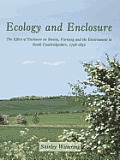
April's Environmental History has a review by David Zylberberg of Shirley Wittering's Ecology and Enclosure: The Effect of Enclosure on Society, Farming and the Environment in South Cambridgeshire, 1798-1850 (Oxbow, 2013). There is a lot of theoretical writing on the environmental effects of enclosure; this book seems to provide some real environmental-historical data. Zylberberg writes that Wittering:
is able to demonstrate the adaptability of open-field agriculture and refute some of its eighteenth- and twentieth-century critics. It is refreshing to read a discussion of enclosure that focuses on the actual crops planted rather than trying to extrapolate agricultural change from rental values or the intellectual history of improvement. Moreover, this focus demonstrates that the agricultural changes that followed enclosure in South Cambridgeshire increased the number of sheep that could be pastured but did not lead to higher grain yields.

The chapter on the ecological consequences of enclosure is the most original and of interest to environmental historians. Wittering uses the notes of Cambridge botanists, maps, and receipts of timber sales to trace the presence and location of plant species. She is able to demonstrate that the location of trees changed as many older ones were cut down to pay for enclosure while hedges were planted along field boundaries. Another major contribution comes from comparing the grass and flower species in fields at various dates. In this regard, she can demonstrate the loss of heathland flowers and bird habitat as former sheep pastures were plowed up to plant grain following enclosure. Current efforts to preserve characteristically English environments and reintroduce fauna will benefit from these holistic descriptions of Cambridgeshire ecology. 

Sunday, May 19, 2013

Ecological & Environmental Worldviews: A Basic Transdisciplinary Bibliography

Blog readers may be interested in a select but extensive bibliography on the science and philosophy of ecology posted by Patrick O'Donnell to our accompanying discussion group. The trans-disciplinary list includes many titles with a historical or legal angle. While you're there, sign up for the discussion group if you haven't done so already.

A Reading Room in Leeds Castle
(David Iliff)