Saturday, December 17, 2022

Changes in environmental law scholarship

Recently published in Journal of Environmental Law: Ole Pedersen, "The Evolution and Emergence of Environmental Law Scholarship—A Perspective from Three Journals". The abstract:

In the attempt to lay the foundations for a better understanding of environmental law scholarship, this article offers a local perspective of environmental law scholarship in the UK. Through a study of more than 1,400 articles published in three leading UK environmental law journals over the course of three decades, the article considers the ways in which environmental law scholarship has changed over time by reference to gender and geographical location of authors. The article also interrogates the ways in which the topics of scholarship have changed over time, as well as the extent to which environmental law scholars make use of empirical methods and external sources of funding for their research. Finally, the article explores the extent to which environmental law scholarship is published in generalist law journals.

There are a lot of interesting data in the article. Here, for instance, is a graph showing the changes (mainly increases) in the number of environmental law articles published in leading UK generalist law journals:

It would be interesting to see parallel date for other countries.

Thursday, December 15, 2022

How control of nature shaped the international order

Posted recently to International Law Reporter, a nomination by Gail Lythgoe for the most interesting, important, or influential article or book published in 2022:

Joanne Yao, The Ideal River: How Control of Nature Shaped the International Order (Manchester Univ. Press 2022)

This book explores the geographical imaginaries of three rivers (the Rhine, Danube, and Congo) and how these very imaginaries shaped the constitutions, structure, and life of three early international organizations. It is a marvellous tale of how (and why) experts sought to tame nature and also says much about law’s relationship to the physical geography. I always really recommend and admire it because of how well written and engaging it is.

From the publisher's website:

The ideal river examines nineteenth-century efforts to establish international commissions on three transboundary rivers - the Rhine, the Danube, and the Congo. It charts how the Enlightenment ambition to tame the natural world, and human nature itself, became an international standard for rational and civilized authority and informed our geographical imagination of the international. This relationship of domination over nature shaped three core International Relations concepts central to the emergence of early international order: the territorial sovereign state; imperial hierarchies; and international organizations. The book contributes to environmental politics and international relations by highlighting how the relationship between society and nature is not a peripheral concern, but one at the heart of international politics. 

Tuesday, December 6, 2022

Problems with formalizing rights in the commons

Political Geography recently published "Grabbing the commons: Forest rights, capital and legal struggle in the Carpathian Mountains", by Stefan Voicu and Monica Vasile. The abstract:

In this paper we show that formalizing communal rights is a process riddled with struggles leading to a partial or total grabbing of commons. Drawing on long-term research and using interviews, surveys, and historical sources, we analyze struggles that emerged from processes of formalizing rights to commons, occurring one century apart in the Carpathian Mountains of Romania. The first wave of formalization, initiated by the state in 1910, institutionalized a model of hybrid commons in which individual rights to communal forests and pastures were understood as inheritable and tradable shares. This generated never-ending contention and a vulnerability to capital, allowing timber companies to grab shares and dispossess rightsholders. The second formalization, post-1989, enabled local communities to regain rights to forests that had been nationalized by the state at the beginning of the socialist rule. However, this resurgence of mountain commons unleashed again a suite of legal struggles, bringing back to life previous vulnerabilities and dispossessions. We argue that the formalization of rights often does not bring clarity and security to commons rightsholders. Instead, it creates a suite of vulnerabilities, ambiguities, and complexity within regulatory texts, begetting the grabbing of the commons.

Barat Roland, Lambs in the autumn in the mountains

Sunday, December 4, 2022

Nazi legislation against animal cruelty


From Sydney Criminal Lawyers, on Lexology (via Legal History Blog): "The History of Laws Against Cruelty to Animals". A particularly interesting section discusses the Nazis:

There can be no words to sufficiently encapsulate the appalling atrocities perpetrated by one of history’s most evil people, Adolf Hitler, and his fascist Nazi party.

And one must take special care before giving credit for any act to the person at the helm of history’s most disgusting and shameful political, social and cultural regime, whereby millions of innocent men, women and children were tortured and murdered, including the systematic use of humans for medical experimentation, annihilation of ‘undesirable’ groups in society including the disabled and slaughter of large segments of targeted racial and religious groups.

Hitler and his extreme right-wing party exemplified the very worst of humankind, and the regime’s ultimate demise was a Godsend to all moral people.

But the irony must also be acknowledged that while on the way to murdering millions of human beings, the famously vegetarian and dog-loving Hitler took unprecedented steps to protect non-human animals from cruelty. And many of the enacted laws go way further than present day legislation.

In that regard, 24 November 1933 saw the German parliament (the Reichstag) the under the Chancellorship of Hitler and Presidency of Hermann Göring) pass the Reichstierschutzgesetz, or Reich Animal Protection Act, which is listed in the above table.

The law imposed a total ban on the almost-universally accepted, and even encouraged and publicly funded, practices of vivisection (operating or experimenting on live animals) and slaughter of animals without anaesthetic.

In a 1933 speech approved by Hitler, Göring declared an end to the “unbearable torture and suffering in animal experiments” and warned that those who “still think they can continue to treat animals as inanimate property” would be sent to concentration camps.

The regime saw a range of further prohibitions to protect animals including bans on animal trapping, the boiling of crustaceans such as crabs and lobsters, live baiting, neglect and cruel acts to domestic animals, and severe restrictions on hunting.

And so it was – perhaps history’s most evil regime was ironically perhaps the most benevolent in the treatment of non-human animals.

This is just one one section of the long post, which includes a chronology of developments and a discussion of Australian law. 

Monday, November 7, 2022

The US Supreme Court’s earliest pollution cases

Over at Legal Planet, Dan Farber recently posted on "The Supreme Court’s Earliest Pollution Cases". Farber writes:

Well over a century ago, the Supreme Court ruled that it had that power to remedy interstate water pollution. That was in 1901. Six years later, the Court decided its first air pollution case.  Notably, these cases came during the conservative Lochner era when the Court was hardly known for its liberalism.  Quite the contrary. Yet the Court didn’t hesitate to address pollution issues.

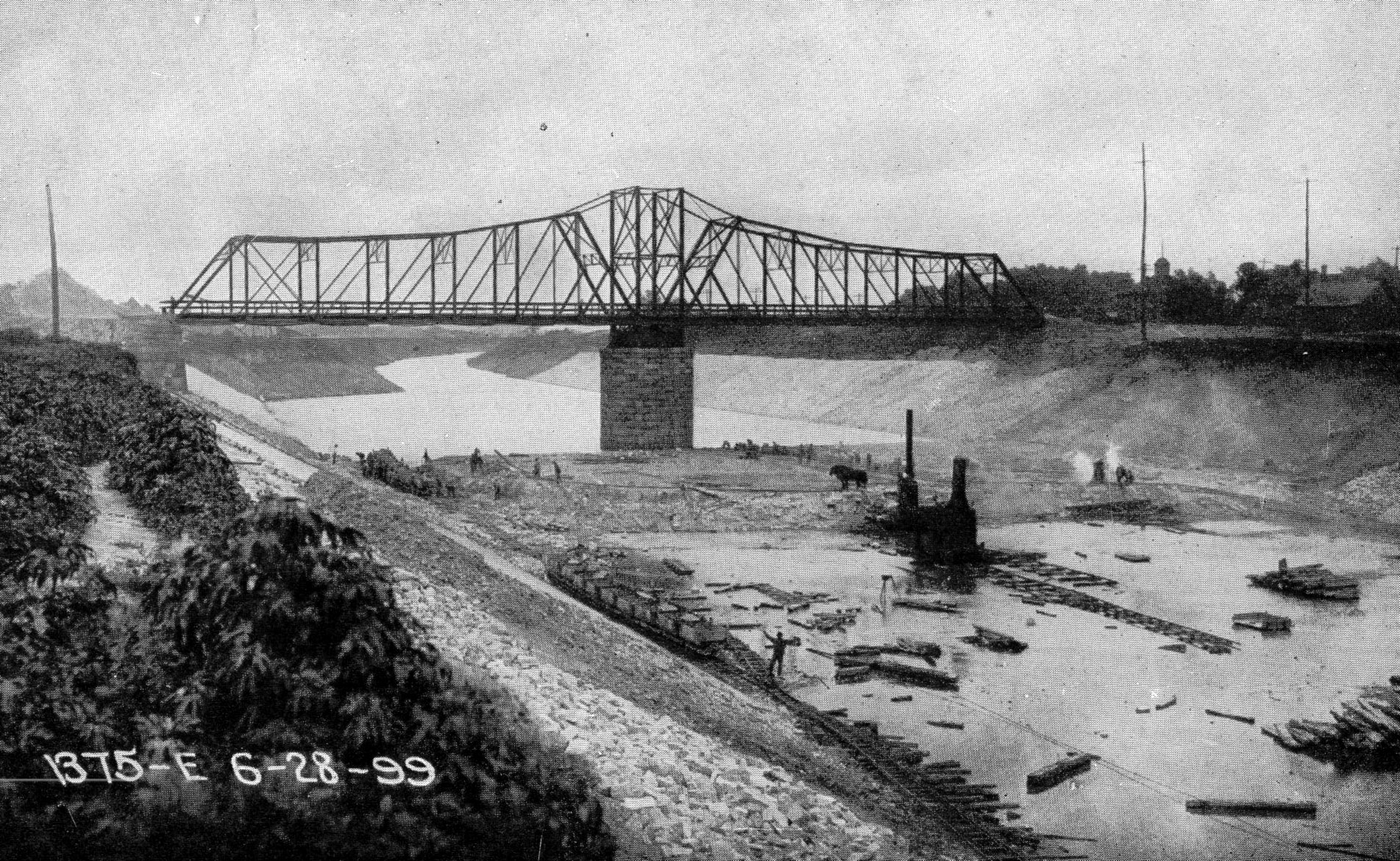
The water pollution case was Missouri v. Illinois.  In a feat of engineering prowess or incredible hubris, depending on how you look at it, Illinois had built a canal to reverse the flow of a river from Lake Michigan to the Mississippi. The canal then became a dumping place for the city’s raw sewage. Missouri claimed that the sewage was befouling the water as far away as St. Louis. The Court had long heard other law suits between states, but this was apparently the first one to involve pollution.

Chicago Drainage Canal being built (from The New Student's Reference Work (1914))

I'm not sure this was really the US Supreme Court's first pollution case - how about the Slaughterhouse Cases? In any case, Farber goes on to also discuss Georgia v. Tennessee Copper Co., an interstate air pollution case. He comments:

These two cases are little known today, but they have cast long shadows.  Very briefly, here were some of their longterm impacts:

  1. International law. This line of precedent got the attention of an international tribunal in the Trail Smelter case, which involving a Canadian smelter polluting across the U.S. border. The tribunal held that a country has a duty to prevent its inhabitants from inflicting serious harm within another country. Thus, Canada had to take responsibility for the pollution. This principle is now famous in international law as the Smelter Trail rule. In turn, that principle of international law was taken up in international concords such as the 1992 Rio Declaration on Environment and Development.

  2. Water pollution. Use of federal common law to pursue water pollution cases enjoyed a big revival in the 1960s and early 1970s. It was ended by the Supreme Court, which held that the then-new Clean Water Act took over the field of interstate water pollution in lieu of court-made rules.

  3. Climate change.  In a groundbreaking climate decision, Massachusetts v. EPA, Justice Stevens invoked this line of cases to emphasize the special interest that states have in access to the Court to protect their interests as sovereigns.  The upshot was to give states standing to sue EPA for failing to take action against carbon emissions. Also, this line of cases was repurposed  early in this century in order to bring lawsuits against major carbon emitters in federal court. The Supreme Court ultimately said that since the Clean Air Act covered climate change, lawsuits based on judge-made federal rules were no longer needed. It left open the possibility of lawsuits based on state law, and state lawsuits against oil companies are now underway.
More on the US Supreme Court and the history of environmental law here.

Tuesday, October 25, 2022

A prize for my article

I'm happy to report that my article,  "Horizontal and vertical influences in colonial legal transplantation: water by-laws in British Palestine", recently was awarded the best article prize by the Israel Association for Law and History. (See related posts here.) I'd like to reproduce (in translation) one point made by the  prize committee in its statement, as I think it could be useful for others' research:

Beyond the excellence of the article itself, the committee believes that Schorr's article can serve as a model for future studies of legal transplantation. The article considers not only the process of transplantation as a product of the sovereign or lawyer's will, but also the material objects through which transplantation takes place - letters, memos, newspapers, and statute books - and it shows the importance of prosaic, everyday factors for this process, such as bureaucratic practices or even the location of law libraries.

In short, material factors matter - a point that environmental history knows full well, but is often shortchanged by legal histories.

Jerusalem Water Works. Ras el Ain. Engine room (Matson, 1930s?)

Tuesday, October 18, 2022

More on the Clean Water Act at 50


Legal Planet's Richard Frank posted today on the US Clean Water Act's 50th birthday. An excerpt:

The CWA as enacted a half-century ago was enormously ambitious and, with the benefit of hindsight, quite naive: in the law’s legislative findings, Congress declared that “it is the national goal that the discharge of pollutants into the navigable waters be eliminated by 1985.”  That obviously did not, and will not, happen.

Nevertheless, and with the possible exception of the Clean Air Act, no law enacted as part of the outpouring of federal environmental legislation in the 1970’s has proven more successful and transformational than the CWA.  The nation’s rivers, streams, lakes and ocean waters are dramatically cleaner and healthier than they were a half-century ago.

That’s primarily due to two key features of the CWA: first, a nationwide permit system designed to mandate aggressive application of pollution control technology to limit pollution from “point sources” such as factories and power plants.  The second feature is a massive infusion of federal funding to state and local governments to upgrade sewage treatment plants across America.

Another key element of the CWA is its incorporation of “environmental federalism” principles.  Subject to federal review and approval (and incentivized by generous federal funding), willing states were allowed to assume responsibility for administering and enforcing the CWA’s federal permit systems.  California was the first state to seek and obtain this delegation of federal CWA authority in 1972, and most–but not all–states have since done so as well.

Yet another important element of the CWA has been its incorporation of the principle of private enforcement.  In virtually all other nations, enforcement of water pollution control and other environmental laws is the sole responsibility of government regulators.  But the CWA authorizes and incentivizes private citizens and organizations to enforce the statute as well.  Today, the private enforcement model is replicated in many of the nation’s environmental laws.  But far more private enforcement actions are brought under the CWA than any other federal environmental statute.  And the number of private CWA enforcement lawsuits far exceeds those brought by federal and state regulators.

More on the history of the Clean Water Act here and here

Tuesday, October 11, 2022

Class and conservation

Recently published in the American Journal of Legal History is William B Meyer's "Class, Conservation, and the Police Power in the American Gilded Age: The Origins of Lawton v. Steele". The abstract:

The leading police power case of Lawton v. Steele, decided by the US Supreme Court in 1894, offers insight into the question of judicial class bias during the decades following the Civil War. Conflict arose in rural northern New York State over restrictions on livelihood fishing by nets imposed to protect sport angling by affluent tourists. Opposition to the restrictions was grounded in a producerist worldview and class consciousness. The matter reached the courts in a challenge to state laws permitting the summary destruction, without legal process, of nets placed illegally. Seemingly prohibited by the Fourteenth Amendment and previous case law, such destruction was upheld by a Supreme Court divided along ideological lines, correlating with the justices’ Whig or Jacksonian antecedents. The dissenters, those of Jacksonian sympathies, argued unsuccessfully against the challenged laws.

Winslow Homer, Adirondack Lake (Blue Monday) (1892)

Wednesday, September 28, 2022

The US Clean Water Act at 50

Another 50th anniversary: Legal Planet reports that the California Environmental Law & Policy Center at U.C. Davis School of Law will convene a conference to commemorate the 50th anniversary of the federal Clean Water Act on Friday, October 7th. Highlights include "a stimulating conversation between two water quality experts who were instrumental in drafting the Clean Water Act in 1972 and California’s landmark Porter-Cologne Act, the state’s comprehensive water pollution control statute that both predated and influenced the CWA."

The free, in-person conference will be held at the U.C. Davis School of Law.  Advance registration is required.


Saturday, September 24, 2022

UNEP at 50

A little while back Environmental Politics carried a review by Katarina Eckerberg of The Untold Story of the World’s Leading Environmental Institution: UNEP at Fifty by Maria Ivanova (MIT Press, 2021). From the review:

UNEP’s mission was to assess the state of the environment and to inform, inspire, empower, and catalyse the UN system in environmental affairs. But why has progress been so slow? There is urgent need to critically assess what UNEP has achieved – and not – in the past 50 years, to investigate why it has yet not become sufficiently powerful in the struggle for a more sustainable world, and what can be done to improve this.

Maria Ivanova’s book helps to understand exactly those issues. It delivers profound knowledge about the functioning of international relations, politics, and administration in practice, by revealing how UNEP’s successes, crises, and turning points have been shaped by both politics, geography, and individuals within and beyond UNEP itself. The book addresses a concern at the core of international environmental politics, focusing on the history and performance of the world’s leading global environmental authority over 50 years.

Its theoretical contribution lies foremost in the thick narratives of the development of our major international environmental conventions – including reversing the depletion of the ozone layer, regional seas pollution, chemicals and waste, climate change, as well as tackling land degradation, and the loss of biodiversity and forests. By applying the concepts of capacity, connectivity, and credibility as elements of performance she guides us through both the empirical analysis and the potential ways forward. Capacity here refers to the people and resources, connectivity to infrastructure and representation, and credibility to authority and legitimacy of the institution.