Covering a wide range of relevant topics, Car Country begins with efforts to improve roads and streets that antedated the automobile. This is followed by a chapter on the first phase of automotive evolution, culminating with the transformative Ford Model T. The narrative then returns to roads; efforts to design and build roads for the accommodation of the rapidly expanding automobile fleet are well-covered, along with largely successful efforts to re-define roads as conduits for automotive traffic rather than serving as sites for shopping, socializing, and play in addition to the movement of goods and people. Changing approaches to land use are then taken up in the next chapter, which emphasizes the development, application, and consequences of zoning. The chapter also describes the different perspectives of city planners and traffic engineers, and how the visions of the latter eventually triumphed. Next up is a chapter on the development of the petroleum industry and the significance of gasoline taxes for financing an expanding road network. The succeeding chapter looks into two diametrically opposed aspects of the automobile's domination: the construction of massive manufacturing facilities as exemplified by Ford's River Rouge plant juxtaposed with efforts to make “nature” accessible to motorists through the development of the national parks system and automotive parkways. The final chapter brings the story to recent times and the post-World War II efflorescence of suburbia. Singled out are the rules promulgated by the Federal Housing Administration for low-cost mortgages that favored car-dependent suburban growth. Also spotlighted is the movement of shops, offices, and factories to the suburbs. Greatly aiding these massive relocations was the greatest public-works program of all time, the building of the Interstate Highway System.
Friday, May 30, 2014
Cars
The January issue of Environmental History had a review by Rudi Volti of Christopher Wells's Car Country: An Environmental History (U Washington Press, 2013). Volti summarizes:


Wednesday, May 28, 2014
Hard-to-see legal changes illustrated by environmental history
Today we have a guest post from Dan Allosso, a PhD candidate in history who runs the new www.environmentalhistory.us website, which has video lectures, a blog, and reviews of important books in environmental history. Dan recently reviewed one of the most important books of legal history, Morton Horwitz's The Transformation of American Law, 1780-1860 (Harvard UP, 1977), as well as Ted Steinberg's Nature Incorporated: Industrialization and the Waters of New England (U Mass Press, 1994). He put together a condensed version for our blog:
Harvard Law professor Morton Horwitz’s The Transformation of American Law, 1780-1860 is not an Environmental History text, per se. Nor is it a well-known volume outside legal history circles, in spite of winning the Bancroft Prize in 1978. It’s not an easy read, but it tells an important story, which was amplified by Horwitz’s student Ted Steinberg in the EH classic, Nature Incorporated.
 Horwitz argues a fairly radical case, which unfortunately is not widely understood because of the book’s subject matter and style. Horwitz focuses on common law. Constitutional law, he says, “represents episodic legal intervention buttressed by a rhetorical tradition that is often an unreliable guide to the slower (and often more unconscious) processes of legal change in America” (xii). Constitutional law also focuses on judicial review, rather than what Horwitz characterizes as a very active, constructive, legislative role taken on by nineteenth century jurists. “By 1820,” he says, “the process of common law decision making had taken on many of the qualities of legislation. As judges began to conceive of common law adjudication as a process of making and not merely discovering legal rules, they were led to frame general doctrines based on a self-conscious consideration of social and economic policies” (2). The ancient tradition of “an eternal set of principles expressed in custom and derived from natural law” gave way to an understanding of law as “an instrument of policy” that could be used “for governing society and promoting socially desirable conduct” (30). Once this change had been accomplished, the game became defining the terms “socially desirable.”
Harvard Law professor Morton Horwitz’s The Transformation of American Law, 1780-1860 is not an Environmental History text, per se. Nor is it a well-known volume outside legal history circles, in spite of winning the Bancroft Prize in 1978. It’s not an easy read, but it tells an important story, which was amplified by Horwitz’s student Ted Steinberg in the EH classic, Nature Incorporated.
Horwitz argues a fairly radical case, which unfortunately is not widely understood because of the book’s subject matter and style. Horwitz focuses on common law. Constitutional law, he says, “represents episodic legal intervention buttressed by a rhetorical tradition that is often an unreliable guide to the slower (and often more unconscious) processes of legal change in America” (xii). Constitutional law also focuses on judicial review, rather than what Horwitz characterizes as a very active, constructive, legislative role taken on by nineteenth century jurists. “By 1820,” he says, “the process of common law decision making had taken on many of the qualities of legislation. As judges began to conceive of common law adjudication as a process of making and not merely discovering legal rules, they were led to frame general doctrines based on a self-conscious consideration of social and economic policies” (2). The ancient tradition of “an eternal set of principles expressed in custom and derived from natural law” gave way to an understanding of law as “an instrument of policy” that could be used “for governing society and promoting socially desirable conduct” (30). Once this change had been accomplished, the game became defining the terms “socially desirable.”Tuesday, May 27, 2014
Happy Oakapple Day!
May 27 is Oakapple Day, according to Rachel Laudan's blog. She quotes the story of her childhood hero, Grace Reed, from W.H. Hudson‘s A Shepherd’s Life: Impressions of the South Wiltshire Downs (1910):
Grace Reed was a native of Barford St. Martin on the Nadder, one of two villages, the other being Wishford, on the Wylye river, the inhabitants of which have the right to go into Groveley Wood, an immense forest on the Wilton estate [owned by the Earl of Pembroke] to obtain wood for burning, each person being entitled to take home as much wood as he or she can carry.

The people of Wishford take green wood, but those of Barford only dead, they having bartered their right at a remote period to cut growing trees for a yearly sum of five pounds, which the lord of the manor still pays to the village, and, in addition, the right to take dead wood.
It will be readily understood that this right possessed by the people of two villages, both situated within a mile of the forest, has been a perpetual source of annoyance to the noble owners in modern times, since the strict preservation of game, especially of pheasants, has grown to be almost a religion to the landowners.
Now it came to pass that about half a century or longer ago, the Pembroke of that time made the happy discovery, as he imagined, that there was nothing to show that the Barford people had any right to the dead wood. They had been graciously allowed to take it, as was the case all over the country at that time, and that was all. At once he issued an edict prohibiting the taking of dead wood from the forest by the villagers, and great as the loss was to them they acquiesced; not a man of Barford St. Martin dared to disobey the prohibition or raise his voice against it.
Grace Reed then determined to oppose the mighty earl, and accompanied by four other women of the village boldly went to the wood and gathered their stick and brought them home.
Monday, May 26, 2014
Guano and debt peonage
Edward D. Melillo's 2012 American Historical Review article, "The First Green Revolution: Debt Peonage and the Making of the Nitrogen Fertilizer Trade, 1840–1930", has been awarded the Nineteenth Century Studies Association Article Prize. From the beginning of the article:
Between the 1840s and the 1930s, Peru and Chile exported hundreds of millions of tons of nitrogen-rich guano (dried bird excrement) and sodium nitrate (NaNO3) to places as far-flung as California, Virginia, Prussia, Great Britain, and France. For farmers in North America and Europe, guano and sodium nitrate dramatically increased agricultural productivity during the final phase of the Industrial Revolution, which lasted from roughly the mid-1800s through World War I. The widespread availability of imported fertilizers also facilitated a departure from organic “closed systems” of farming, in which nitrogen is cycled among soil, plants, animals, and people at the local scale, toward “open,” energy-intensive approaches to agriculture that included additions of nitrogen from distant places.

This major human intervention in the nitrogen cycle was closely linked to fundamental shifts in global labor relations during the Age of Abolition (1780s–1880s). In 1807, Britain outlawed the importation of African slaves to its colonial empire. The following year, the United States banned the importation of slaves, while in 1811, Spain abolished chattel slavery at home and in all of its colonies except the “sugar islands” of Cuba, Puerto Rico, and Santo Domingo. Despite such overwhelming victories for abolitionism, new forms of servitude emerged to replace those that faced extinction. Often these arrangements involved debt peonage, the repayment of loans with fixed periods of physical labor.
Sunday, May 25, 2014
CFP: ASEH 2015
The American Society for Environmental History will be having its next annual conference in Washington, DC, on March 18-22, 2015. The conference theme is "Turning Protest Into Policy: Environmental Values and Governance in Changing Societies". The Call for Papers indicates that law-related papers and panels will fit nicely in this theme. Proposals are due July 20.
 You may want to use the Environment, Law, and History list to reach potential panel partners whom you might not reach through lists focused on environmental history, legal history, or environmental law alone. If you're not a member, please see "Sign up for the listserve" on the right side of this page.
Hopefully we can also use the conference to have a meeting of the Environment, Law, and History "special interest group" and make some progress on other activities that some of you have proposed over the last year or so.
Friday, May 23, 2014
Forest and Labor in Madagascar
The January issue of Environmental History has a review by Ivan Scales of Forest and Labor in Madagascar: From Colonial Concession to Global Biosphere by Genese Sodikoff (U Indiana Press, 2012). Scales writes:


The book touches on familiar themes of exclusion, subjugation, resistance, and the clash of worldviews. It focuses in particular on the role of low-wage manual labor in biodiversity conservation, the conservation agents who do the “grunt work” of protecting biodiversity in Madagascar. As well as building and maintaining park infrastructure, portering, guiding tourists, and policing protected areas, conservation agents are expected to spread Western conservation ideology and educate members of their own communities. Low pay and uncertain working conditions mean they must often continue with the swidden forest clearance practices that their bosses find so problematic. This is just one of the many contradictions at the heart of environmental management in Madagascar.
Despite the importance of these laborers, they have often been rendered invisible by the heroic view of conservation in Madagascar, where the intellectual labor of scientists and conservationists is privileged over the day-to-day practices of on-the-ground environmental management and rural life. Sodikoff's thesis is given empirical and analytical depth through its historical approach and comparison of contemporary conservation with colonial labor practices. The book covers a period of just over a century, starting with the arrival of French colonialism at the end of the nineteenth century. Sodikoff reveals the values that shaped colonial attitudes to both nature and labor. While the colonial state saw the island's natural resources as a potential source of great wealth, it saw the Malagasy workforce as a barrier to progress, reluctant as it was to undertake waged labor on concessions and public works. The French government's answer was to instigate a system of “moralizing taxes” and forced labor that it believed would not only supposedly encourage rural Malagasy into the cash economy but also convey a new work ethic and help its mission civilisatrice.
Thursday, May 22, 2014
Two on the American administrative state
Yesterday Legal History Blog posted notices on two new books with very different takes on the history of American administrative law. Nothing explicitly environmental here, but environmental law was and is a big part of the administrative state under discussion, and the stakes of this debate for contemporary environmental law couldn't be greater (to the extent that policymakers and lawyers really care about history).
First is Dan Ernst's Tocqueville’s Nightmare: The Administrative State Emerges in America, 1900-1940 (OUP, 2014). The press writes that Ernst shows that:
First is Dan Ernst's Tocqueville’s Nightmare: The Administrative State Emerges in America, 1900-1940 (OUP, 2014). The press writes that Ernst shows that:
Next is Philip Hamburger's Is Administrative Law Unlawful? (U Chicago Press, 2014). The Press describes the book's modest claims:the principles of individual rights, limited government, and due process were built into the administrative state. Far from following "un-American" models, American state-builders rejected the leading European scheme for constraining government, the Rechtsstaat (a state of rules). Instead, they looked to an Anglo-American tradition that equated the rule of law with the rule of courts and counted on judges to review the bases for administrators' decisions. Soon, however, even judges realized that strict judicial review shifted to courts decisions best left to experts. The most masterful judges, including Charles Evans Hughes, Chief Justice of the United States from 1930 to 1941, ultimately decided that a "day in court" was unnecessary if individuals had already had a "day in commission" where the fundamentals of due process and fair play prevailed. This procedural notion of the rule of law not only solved the judges' puzzle of reconciling bureaucracy and freedom. It also assured lawyers that their expertise in the ways of the courts would remain valuable, and professional politicians that presidents would not use administratively distributed largess as an independent source of political power.
Wednesday, May 21, 2014
The history of public lands, the other way around now
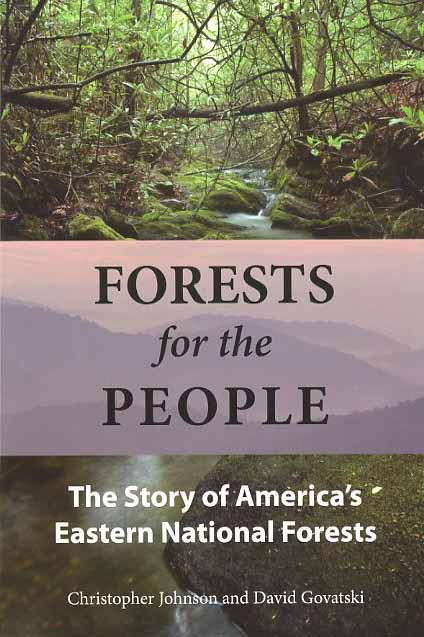
Yesterday's post raised the issue of privatizing public lands. Today's is on the transformation of private lands to public. The latest Environmental History has a book review by Sara Gregg of Forests for the People: The Story of America's Eastern National Forests by Christopher Johnson and David Govatski (Island Press, 2013). Gregg writes that the book:
traces the evolution of new ideas about conserving the eastern forests and their watersheds, and it provides an informative history of the conservation movement, the move to pass the 1911 Weeks Act, and the process of creating the eastern national forests. While the authors overstate the role of public advocacy in early forest conservation a bit, this section captures the fascinating evolution in federal land policy that led Congress to fund the reacquisition of eastern forests in order to protect vulnerable landscapes and regionally important watersheds. It is useful, especially so near to the hundredth anniversary of this landmark conservation law, to reflect on the process by which private lands once again entered the public domain, as well as on the long-term consequences of increased federal oversight.
Tuesday, May 20, 2014
History rears its head in controversy over federal lands
Donald Kochan's recently posted "Public Lands and the Federal Government's Compact-Based 'Duty to Dispose': A Case Study of Utah's H.B. 148 — The Transfer of Public Lands Act" shows how the ongoing controversy in the western United States over federal lands (lately given prominence by the Cliven Bundy controversy), with its environmental ramifications, has interesting legal-historical roots. The abstract:
 |
| Ruin in Utah’s Recapture Canyon (Great Old Broads for Wilderness, via Adventure Journal) |
Recent legislation passed in March 2012 in the State of Utah — the “Transfer of Public Lands Act and Related Study,” (“TPLA”) also commonly referred to as House Bill 148 (“H.B. 148”) — has demanded that the federal government, by December 31, 2014, “extinguish title” to certain public lands that the federal government currently holds (totaling an estimated more than 20 million acres). It also calls for the transfer of such acreage to the State and establishes procedures for the development of a management regime for this increased state portfolio of land holdings resulting from the transfer. The State of Utah claims that the federal government made promises to it (at statehood when the federal government obtained the lands) that the federal ownership would be of limited duration and that the bulk of those lands would be timely disposed of by the federal government into private ownership or otherwise returned to the State.
Monday, May 19, 2014
Wheat and industrialization?
Food historian Rachel Laudan has a nice blog post on a recent article from Science, "Large-Scale Psychological Differences Within China Explained by Rice Versus Wheat Agriculture", by T. Talhelm, X. Zhang, S. Oishi, C. Shimin, D. Duan, X. Lan, and S. Kitayama. (This kind of work is a close relative of "legal origins" scholarship.) To me Laudan's critiques are a good example of how good humanities thinking is critically valuable in this age of supposed reverence for numbers and the social sciences (a claim which could use some historicizing itself). The article's abstract explains:
Cross-cultural psychologists have mostly contrasted East Asia with the West. However, this study shows that there are major psychological differences within China. We propose that a history of farming rice makes cultures more interdependent, whereas farming wheat makes cultures more independent, and these agricultural legacies continue to affect people in the modern world. We tested 1162 Han Chinese participants in six sites and found that rice-growing southern China is more interdependent and holistic-thinking than the wheat-growing north.After making the point that recent scholarship in many fields casts doubt on supposed different ways of thinking in the East and West, Laudan goes on to question these categories:
 |
| Woman harvesting wheat, Raisen district, Madhya Pradesh, India |

West and East seem incredibly problematic categories. The authors tend to use the West as a synonym for Europe (and, I presume, European settlement colonies such as the US, Canada, and Australasia, though whether the former Iberian empires would count as western is not addressed). Japan and Korea, both with modern economies, remain according to the psychologists more holistic than might be expected.
India, with a similar wheat/rice split is mentioned as a possible test case.
And the Middle East, a wheat area, is left unmentioned.Laudan goes on to raise some additional questions about the article's commentator's claim that “wheat farming may contribute to explaining the origins . . . of the industrial revolution”:
What about millets and maize in China? Not to mention root crops? What about the fact that China was on a par with the West until the late eighteenth century? What about the fact that its most economically dynamic area was the lower Yangtze Valley in rice country. What about the industrialization of Japan that was more or less simultaneous with the West? And when Japan was still relying heavily on root crops in farming? What about the other Western staple crops (mentioned in passing as being barley similar to wheat). What about maize in the industrializing United States? What about Asian Americans?
Subscribe to:
Posts (Atom)